





































































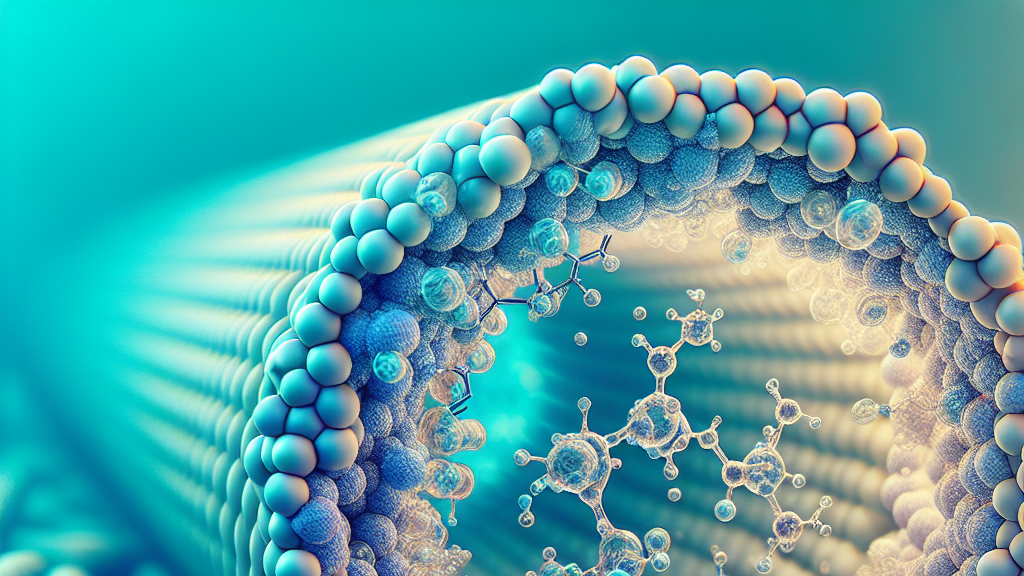
Ever wondered what happens to water when it’s squeezed into a space smaller than the width of a hair? It turns out, it behaves in ways you wouldn’t expect! This intriguing research reveals how the natural order of water molecules shifts when confined to nano-sized spaces, which could have a huge impact on how we understand everything from electronics to biology. You see, in our world, water has a unique ability to form hydrogen bonds, giving it an unusually high dielectric constant. However, when water is trapped in tiny spaces, like those between proteins or within nanostructures, this can change drastically. Imagine the molecules like tiny dancers who normally move freely on a large dance floor. Now, they’re packed into a tight circle; their movements are restricted, and they interact differently with the ‘walls’ around them.
This study dives deep into these changes, using cool-sounding techniques like molecular dynamics simulations. It explores not just simple water, but also what happens when proteins are thrown into the mix. Proteins have a complex surface that can influence the water surrounding them, leading to surprising effects. By examining these interactions, scientists hope to understand how water behaves on a micro-nano level, which is crucial for many scientific fields.
So, why should this matter to you? Well, understanding how water acts in these confined spaces is crucial for advancing technologies like drug delivery or the development of new materials. Imagine being able to design medicines that target specific areas within the body more effectively, or creating materials that can mimic natural proteins. This could lead to innovations that make life easier, healthier, and more efficient for all of us!
The dielectric constant of water is unusually high due to its extensive hydrogen bond network, but this can change drastically when water is nano-confined.
FAQs
What is nano-confinement of water?
Nano-confinement of water refers to trapping water in spaces so tiny, they are only a few molecules thick. This unique environment affects the behavior and properties of water, making it a fascinating area of study.
How do surfaces affect water molecules in nano-confinement?
Surfaces can realign water molecules and alter their interactions in nano-confinement. This is due to the close proximity of surfaces that influence how water’s hydrogen bonds form and maintain, leading to unexpected changes in water’s properties.
Why is studying water behavior in tiny spaces important?
Understanding water behavior in tiny spaces is crucial for advancements in fields like electronics, medicine, and material science. It can enhance drug delivery systems, create more efficient electronic devices, and help in designing new technologies.
How does this research impact the understanding of protein interactions?
This research helps reveal how proteins influence water molecules surrounding them, offering insights into protein behavior and function, which is vital for drug development and biotechnology.
What are the practical applications of this research?
This research can lead to better-targeted drug delivery systems, innovative materials, and improved understanding of biological processes, impacting technology and health sciences significantly.
Background
Water is unique due to its hydrogen bonding capability, which greatly impacts its dielectric constant. Dielectric constant is a measure of a substance’s ability to store electrical energy in an electric field. In water’s case, these hydrogen bonds create a network that influences its properties. When water is confined to very small spaces, such as between sheets of graphene or within biology’s complex protein structures, these properties change significantly, leading to intriguing new behaviors and interactions.
History
The study of water’s behavior under different conditions has a rich history. Traditionally, water was studied in bulk. However, with advancements in nanotechnology, scientists began investigating how water behaves when its movement is restricted. Earlier studies showed that water near surfaces behaved differently, but it was unclear how this translated to nanoscale confinement. This research builds on that foundation, revealing the detailed interplay between molecular interactions and confinement effects.
Based on “Surface Induced Frustration of Inherent Dipolar Order in Nanoconfined Water” by Sayantan Mondal, Saumyak Mukherjee, Biman Bagchi, available on arXiv (arxiv.org/abs/2506.09809), used under CC BY 4.0 (creativecommons.org/licenses/by/4.0/).
