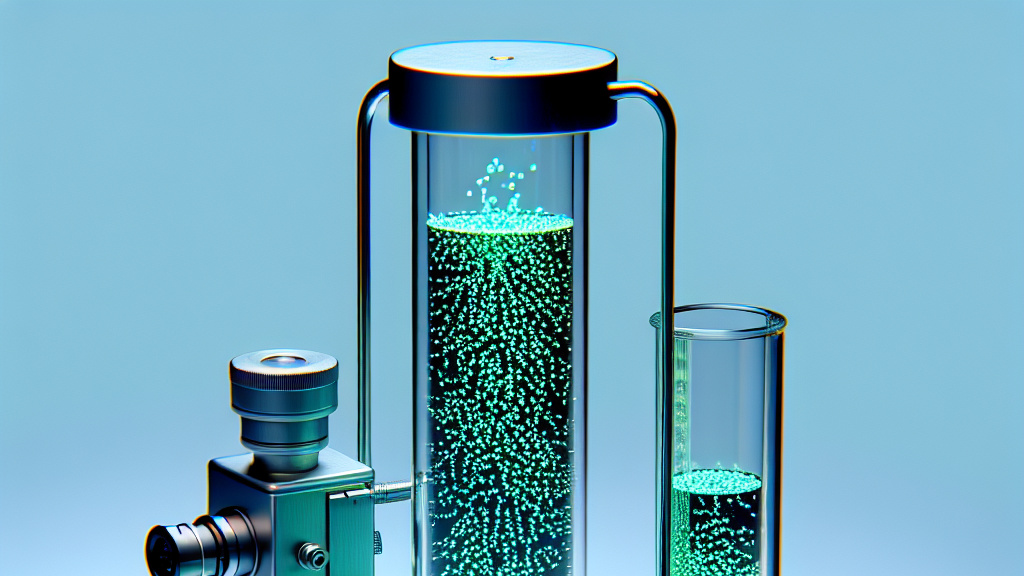
Imagine tracking the motion of tiny algae as they swim through a narrow tube of water, just like watching tiny boats navigating a river. This new device captures every twist and turn of these microscopic swimmers in 3D, all with the help of a clever mirror setup and a single camera. It’s like having a super-detailed map of their journey, revealing how they interact not just with each other but with the swirling currents around them.
Scientists are diving deep into how this system works, studying the behavior of Chlamydomonas reinhardtii—a tiny single-celled microalgae under a Poiseuille flow, a scientific term for the way fluids move in a tube. Using advanced techniques like natural fluorescence and bright-field imaging, they can now see how the algae move and respond to the forces at play in their tiny, watery world. This is an incredible leap in understanding tiny life forms, which could change everything from how we study ecosystems to developing new medical technologies.
One day, this innovative tracking system might help us develop smarter ways to clean polluted waterways, or design tiny robots that swim through our bodies to deliver medicines directly where they’re needed. The possibilities are as vast as the currents these algae swim against, with many practical applications waiting on the horizon.
Algae like Chlamydomonas reinhardtii can move by rotating their flagella, which act like little propellers, allowing them to swim toward light or nutrients.
FAQs
What does 3D tracking of microalgae reveal about their behavior?
3D tracking of microalgae shows how they move and interact with their environment when influenced by flowing liquids. This understanding is crucial for studying ecological systems and can inform advancements in medical technology.
How do mirrors and a camera work together in this microalgae tracking device?
The mirrors reflect the images of the microalgae in such a way that they appear on the same optical plane, allowing a single camera to capture their movement with precise detail in three dimensions.
Why is studying Chlamydomonas reinhardtii under a Poiseuille flow important?
Studying Chlamydomonas reinhardtii under a Poiseuille flow helps scientists understand how this microalgae navigates through flowing environments. This insight is important for various applications, including environmental monitoring and medical developments.
What technology is used in this microalgae tracking process?
This process uses natural fluorescence and bright-field imaging to observe and document the movement of microalgae with high precision and detail.
What are potential future applications of this 3D particle tracking research?
The research could lead to innovations such as improved pollution treatment methods and the development of microscale robots for healthcare purposes, enhancing both environmental and medical solutions.
Background
This research focuses on 3D tracking, a method used to precisely follow the movement of particles or organisms in three dimensions. It’s particularly important in studying motility, which is the ability of organisms to move by themselves. Scientists use this capability to explore interactions within confined spaces, such as those seen in narrow tubes or channels, which is key for understanding environmental and medical processes.
History
This study builds upon previous research in particle tracking and fluid dynamics. Earlier advancements in microscopy and imaging technologies allowed scientists to observe how organisms like microalgae move. This new 3D tracking method refines these technologies, offering a more integrated and precise approach with applications in both environmental sciences and medical research.
Based on “3D tracking of Plankton with single-camera stereoscopy” by J. Moscatelli, X Benoit Gonin, F. Elias, available on arXiv (arxiv.org/abs/2506.05365), used under CC BY 4.0 (creativecommons.org/licenses/by/4.0/).