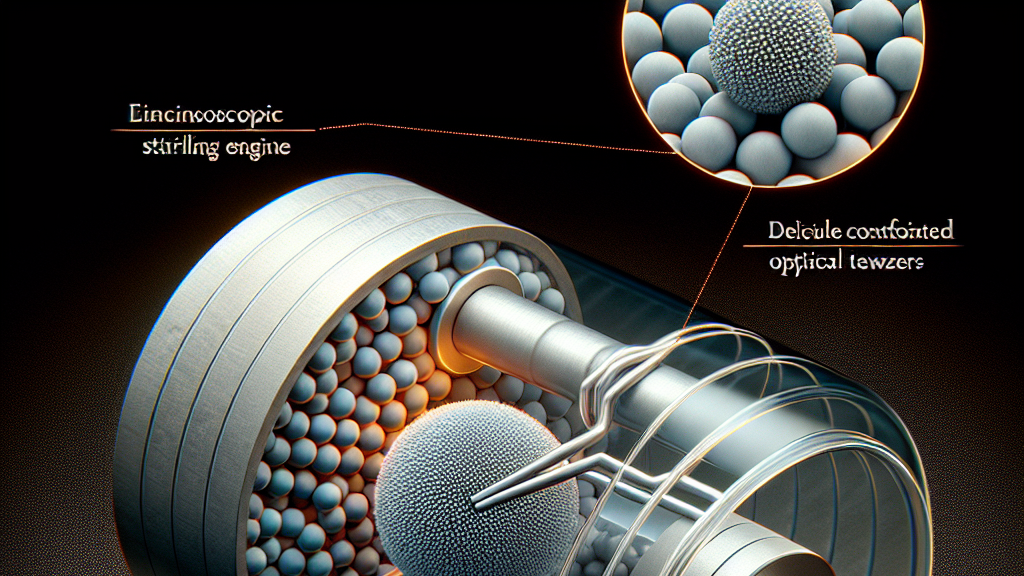
In the world of science, even the smallest things can make a huge difference. Researchers have just proposed a fascinating model where microscopic engines run on the random motion of particles, steered by optical tweezers. These microscopic ‘Stirling engines’ are powered by tiny ellipsoid particles moving between hot and cold environments, harnessing heat to do work. This might sound like abstract science fiction, but it’s a reality that holds massive potential.
The Stirling engine uses a special particle known as a passive Brownian ellipsoid. Imagine this as a little object that bounces around without a motor, just relying on heat to move. By cleverly manipulating its path with light-based tools called optical tweezers, scientists can make it run a cycle that resembles a tiny engine. During this process, the engine takes in heat from a hot source, converts some of it into useful energy, and dumps the rest into a cold source. It’s like a microscopic dance that leads to energy creation, with efficiency defined by the particle’s shape and orientation.
You might wonder why such tiny engines matter. Well, if perfected, they could lead to groundbreaking new ways to power small devices, like pacemakers or sensors, without the need for traditional batteries. This technology might also inspire new methods to harness and store energy more efficiently, taking cues from the natural world. Imagine our gadgets running cleaner and longer, or renewable energy systems becoming even more efficient – all thanks to understanding how these tiny engines work.
Did you know that Brownian particles are always in motion due to collisions with fast-moving molecules in a fluid? Even at rest, they still dance around! This is the secret motion that tiny engines can harness for power.
FAQs
What is a microscopic Stirling engine?
A microscopic Stirling engine is a tiny engine model that uses a passive Brownian ellipsoid, manipulated by optical tweezers, to convert heat into useful work. It’s a small-scale representation of a larger Stirling engine that operates using heat exchange between hot and cold sources.
How do optical tweezers work in energy conversion?
Optical tweezers use focused laser beams to trap and manipulate tiny particles like the Brownian ellipsoid. By controlling its position and orientation, they help guide the particle through a cycle that mimics an engine, thus converting heat into work.
Why is the shape of the particle important for the engine’s efficiency?
The shape of the particle affects how it interacts with the thermal baths and optical tweezers, influencing the efficiency of heat conversion. Anisotropic shapes, like the ellipsoid, can harness energy more effectively due to directional biases.
How could this research impact future energy systems?
If further developed, these microscopic engines could inspire new ways to sustainably power small devices, improving energy efficiency and potentially revolutionizing energy harvesting and storage systems in various applications.
What makes this microscopic engine different from traditional engines?
Unlike traditional engines that rely on mechanical parts, these engines use the random motion of particles and light manipulation to convert heat into work. This unique approach allows for energy conversion at a microscopic scale, with minimal energy loss.
Background
Optical tweezers are powerful scientific tools that utilize focused laser beams to manipulate small particles. They are used to exert forces on microscopic objects, allowing scientists to precisely control their position and orientation. Brownian motion refers to the random movement of particles suspended in a fluid, resulting from collisions with fast-moving molecules. The Stirling engine is a heat engine that operates by cyclically compressing and expanding a working fluid at different temperatures to convert heat energy into mechanical work. By combining these concepts, researchers have developed a model where an anisotropic particle, or one with direction-specific properties, is manipulated in a controlled environment to function as a microscopic engine.
History
The Stirling engine was invented in 1816 by Robert Stirling as an alternative to the steam engine, with better efficiency and safety. Over the years, it has evolved and inspired various applications in energy and mechanical systems. Optical tweezers, introduced in the 1970s, have pioneered the manipulation of small particles, revolutionizing molecular biology and physics. This research combines these historical advancements to propose a microscopic version of the Stirling engine, leveraging the unique properties of Brownian motion and anisotropy for efficient energy conversion.
Based on “Stochastic Heat Engine Using a Single Brownian Ellipsoid” by Soham Dutta, Arnab Saha, available on arXiv (arxiv.org/abs/2505.17313), used under CC BY 4.0 (creativecommons.org/licenses/by/4.0/).