





































































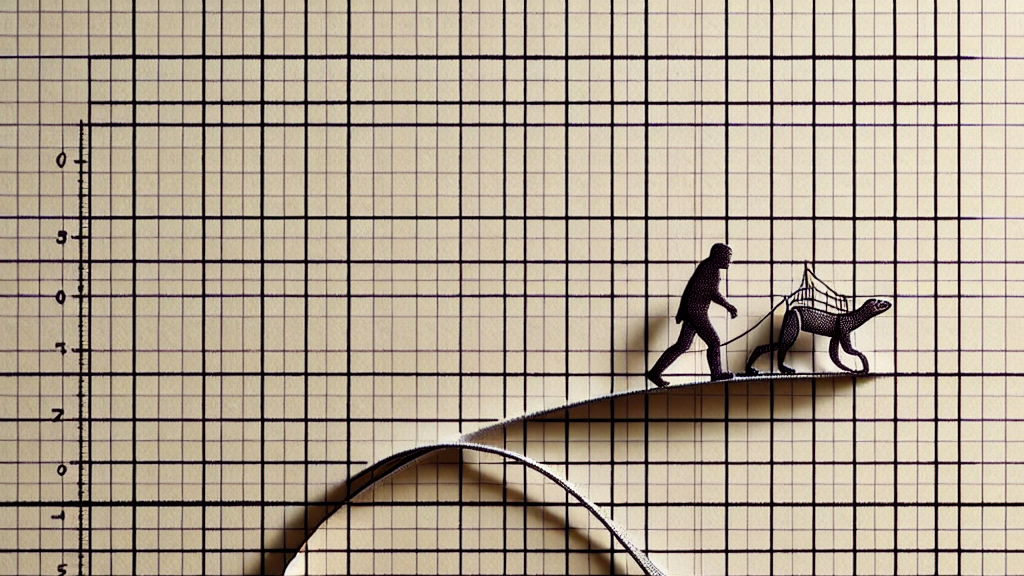
What if I told you that slowing things down could actually make something last longer? A new study finds that when danger approaches slowly, it changes how much time we have left instead of quickly cutting it short. This surprising twist could redefine how we deal with challenges and risks in life.
The research focused on ‘random walkers’, which are basically things or people moving in random directions. When there’s a threat moving super slow, the possibilities of surviving don’t drop off quickly. Instead, they follow something called a power-law decay, which means survival chances tail off slowly over time. This is a complete shift from what we knew about static dangers, which cause chances to drop like a rock!
Imagine there’s a video game where enemies move slower as time goes on, giving you more time to plan and survive. Using this research, designers could create thrilling experiences where players need to adapt to slowly changing threats. It may also teach us about adapting to challenges in real life, like climate change or market fluctuations, where slow and steady can win the race.
Did you know? Power-law decays can mean that things take longer to fade away, creating tails that stretch on surprisingly longer than expected!
FAQs
What is the core focus of this Sisyphus random walkers research?
The focus of this study is on how the survival probabilities of Sisyphus random walkers change when faced with a moving trap that slows down over time.
Why is a moving trap interesting in the context of random walkers?
A moving trap adds a dynamic element to the problem, revealing unexpected survival behavior, especially that survival probabilities change from exponential decay to a power-law decay.
How can the findings about moving traps and survival probabilities affect everyday life?
Understanding these dynamics can help in designing strategies for dealing with gradual threats, teaching us to adapt and plan better for slow changes in various scenarios like economics or health.
Background
In mathematics and physics, a ‘random walker’ is a model used to describe a path consisting of a sequence of random steps. This is often used to simulate random processes in various fields. The Sisyphus effect refers metaphorically to tasks that are never finished, drawing from the Greek myth of Sisyphus. When traps are introduced, they represent a constant danger that influences the walker’s path and survival probability.
History
This research builds upon earlier studies involving static traps where survival probabilities were known to decrease exponentially. The new angle involves adding motion to the trap, following a history of refining dynamics in random walks, which has been a subject of curiosity and scientific investigation for many decades.
Based on “Sisyphus random walks in the presence of moving traps” by Shahar Hod, available on arXiv (arxiv.org/abs/2503.08171), used under CC BY 4.0 (creativecommons.org/licenses/by/4.0/).
