





































































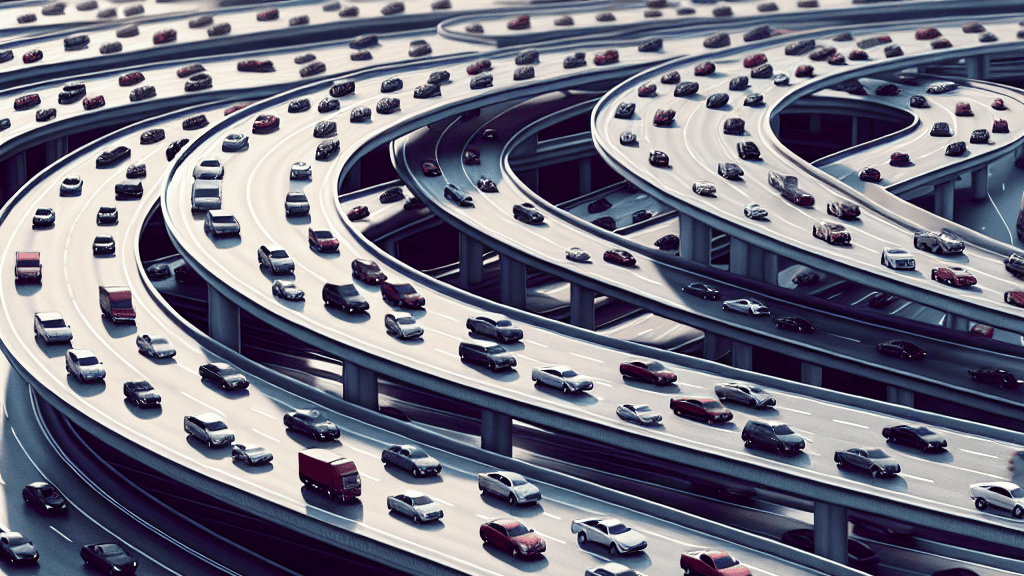
Ever wondered why traffic can sometimes just feel sticky, even when you’re constantly switching lanes trying to find the fastest route? This study might have the answers you’ve been looking for. Researchers have dug deep into what makes traffic unstable or smooth and how our driving behaviors, particularly those sudden lane changes, really come into play.
In this study, scientists set out to understand traffic flow by tweaking a classic car-following model. What they found is fascinating: there’s a critical reaction time, meaning how quickly a driver reacts to the car in front, affecting the flow—too slow, and your lane might become unstable. On top of that, they introduced a model linking a driver’s frustration level to lane changes. It turns out switching lanes frequently doesn’t necessarily make your drive faster and might only shuffle around the traffic load, not reduce it.
Imagine a highway on your daily commute. You’re weaving in and out, thinking you’re outsmarting the traffic, but in reality, these findings suggest that sticking to your lane might be just as effective. As our understanding of these principles grows, future traffic systems could use this data to manage road usage better, possibly reducing congestion and making our drives less of a headache.
Frequent lane changing only marginally increases speed while adding to traffic chaos.
FAQs
What unexpected discovery did scientists make about traffic flow?
They found a critical reaction time affecting traffic stability; if drivers react too slowly, traffic becomes unstable, leading to slowdowns.
How does a driver’s psychological state impact their driving?
Researchers linked drivers’ frustration levels to their likelihood of changing lanes, affecting overall traffic patterns.
Does changing lanes often make my commute faster?
Not as much as you’d think—frequent lane changes only marginally benefit travel speed and can redistribute traffic congestion.
Why is understanding car-following models critical?
Car-following models help predict traffic flow and stability, which is essential for improving road safety and efficiency.
Could this research improve future traffic management?
Yes, by integrating findings into traffic systems, we could reduce congestion and enhance road usage efficiency.
Background
The key scientific concept here is the car-following model, which describes how each driver follows the car in front of them. Researchers use this model to predict and analyze traffic patterns. The stability of traffic flow relies on the quickness of drivers’ reactions, known as reaction time. Additionally, driving psychology plays a role, as frustration influences a driver’s tendency to change lanes.
History
Traffic flow studies originated with simple models like those developed by Newell, which looked at how cars follow each other in a single lane. Over time, researchers have built on these models, adding complexity and real-world drivers’ behaviors, such as the desire to change lanes, aiming to better predict and manage traffic flow.
Based on “A car-following framework for traffic instability and lane changes” by Nicholas Mankowski, Hassan Mushtaq, Hanliang Guo, available on arXiv (arxiv.org/abs/2501.01988), used under CC BY 4.0 (creativecommons.org/licenses/by/4.0/).
