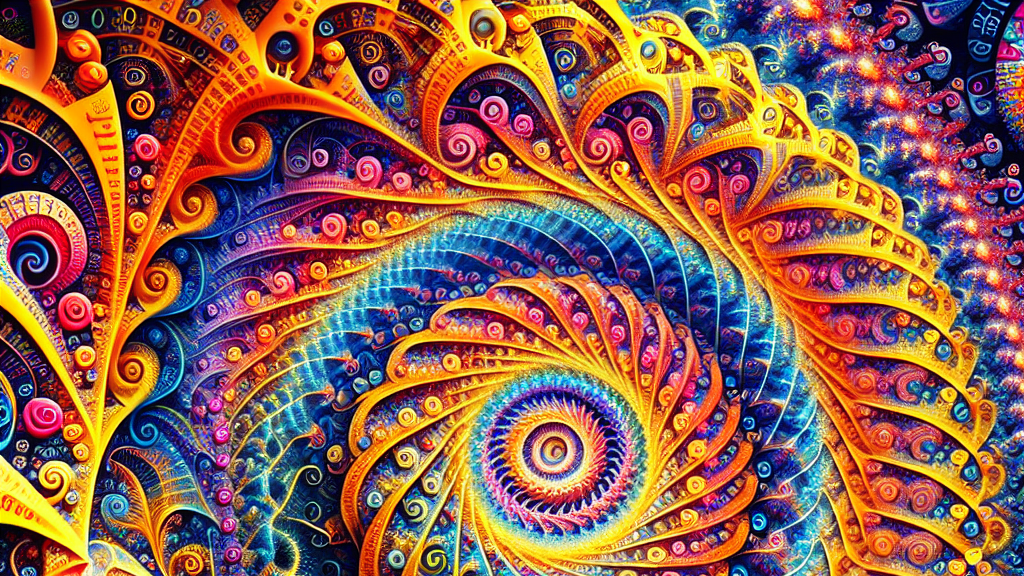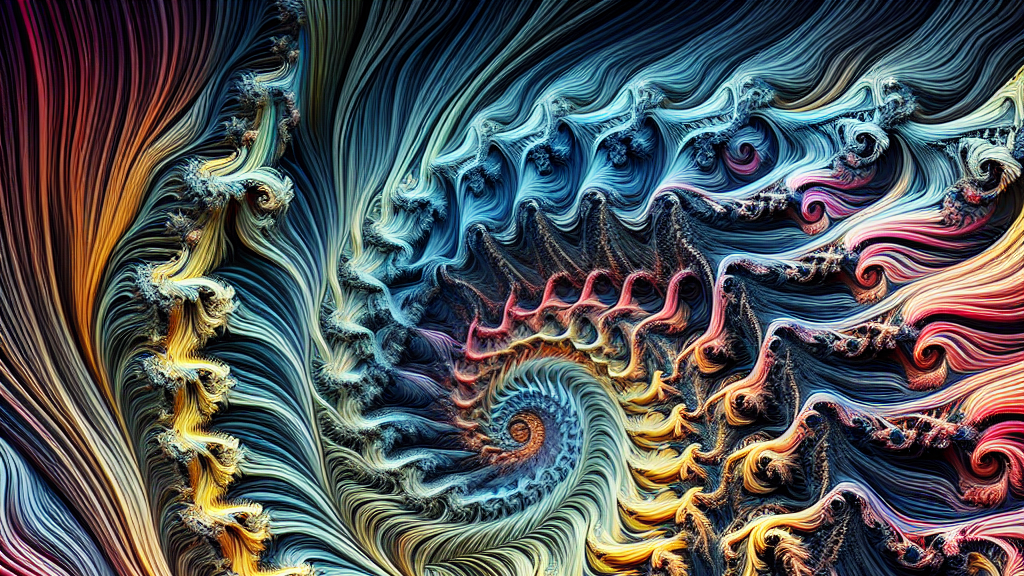
Imagine witnessing the transformation of a jagged, sharp-edged shape into a mesmerizing and continuous fractal pattern. It sounds like magic, but it’s actually mathematics! This fascinating process is uncovered in recent research using a math equation known as the Benjamin-Ono equation. The findings reveal that even when a shape begins with sharp, harsh edges, it can smoothly transform into a fractal that looks seamless and continuous at almost every moment in space.
So, what’s going on here? The researchers explored a math puzzle related to a specific type of equation which shows a curious behavior: it can propagate sharp discontinuities as special points called logarithmic cusps. Moreover, they demonstrated that for nearly every moment, the edges evolve into fractal patterns with a consistent and peculiar jaggedness measured by something called the Minkowski dimension of 3/2. It’s like having a rough shape that reveals a stunning hidden symmetrical pattern you may not expect.
Picture this: you draw a rough, zig-zag line on paper, thinking it’s just a squiggly mess. But suddenly, upon closer inspection, it reveals a beautiful pattern that keeps repeating itself intricately. This is akin to what the research has uncovered. In the future, understanding these transformations could lead to creating more efficient ways to process images or even inspire new forms of digital art, all thanks to the curious behavior captured by the Benjamin-Ono equation.
Fractals have been used in graphics and art to create stunning visual pieces that seem to repeat indefinitely, from the veins on a leaf to computer-generated landscapes!
FAQs
How does the Benjamin-Ono equation turn jagged lines into fractals?
The Benjamin-Ono equation can convert jagged, discontinuous lines into fractals by changing the shape over time. It captures the dynamics of how sharp points gradually evolve into continuous and intricate patterns.
What is a fractal, and why is it important in mathematics?
A fractal is a complex geometric shape that can be split into parts, each of which is a reduced-scale version of the whole. Fractals are important in mathematics for modeling naturally occurring patterns like mountain ranges and coastlines.
What are logarithmic cusps, and how do they relate to the Benjamin-Ono equation?
Logarithmic cusps are special points where sharp discontinuities of a shape appear in a particular way. The Benjamin-Ono equation demonstrates how these points propagate and transform under certain conditions, revealing a link to fractal patterns.
Background
The Benjamin-Ono equation is a mathematical tool used to study wave dynamics in fluids. It helps analyze how certain functions behave over time, especially those with discontinuities or irregularities. The Hilbert transform, a related mathematical concept, is critical for understanding how jagged shapes turn into smoother curves or even fractals.
History
The journey into understanding fractals began with early studies on mathematical patterns in the 20th century, notably by scientists like Benoît Mandelbrot. The Benjamin-Ono equation, a less common yet intriguing equation in mathematical physics, extends this understanding by showing how seemingly chaotic shapes can evolve smoothly over time. This research builds on those ideas by exploring how discontinuities in these equations can evolve into fractal patterns.
Based on “Jumps, cusps and fractals in the solution of the periodic linear Benjamin-Ono equation” by Lyonell Boulton, Breagh Macpherson, Beatrice Pelloni, available on arXiv (arxiv.org/abs/2501.01322), used under CC BY 4.0 (creativecommons.org/licenses/by/4.0/).