





































































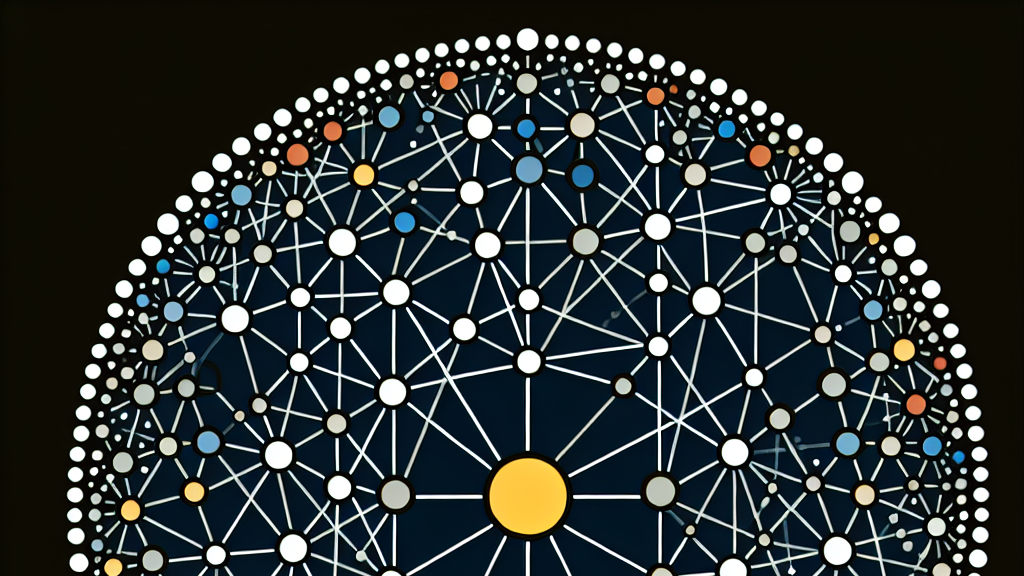
Imagine if a secret code could predict every decision you make! That’s what some researchers are saying about special math groups. They’ve discovered that some groups, called ‘finitely generated free metabelian groups,’ can be uniquely identified from a distance, like spotting the secret sauce in a recipe, by analyzing their finite pieces, a concept known as ‘profinite rigidity.’ This could change how we perceive the structure and essence of mathematical objects.
In more technical terms, this study has proved that these specific groups, when examined through the lens of their finite quotients, are unique among all similar groups. It’s like having a unique DNA fingerprint that sets them apart. The research relies on earlier foundational work that examined how these groups behave like modules over a particular mathematical space, along with specific characteristics described by earlier mathematicians, Groves and Miller.
So, why does this matter to you? Well, imagine that we could apply this ‘predictive power’ to technology, potentially improving encryption or data security. Understanding these unique structures might inspire innovative ways of securing information, much like a lock that can only be opened with a very specific key. This fascinating possibility shows how the mysteries of math can translate into real-world applications.
Did you know? Profinite rigidity in mathematics is like having a unique fingerprint among infinite possibilities!
FAQs
What are finitely generated free metabelian groups?
Finitely generated free metabelian groups are a type of mathematical group that can be uniquely described using a finite set of elements. This makes them special in the world of math because they can be distinguished from other groups based on their finite pieces.
Why is profinite rigidity important in math?
Profinite rigidity is important because it allows mathematicians to identify and distinguish certain groups as unique, based on their finite characteristics. It’s like recognizing a hidden pattern that sets them apart.
How does this research impact technology?
This research might impact technology by suggesting new ways to secure data or enhance encryption through understanding unique mathematical structures, much like using a very specific lock-and-key system.
What is a Noetherian domain in math?
A Noetherian domain is a specific type of mathematical space where certain well-behaved properties occur, making it easier to study and understand different mathematical concepts, such as profinite rigidity.
Who were Groves and Miller?
Groves and Miller were mathematicians who identified key characteristics of free metabelian groups, contributing to the foundational understanding that this research builds upon.
Background
At the heart of this study are free metabelian groups, which are a type of mathematical group distinguished by their structure. They’re classified as ‘finitely generated’ because a finite number of elements can describe them entirely. Profinite rigidity refers to the ability to discern these groups’ unique structures just from their finite components or quotients. Earlier work in this area involved understanding these groups in the context of modules over a Noetherian domain, which is a foundational concept in algebra involving a specific type of ring that helps manage complexity.
History
This research builds on earlier studies that explored how different groups can be classified and understood through their mathematical properties. The idea of profinite rigidity ties back to foundational theories in algebra that examine the relationships between elements and their resultant structures. The work of Groves and Miller plays a significant role, as their characterization of free metabelian groups provided the groundwork for further exploration into their unique properties.
Based on “The Profinite Rigidity of Free Metabelian Groups” by Julian Wykowski, available on arXiv (arxiv.org/abs/2503.10321), used under CC BY 4.0 (creativecommons.org/licenses/by/4.0/).
