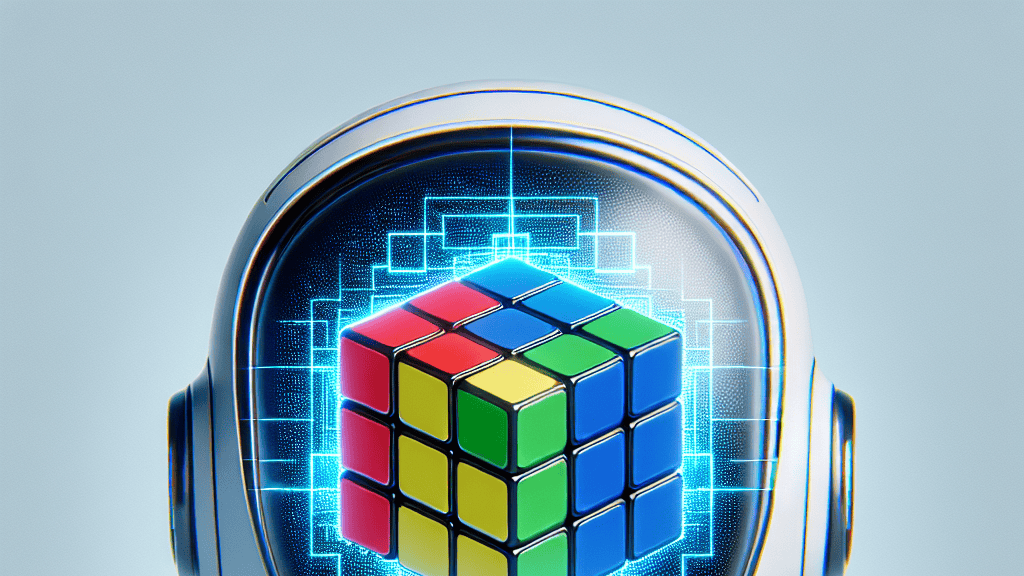
What if the classic Rubik’s Cube wasn’t the limit of our puzzle-solving adventures? Researchers have opened the door to an exciting twist in the world of brainteasers by expanding the Rubik’s Cube into new, more complex shapes. Imagine a Rubik’s puzzle with limitless possibilities, not confined to a cube but taking on mind-bending forms like simplexes and hypercubes. This means an entirely new level of challenge for puzzle enthusiasts everywhere!
The study delves into the realm of abstract geometry by generalizing the Rubik’s Cube to any shape known as a regular polytope, which includes not only 3D shapes but potentially shapes from higher dimensions as well. By working with these abstract shapes, scientists aren’t just playing with puzzles but exploring deep mathematical concepts. They’ve developed a new understanding of Rubik’s Simplexes and provided a comprehensive explanation of the puzzle’s group configurations—a fancy way to describe all the potential moves and orientations of the puzzle.
In practical terms, imagine a world where new Rubik’s challenges await us, potentially available in virtual reality or as physical models, expanding the horizons of what puzzle-solving can be. Such innovations could inspire new games, educational tools, and entertainments that push the boundaries of creativity and logic. How cool would it be to solve a Rubik’s Hypercube on your coffee table?
Did you know? The Rubik’s Cube has over 43 quintillion possible configurations, but imagining solving a hypercube with even more solutions is simply mind-blowing!
FAQs
What is a Rubik’s Simplex and how does it compare to the traditional Rubik’s Cube?
A Rubik’s Simplex is a generalized version of the classic Rubik’s Cube, but instead of a cube shape, it is based on a simplex—a type of geometric shape in higher dimensions. Like the Rubik’s Cube, it can be twisted and turned to solve, but it offers a new level of complexity.
How does solving a Rubik’s Hypercube differ from a standard Rubik’s Cube?
Solving a Rubik’s Hypercube involves navigating through a more complex three-dimensional structure, with extra layers and dimensions to twist and solve, unlike the traditional six-faced cube.
What are the real-world applications of studying these complex geometric puzzles?
Understanding and solving complex geometric puzzles like the Rubik’s Simplex helps develop problem-solving skills and can inspire innovations in fields such as artificial intelligence, robotics, and education by promoting abstract thinking and creativity.
Background
The Rubik’s Cube is a three-dimensional combination puzzle that has been challenging minds since the 1980s. It’s built around the concept of permutations and symmetry, which are key mathematical principles. By generalizing it to shapes like simplexes, which can exist in higher dimensions, researchers explore even more complex configurations and symmetries, further connecting the simple joy of puzzles to advanced geometric theories.
History
The Rubik’s Cube was invented by Ernő Rubik in 1974 and quickly became a symbol of intellectual challenge. Over time, mathematicians have studied its mathematical properties and group theory aspects. This new study is part of a long line of research that stretches the concept of the cube into new geometric territories, bringing fresh insights and challenges to the puzzle world.
Based on “Rubik’s Abstract Polytopes” by Giovanni Luca Marchetti, available on arXiv (arxiv.org/abs/2502.13518), used under CC BY 4.0 (creativecommons.org/licenses/by/4.0/).