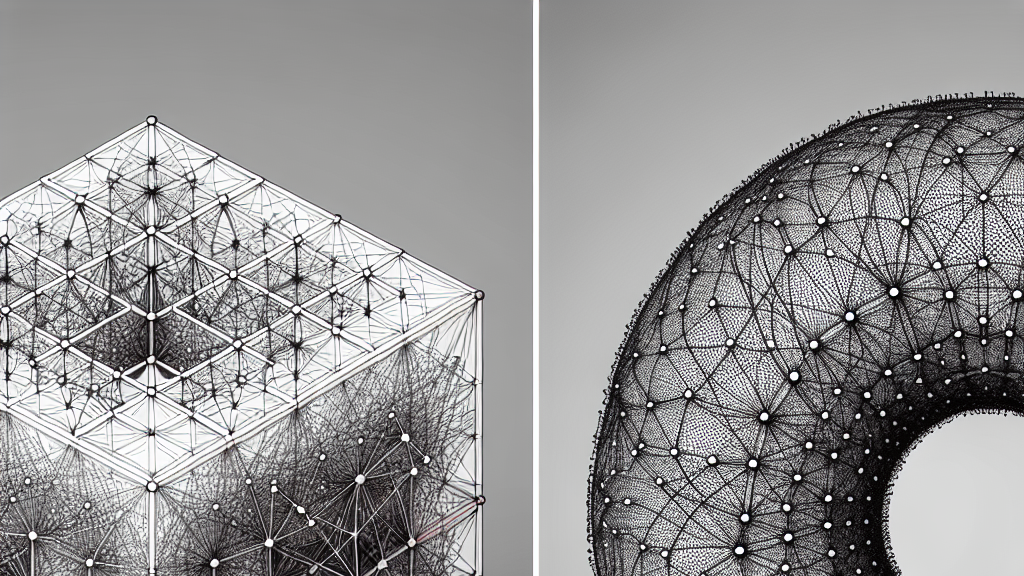
Have you ever thought about how the shape of a space might change the way things connect within it? Imagine a cube and a donut-shaped torus: both are three-dimensional objects, but what happens if you were to fill them with lines that randomly connect different points? It turns out, the shape makes a big difference, and this is what researchers have been uncovering.
In a highly complex but fascinating study, scientists applied something called a central limit theorem to unravel how these shapes influence connections, a field known as random geometric graphs. They found that on a torus, the pattern of connections mimics a well-known random network called the Erdős-Rényi model—a kind of gold standard in understanding randomness. But on a cube, the connections don’t fit this model at all! Instead, they have their unique style of randomness, with a slightly lower capacity for disorder, called entropy.
Why should you care? Well, the insights from this study might one day help build more efficient network systems. Imagine internet cables mapped out in a way that minimizes delays, just because we figured out how shapes like cubes handle connections! Or consider futuristic city planning where public transport lines or even urban WiFi networks are designed using these principles to ensure seamless connectivity. The possibilities are as wide-ranging as they are exciting!
A donut-shaped object in geometry is called a ‘torus,’ and it plays a central role in studying random graphs!
FAQs
What is a random geometric graph on a torus?
A random geometric graph on a torus is a collection of randomly connected points mapped onto a donut-shaped surface. This study found that connections here resemble a random network model known as the Erdős-Rényi ensemble, making it an exciting case to study randomness.
How does the shape of a cube affect random connections?
The shape of a cube influences random connections by creating a unique pattern of randomness with less maximum possible disorder (entropy) compared to a torus, offering new insights into how different shapes handle connections.
Why does Shannon entropy matter in this study?
Shannon entropy is used to measure the randomness of a network. By understanding entropy in different geometries like cubes and tori, the study helps predict how networks will behave, which is crucial for designing effective systems.
Can these findings improve internet systems?
Yes, understanding how shapes influence random connections can inspire new ways to design network systems, potentially improving internet layouts to ensure smoother and faster data flow.
What’s next for research on random geometric graphs?
Future research could explore how other complex shapes affect connectivity, leading to advanced applications in technology and urban planning.
Background
The central limit theorem is a statistical method used to understand how random variables behave in large quantities. Random geometric graphs are networks formed by connecting points randomly within a given space, like a cube or a torus. Understanding how these shapes influence the randomness of connections can reveal patterns crucial for designing complex systems.
History
The study of random graphs began with the Erdős-Rényi model, which presents a simple way to understand randomness by connecting nodes at random. This research builds on that by examining how spatial constraints, like those in a cube or torus, alter the nature of these connections, providing deeper insights into the behavior of networks in high-dimensional spaces.
Based on “Entropy of Random Geometric Graphs in High and Low Dimensions” by Oliver Baker, Carl P. Dettmann, available on arXiv (arxiv.org/abs/2503.11418), used under CC BY 4.0 (creativecommons.org/licenses/by/4.0/).