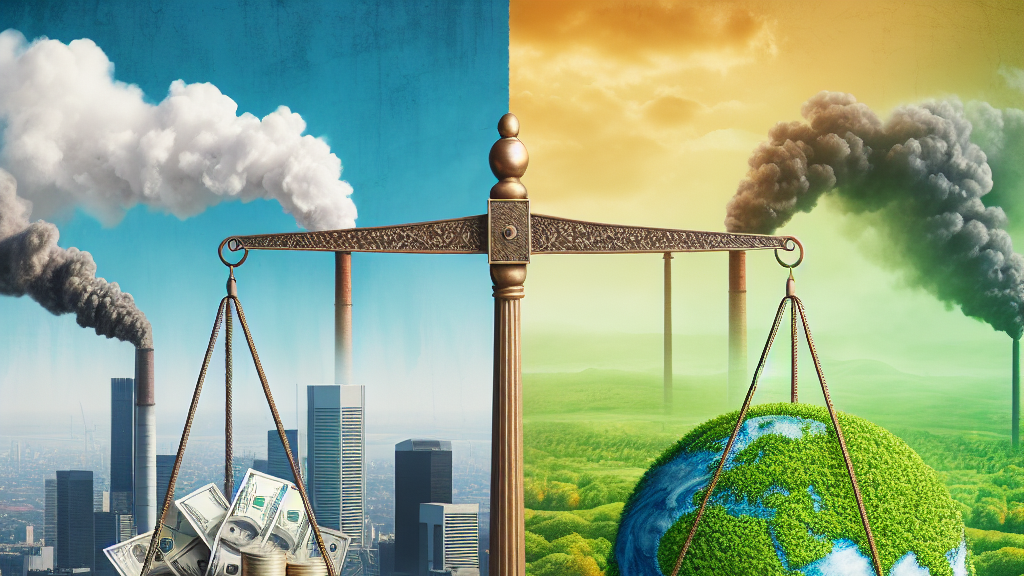
How does the money in our pockets affect the taxes meant to protect our planet? This study shakes up the way we think about carbon taxes by showing that income inequality can change the game. When governments consider how different we are financially, it impacts how these taxes are set and adjusted.
The research digs into two main scenarios. The first is where the government can freely redistribute income to make things fairer. The second scenario restricts redistribution efforts to only use what’s collected from carbon taxes. It turns out that when planners focus on helping the poorer households, the optimal tax rate ends up lower. This means a balance needs to be struck between being fair to everyone and still being efficient in combating pollution.
Imagine future policies where the tax rate for fighting climate change isn’t a fixed number but moves up and down based on who needs help. Such an approach could make our fight against pollution more flexible and more attuned to financial realities, ensuring everyone carries the weight fairly while still prioritizing our planet’s future.
Did you know? Income inequality can change how we tax carbon, reflecting not just environmental needs but also social justice!
FAQs
What is the surprising link between income inequality and carbon taxes?
Income inequality affects carbon taxes by creating a trade-off between fairness and efficiency in environmental policy. When income inequality is considered, the optimal carbon tax rate can become lower and vary based on economic circumstances.
How does household heterogeneity influence carbon tax levels?
Household heterogeneity, or differences in economic situations among households, influences how carbon taxes are set by creating an equity-efficiency trade-off. As governments aim to help poorer households, the tax rate might be adjusted to consider these differences.
Why is redistribution policy important in setting carbon tax rates?
Redistribution policy determines whether and how income from carbon taxes can be used to address inequality. Depending on whether redistribution is unrestricted or limited to carbon tax revenues, tax rates and their fluctuations can differ significantly.
Background
Carbon taxes are designed to reduce pollution by charging a fee based on carbon emissions. The equity-efficiency trade-off refers to the balance between being fair to all economic classes (equity) and achieving the greatest overall benefit (efficiency). Household heterogeneity speaks to the real-life differences in what each family can afford or needs.
History
Traditionally, carbon taxes have been seen as a straightforward way to put a price on pollution, encouraging businesses and individuals to reduce emissions. However, as research has evolved, it became clear that factors like income inequality can significantly influence how these taxes are set, leading to more nuanced approaches in recent studies.
Based on “The Unequal Costs of Pollution: Carbon Tax, Inequality, and Redistribution” by Cristiano Cantore, Giovanni Di Bartolomeo, Francesco Saverio Gaudio, available on arXiv (arxiv.org/abs/2503.00142), used under CC BY 4.0 (creativecommons.org/licenses/by/4.0/).