What if gravity could zip around faster than the fastest thing we know: light? Scientists have come up with this mind-blowing theory that turns our usual understanding of the universe on its head. The idea is that gravity, which keeps our feet on Earth and the planets in orbit, might actually move at superluminal speeds. Imagine a quick, invisible force working behind the scenes to shape the cosmos in ways we never thought possible.
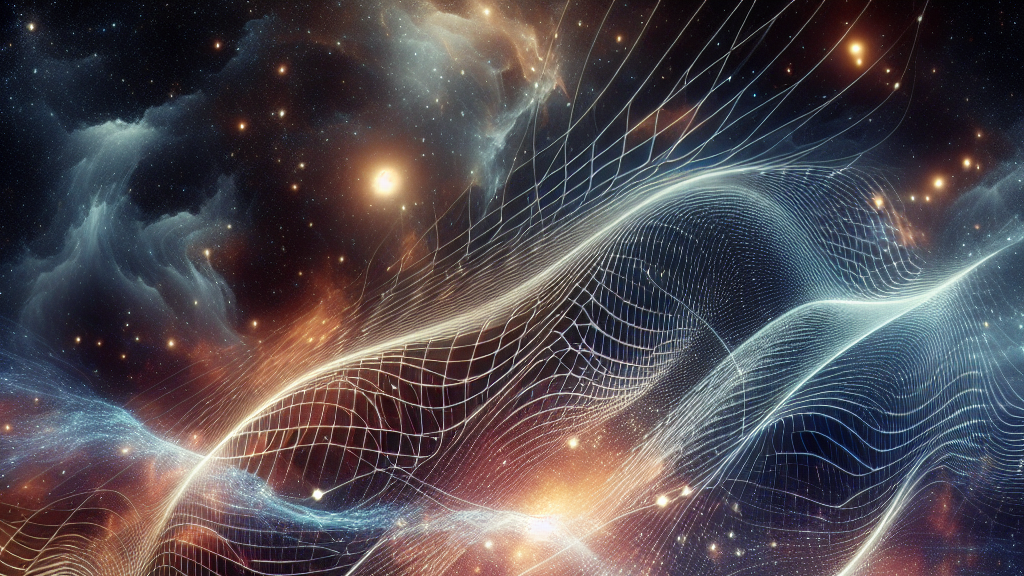
In this exciting theory, gravity is not just a force we feel but something that travels incredibly fast, even faster than light. Think of it like sound waves moving through a cosmic grid made of all the matter in the universe. This discovery doesn’t just change how we think about gravity; it also gives a fresh perspective on other cosmic mysteries, like the ‘phantom field’—a mysterious factor in the universe’s expansion. By understanding this, scientists aim to solve the long-standing mystery of the cosmological constant, a puzzling factor in why the universe is expanding the way it is.
Imagine applying this theory to solve real-world mysteries, like why galaxies hold their shape as they spin or why the universe keeps getting bigger. One day, we could harness these faster-than-light gravitational waves to develop technology that makes interstellar travel a reality. We might even discover new ways to understand our universe and others that might exist. The possibilities are endless, and this theory might open the door to a new era of cosmic exploration and discovery.
Did you know? If gravity could travel faster than light, it might solve the mystery of why the universe keeps expanding!
FAQs
What is the ring paradigm in quantum gravity?
The ring paradigm is a newly proposed approach to quantum gravity where gravity may travel faster than light. It envisions the graviton as a phonon—a particle representing a quantum of sound—moving through a grid of matter in the universe, challenging our current understanding of physics.
How could superluminal gravity affect our understanding of cosmology?
Superluminal gravity could revolutionize cosmology by providing new insights into long-standing puzzles such as the cosmological constant, the mysterious force behind the universe’s expansion. By rethinking gravity’s speed, scientists aim to better understand cosmic phenomena and the universe’s behavior.
What is the significance of breaking Lorentz invariance in this theory?
Breaking Lorentz invariance challenges one of the bedrock principles of modern physics, which states that the laws of nature are the same for all observers. This radical shift could expand the Haag-Lopuszanski-Sohnius theorem and open new pathways in quantum field theory, potentially leading to groundbreaking discoveries.
What are phantom fields in this context?
Phantom fields are theoretical constructs that emerge from this new model of quantum gravity. These fields could explain unknown phenomena in cosmic expansion, offering new perspectives on mysterious aspects of the universe’s growth and structure.
What practical applications could arise from this new understanding of gravity?
By potentially enabling superluminal information transfer and understanding gravity differently, this research might lead to advancements in technology, such as new modes of space travel or innovative methods for energy distribution on a cosmic scale.
Background
Gravity has always been one of the fundamental forces shaping our universe. Traditionally, it’s believed to act at the speed of light, a concept central to the theory of relativity. But this research mixes things up by suggesting gravity might operate faster than light, radically changing our view of the universe and its workings. This theory also connects gravity to phonons—particles that transfer sound energy—indicating a novel way to understand how forces might interact across the cosmos.
History
The study of quantum gravity has been a challenging and evolving field within physics. Initially explored through theories like loop quantum gravity and string theory, it aims to reconcile general relativity with quantum mechanics. This new research builds upon the foundations laid by pioneers in these fields by presenting an unorthodox idea that could alter the landscape of modern physics. By introducing superluminal gravity and its potential effects, the research suggests new ways to address cosmic puzzles and expands our understanding of the universe’s fundamental forces.
Based on “The old problem of the cosmological constant solved?” by Jan Novák, Oem Trivedi, available on arXiv (arxiv.org/abs/2505.22553), used under CC BY 4.0 (creativecommons.org/licenses/by/4.0/).