Connect with us

Search by keyword

Nuclear Theory

Can Colliding Nuclei Reveal Hidden Atomic Secrets?

Scientists have discovered an exciting way to explore the shape of atomic nuclei by smashing them together at high-energy. This innovative approach can provide deeper insights into the mysteries of atomic and subatomic structures, potentially revolutionizing our understanding of the building blocks of matter.

Can Colliding Nuclei Reveal Hidden Atomic Secrets
✨Researched by humans. Explained by robots. Learn more.

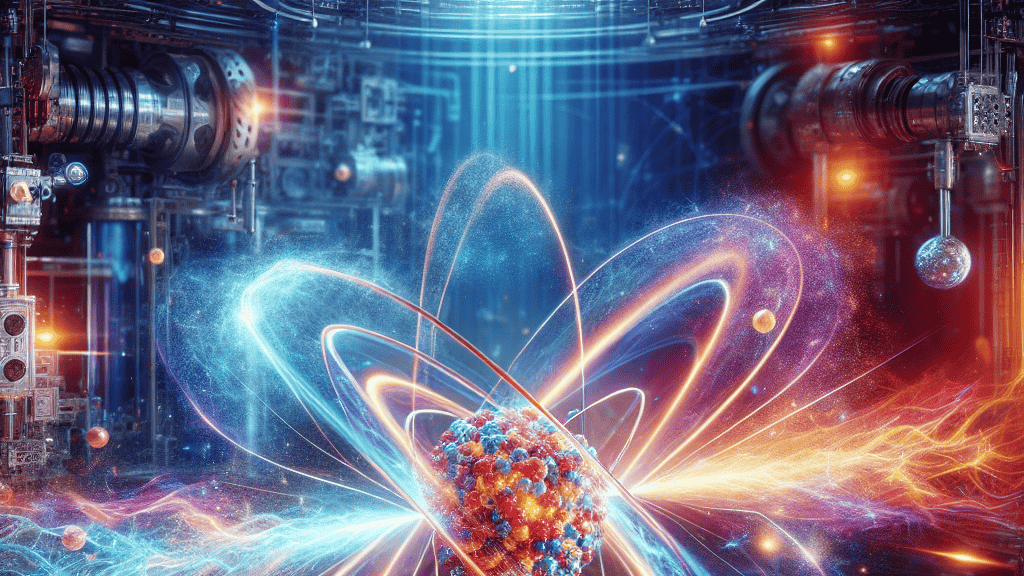
Imagine unlocking the secrets of the universe by simply crashing atoms into each other! Researchers are using high-energy collisions to ‘see’ the shapes of atomic nuclei. It’s like science’s version of smashing coconuts to see what’s inside, but way cooler and without the mess!

In these high-energy smash-ups, scientists observe the formation of a unique state of matter called quark-gluon plasma. This hot, dense soup the universe was made of shortly after the Big Bang encodes information about the original shape of the collided nuclei. By studying the patterns of particles that emerge from these collisions, like detectives piecing together clues, researchers can infer the hidden structures that were present at the beginning.

The implications of this research are mind-blowing. Picture a future where we can predict how atomic particles behave, leading to advancements in materials science, nuclear reactors, or even medical imaging technology. This ‘imaging by smashing’ could open pathways to innovations we haven’t yet dreamed of, making it not just a breakthrough in nuclear physics, but in practical applications that touch our everyday lives.

Did you know that the quark-gluon plasma created in these collisions is a state of matter thought to have existed just after the Big Bang?

FAQs

What is quark-gluon plasma and why is it important?

Quark-gluon plasma is a state of matter where quarks and gluons, which are usually confined within protons and neutrons, are free to move. It is believed to have existed immediately after the Big Bang and studying it helps scientists understand the early universe.

How does smashing nuclei together help us understand their shape?

When nuclei collide at high energy, they create a quark-gluon plasma whose characteristics can reveal information about the original shape of the nuclei. Observing the resulting particle patterns is like reading a cosmic fingerprint of the nuclear structure.

Could this research lead to new technologies?

Yes, understanding subatomic structures can lead to advancements in various fields such as materials science, nuclear energy, and medical imaging, potentially bringing about technologies we haven’t imagined yet.

Why is studying nuclear shapes important?

Nuclear shapes influence how atoms behave and interact, impacting everything from the stability of matter to the reactions happening inside stars. Gaining insight into these shapes can improve our understanding of fundamental physical processes.

Background

Nuclear physics revolves around understanding the building blocks of matter, including nuclei which are made up of protons and neutrons. These particles themselves are made of quarks and are held together by gluons. High-energy nuclear collisions help scientists explore the structures and properties of these tiny yet complex systems by generating conditions that allow quarks and gluons to become a free-flowing state known as quark-gluon plasma.

History

The study of nuclear collisions has roots in particle physics and research into fundamental forces. The idea of using high-energy collisions to study the structure of matter dates back to early 20th-century particle accelerators. This recent work builds on decades of experiments with electron accelerators and discoveries made at facilities like the Large Hadron Collider, seeking to understand the intricate details of atomic nuclei and the formation of quark-gluon plasma.

Based on “Imaging nuclei by smashing them at high energies: how are their shapes revealed after destruction?” by Jiangyong Jia, available on arXiv (arxiv.org/abs/2501.16071), used under CC BY 4.0 (creativecommons.org/licenses/by/4.0/).

Trending

Latest

Can AI Save Water Discover How

Computers

AI is transforming the tech world, but it uses lots of water! A new tool, SCARF, helps us measure and reduce AI's water footprint,...

Whats a Forbush Decrease and Why Should We Care Whats a Forbush Decrease and Why Should We Care

Space

Scientists just observed the biggest solar storm event in years, revealing unexpected cosmic ray patterns. Understanding these changes could help us protect our technology...

Can Cars Spot Danger Faster Than Humans Can Cars Spot Danger Faster Than Humans

Computers

Think about how quickly you react when something unexpected happens on the road. This research brings us closer to creating self-driving cars that can...

Can Fear of the Other Stop Social Harmony Can Fear of the Other Stop Social Harmony

Physics

Fear of the unknown might make it harder for people to agree and get along. This study shows that when people have strong xenophobic...

Can AI Revolutionize Breast Cancer Diagnosis Can AI Revolutionize Breast Cancer Diagnosis

Electricity

This research introduces a groundbreaking AI model that can accurately assess HER2-positive breast cancer using widely accessible staining methods, potentially revolutionizing how we diagnose...

Can AI Transform Your Singing into a Choir Can AI Transform Your Singing into a Choir

Computers

Imagine singing solo and having AI turn you into a choir. This research unveils a groundbreaking AI tool that transforms your voice into rich...

You May Also Like

Physics

Discover how quantum tricks can reveal hidden secrets of particles, making our grasp on the universe even firmer. This research could revolutionize how scientists...

Physics

This research shows how a fun, web-based game helps high school students understand complex particle physics better than regular classroom lessons, suggesting that interactive...

Physics

Imagine a hidden universe in our own, where particles act like a spaghetti soup, in-between two known states of matter. Scientists are discovering this...

Physics

Scientists are exploring the possibility that certain strange particles, mesons, near 2 GeV might be exotic, made of four quarks instead of the usual...

Physics

Ever wondered if protons and neutrons are more than just tiny particles? Discover how their hidden dimensions—like charge, magnetic, and axial radii—reveal a complex...

Nuclear Theory

Imagine if teleportation wasn't just science fiction but a real phenomenon! New research suggests a third type of teleportation could change how we understand...

Physics

Scientists have found a way to better understand mysterious photon signals in hot plasma without getting tangled up in complex equations, potentially solving unsolved...

Physics

Discovering the secrets of pentaquarks might just be the key to unveiling new mysteries in particle physics. This research dives deep into their magnetic...

Physics

This research dives into the mysterious world of axions, tiny particles that could hold the key to understanding dark matter. Unraveling their secrets might...

Copyright © 2024 8ig8rain.

Disclaimer: The content on 8ig8rain.com consists of AI-generated summaries of scientific abstracts from arXiv. Please note that most arXiv abstracts are preprints and may not have undergone formal peer review. While these summaries aim to convey key ideas and potential applications, they are provided for informational purposes only and should not be interpreted as validated scientific findings or professional advice. The summaries are intended to educate, spark curiosity, and inspire further exploration of science.