





































































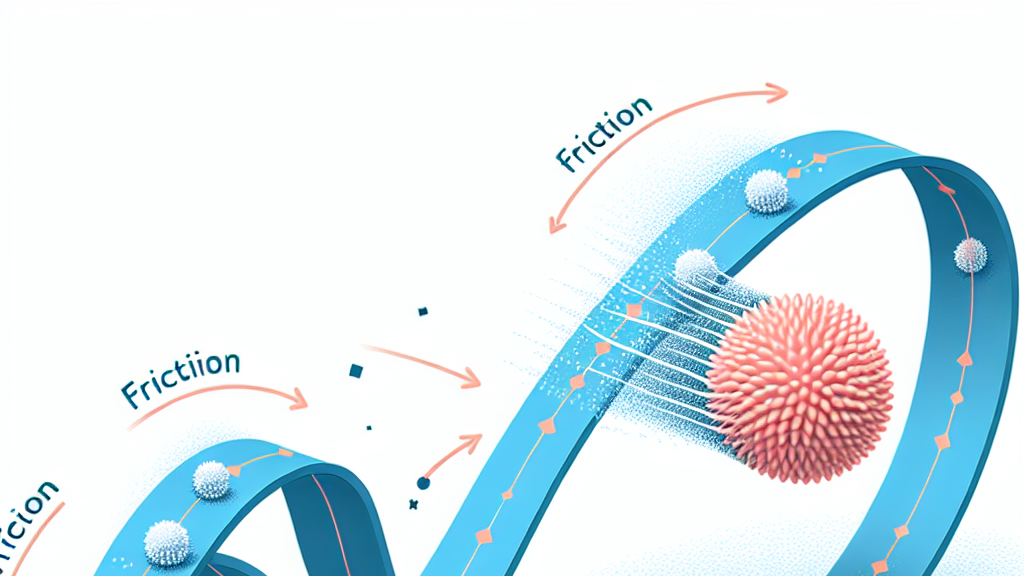
Imagine if simply by increasing friction, a particle no longer takes a winding path but travels straight—sounds unbelievable, right? This new study explores how friction affects the way particles move. As friction increases, the path a particle takes becomes less curved, gradually straightening. This phenomenon challenges our common understanding of motion and sparks curiosity about the hidden powers of friction.
The research delves into the movement of particles in granular materials, which you can think of like how sand behaves under pressure. It uses a simple yet elegant model to show how friction affects energy dissipation during motion. As friction escalates, the winding paths we typically expect start leveling out, ultimately becoming straight when the friction is sufficiently high. The discovery of a straight path, known as a brachistochrone, in such conditions is a surprising twist in physics, revealing a hidden order within chaos.
But why does this matter to you? Imagine the possibilities—cars or machinery moving more efficiently, reducing wear and tear simply by capitalizing on friction’s ability to straighten paths. This could lead to advancements in transport technologies, making them faster and more energy-efficient. In material science, knowing how materials respond to friction could enhance the design of everything from roads to electronics, offering improved performance and longevity in our everyday lives.
The concept of a brachistochrone—a curve of fastest descent—was originally studied by famed mathematicians like Isaac Newton.
FAQs
What is a brachistochrone, and why is it significant in this research?
A brachistochrone is the fastest path a particle can take to move from one point to another in a gravitational field. This research reveals that in conditions of high friction, the brachistochrone path becomes a straight line, which is a new insight into particle motion.
How does increasing friction affect a particle’s path?
With more friction, a particle’s path becomes less curved and can eventually straighten. This new understanding can lead to practical applications in improving machinery and transport systems.
Why should everyday people care about particle motion and friction?
Understanding particle motion and friction could lead to innovations in technology that make everyday devices more efficient and longer-lasting, impacting everything from how we travel to how our gadgets work.
In what ways might this research impact future technologies?
This research could lead to advancements in energy-efficient transport technologies and improved materials that withstand wear better, making future technologies smarter and more durable.
Background
A brachistochrone is a term from physics that describes the path of quickest descent under gravity, typically a curved path. Friction is a force that resists motion, causing energy loss. In particle motion, friction affects the energy and path a particle takes. This research investigates how increasing friction straightens the curve of a particle’s traditional path.
History
The concept of a brachistochrone curve has been studied for centuries and was originally studied by mathematicians like Isaac Newton and Johann Bernoulli in the 17th century. Traditionally, it was believed that friction always disrupts motion, but previous studies did not explore the possibility of friction leading to a straight path. This research builds on past findings by defining how extreme friction can create a straight brachistochrone, expanding our understanding of motion in the natural world.
Based on “The Frictional Brachistochrone” by Shiva P. Pudasaini, available on arXiv (arxiv.org/abs/2502.00368), used under CC BY 4.0 (creativecommons.org/licenses/by/4.0/).
