Connect with us

Search by keyword

Physics

Can Quantum Magic Shape Our Universe?

What if quantum entanglement, the mysterious link between particles, could create the universe as we know it? This groundbreaking idea explores how string theory and quantum magic might shape space itself, revolutionizing our understanding of the cosmos.

Can Quantum Magic Shape Our Universe
✨Researched by humans. Explained by robots. Learn more.

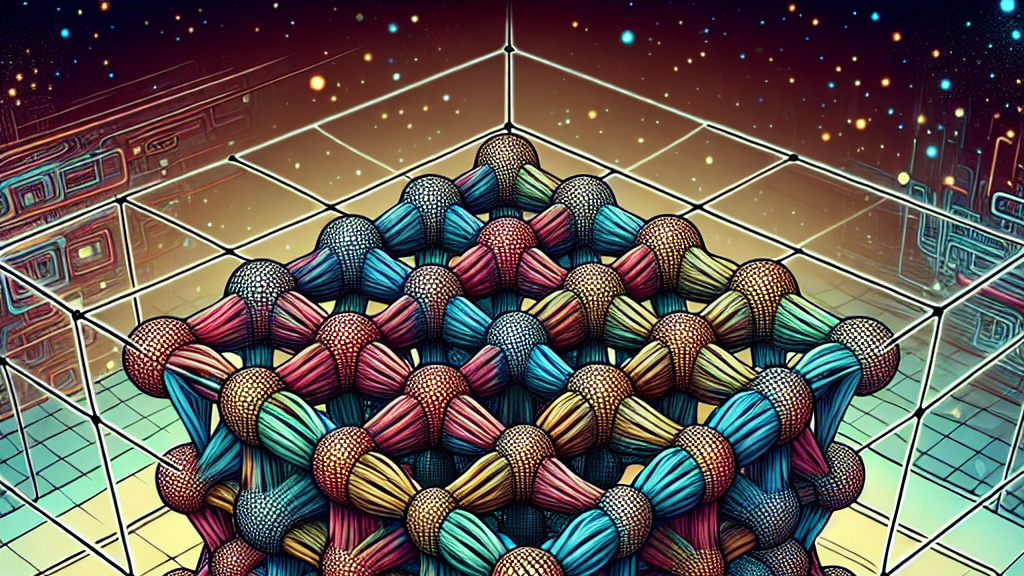
Imagine if the universe as we know it was built from tiny, unseen connections between particles – a kind of cosmic magic called quantum entanglement. This mind-boggling idea suggests that the vast, intricate web of space might just be born from these mysterious links, like a cosmic tapestry woven from invisible threads.

This isn’t just science fiction – it’s a groundbreaking theory that combines quantum mechanics and string theory. At its core, this research delves into how these tiny particle connections, or qubits, might shape spacetime itself. By using string theory, scientists suggest a local geometric transformation can define these qubits, potentially unveiling the secrets of a holographic universe.

Picture this: in the future, understanding these magical links could enable us to manipulate space for incredible advancements. Imagine teleporting like in the movies, or creating new technology that bends space for faster-than-light travel. The possibilities are as limitless as the universe itself, all through the magic of quantum entanglement.

Did you know? Quantum entanglement can link particles across any distance, even light years apart!

FAQs

What is quantum entanglement and how does it relate to space creation?

Quantum entanglement is a phenomenon where particles become interconnected, even across vast distances, behaving as if they’re a single entity. This research suggests these interconnected particles might actually shape and form the fabric of space itself.

How does string theory play a role in shaping space?

String theory suggests that the particles we perceive are actually tiny, vibrating strings. This theory helps explain how these strings might define the entangled particles, or qubits, in space, potentially creating the very structure of the universe.

What practical applications could emerge from understanding quantum entanglement?

By unraveling the mysteries of quantum entanglement, future technologies could harness these links for things like instant communication, teleportation, and advanced space travel, revolutionizing our interaction with the cosmos.

How does this research build on existing theories?

This study builds on the foundation of holographic dualities and string theory, suggesting a new way entangled qubits could manifest in the universe’s gravitating structure, offering a deeper understanding of how space and time may emerge.

Why is this important for our understanding of the universe?

Uncovering how quantum entanglement might create space challenges our traditional concepts of the universe, opening up new possibilities for science and technology that could drastically change our future.

Background

Quantum entanglement is a puzzling concept where two particles behave as if they are one, even when separated by vast distances. This concept, combined with string theory, which envisions particles as one-dimensional strings, provides a potential explanation for how the fabric of space might emerge from these quantum connections. The idea is that these entangled particles, or qubits, can define the structure of space through a process called geometric transition.

History

The ‘It from Qubit’ paradigm builds upon the intriguing idea of holographic dualities, where physics suggests that a lower-dimensional space can contain all the information about a higher-dimensional universe. This research leverages these ideas alongside the established framework of string theory to propose that quantum entanglement might be the very mechanism creating the universe itself, a continuation of one of the most exciting chapters in modern physics.

Based on “Entanglement and local holography in quantum gravity” by Gabriel Wong, available on arXiv (arxiv.org/abs/2504.03452), used under CC BY 4.0 (creativecommons.org/licenses/by/4.0/).

Trending

Latest

Can AI Save Water Discover How

Computers

AI is transforming the tech world, but it uses lots of water! A new tool, SCARF, helps us measure and reduce AI's water footprint,...

Whats a Forbush Decrease and Why Should We Care Whats a Forbush Decrease and Why Should We Care

Space

Scientists just observed the biggest solar storm event in years, revealing unexpected cosmic ray patterns. Understanding these changes could help us protect our technology...

Can Cars Spot Danger Faster Than Humans Can Cars Spot Danger Faster Than Humans

Computers

Think about how quickly you react when something unexpected happens on the road. This research brings us closer to creating self-driving cars that can...

Can Fear of the Other Stop Social Harmony Can Fear of the Other Stop Social Harmony

Physics

Fear of the unknown might make it harder for people to agree and get along. This study shows that when people have strong xenophobic...

Can AI Revolutionize Breast Cancer Diagnosis Can AI Revolutionize Breast Cancer Diagnosis

Electricity

This research introduces a groundbreaking AI model that can accurately assess HER2-positive breast cancer using widely accessible staining methods, potentially revolutionizing how we diagnose...

Can AI Transform Your Singing into a Choir Can AI Transform Your Singing into a Choir

Computers

Imagine singing solo and having AI turn you into a choir. This research unveils a groundbreaking AI tool that transforms your voice into rich...

You May Also Like

Physics

Discover how quantum tricks can reveal hidden secrets of particles, making our grasp on the universe even firmer. This research could revolutionize how scientists...

Physics

Scientists are exploring the mind-bending idea of using strings in extra dimensions to understand particles with weird properties. This groundbreaking research could unlock new...

Physics

The wonder of quantum entanglement, first dreamed up by Einstein and friends in 1935, holds the key to breakthroughs that could change how we...

Physics

Quantum entanglement, a mind-blowing phenomenon, could be created using a simple particle collision with an unbalanced mass ratio. This experiment might open new doors...

Physics

You know the mysterious world where two particles can be linked so perfectly that knowing everything about one tells you everything about the other?...

Physics

Albert Einstein's 1935 thought experiment is getting a real-world test, showing how simple particle collisions may unlock new insights into the mysterious phenomenon of...

Physics

Imagine solving a centuries-old math puzzle with quantum twists to enhance future tech! This research connects mind-boggling math with quantum computing for potentially groundbreaking...

Physics

Scientists have finally created a perfect solution to a 100-year-old math puzzle involving quantum entanglement and 36 imaginary officers. This breakthrough could lead to...

Physics

Scientists are using string theory to tackle puzzles about the early universe. By refining how we understand cosmic inflation, this breakthrough could change how...

Copyright © 2024 8ig8rain.

Disclaimer: The content on 8ig8rain.com consists of AI-generated summaries of scientific abstracts from arXiv. Please note that most arXiv abstracts are preprints and may not have undergone formal peer review. While these summaries aim to convey key ideas and potential applications, they are provided for informational purposes only and should not be interpreted as validated scientific findings or professional advice. The summaries are intended to educate, spark curiosity, and inspire further exploration of science.