Connect with us

Search by keyword

Physics

Can These New Sensors Outsmart Your Smartphone?

This research unveils a groundbreaking type of sensor that pushes the boundaries of technology. With sensitivity levels so high, they could revolutionize how we detect and measure in everyday gadgets, making them smarter and more efficient than ever.

Can These New Sensors Outsmart Your Smartphone
✨Researched by humans. Explained by robots. Learn more.

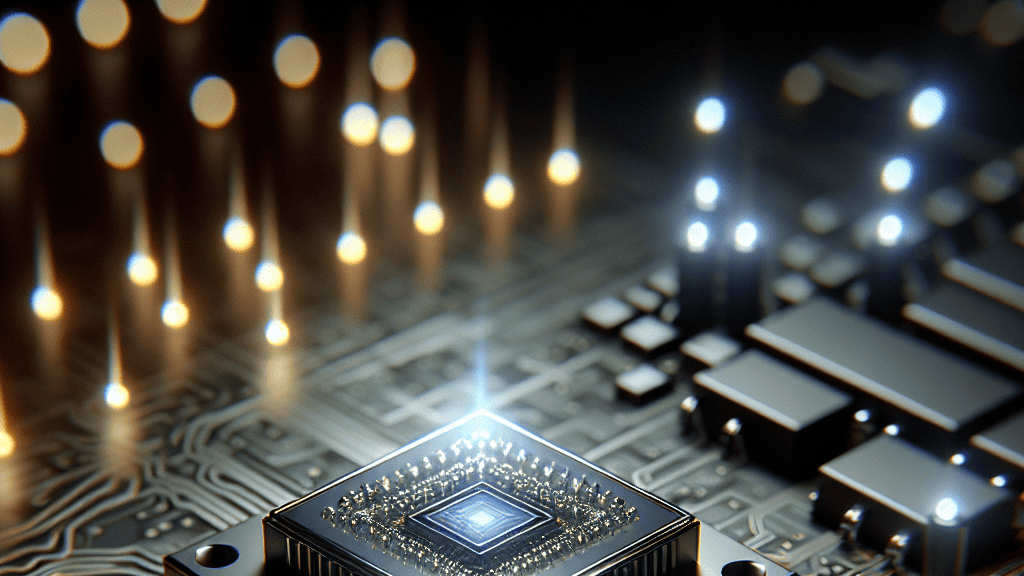
Imagine a world where your smartphone or fitness tracker could detect and measure things with incredible precision, far beyond what they can do today. This isn’t just a dream; it’s becoming reality thanks to a new type of sensor born from a field called non-Hermitian topological physics. These sensors are so sensitive, they measure changes as tiny as 0.001 femtofarads, which is a billion times smaller than your average raindrop!

The magic behind these sensors lies in their ability to grow exponentially more sensitive as they get bigger. It’s like if every time you added a block to a tower, its ability to catch a ball would grow tenfold. They’re integrated onto fully functional chips using tried-and-true semiconductor technology, making them fit for use in the gadgets we already love. This means that the technology is not only cutting-edge but also practical and ready for real-world application.

Looking ahead, these ultra-sensitive sensors could change the game in many fields, from healthcare to environmental monitoring. Imagine a wristband that could alert you of health changes before you even feel them or sensors in your home that detect subtle environmental changes, keeping you more informed and prepared than ever. The potential is as vast as it is exciting, promising a future where our technology is even more in tune with our needs and the world around us.

Did you know? Non-Hermitian topological physics allows sensors to become exponentially more sensitive the larger they get, unlocking sensitivity levels never before possible!

FAQs

How sensitive are these new sensors?

These sensors can measure changes as small as 0.001 femtofarads, which is incredibly sensitive compared to conventional sensors.

What technology is used to create these sensors?

The sensors are built into fully integrated circuit chips using standard 65nm semiconductor process technology, making them both advanced and practical for current applications.

How do these sensors differ from traditional ones?

Unlike traditional sensors, these new sensors exhibit an exponential sensitivity increase with size due to their foundation in non-Hermitian topological physics, allowing unprecedented precision in measurements.

What practical applications could benefit from these sensors?

These sensors have the potential to revolutionize healthcare devices, environmental monitoring, and even consumer electronics by providing highly accurate data.

Why is higher sensitivity in sensors important?

Higher sensitivity allows for more precise detection of variables, leading to better performance and insights in various applications, from medical diagnostics to smart home systems.

Background

The research builds upon non-Hermitian topological physics, a field that studies systems with complex energy landscapes, which can lead to unusual properties like exponentially increasing sensitivity. By designing sensors that utilize these properties, researchers have achieved unprecedented precision in sensor technology.

History

Sensor technology has evolved significantly over the years, from simple mechanical devices to sophisticated electronic sensors. The development of semiconductors and integrated circuits marked pivotal advances, enabling sensors to become smaller and more reliable. This latest research leverages the principles of non-Hermitian physics, representing a novel approach that significantly enhances the sensory capabilities of these devices.

Based on “Ultra-sensitive integrated circuit sensors based on high-order non-Hermitian topological physics” by Wenyuan Deng, Wei Zhu, Tian Chen, Houjun Sun, Xiangdong Zhang, available on arXiv (arxiv.org/abs/2501.11348), used under CC BY 4.0 (creativecommons.org/licenses/by/4.0/).

Trending

Latest

Can AI Save Water Discover How

Computers

AI is transforming the tech world, but it uses lots of water! A new tool, SCARF, helps us measure and reduce AI's water footprint,...

Whats a Forbush Decrease and Why Should We Care Whats a Forbush Decrease and Why Should We Care

Space

Scientists just observed the biggest solar storm event in years, revealing unexpected cosmic ray patterns. Understanding these changes could help us protect our technology...

Can Cars Spot Danger Faster Than Humans Can Cars Spot Danger Faster Than Humans

Computers

Think about how quickly you react when something unexpected happens on the road. This research brings us closer to creating self-driving cars that can...

Can Fear of the Other Stop Social Harmony Can Fear of the Other Stop Social Harmony

Physics

Fear of the unknown might make it harder for people to agree and get along. This study shows that when people have strong xenophobic...

Can AI Revolutionize Breast Cancer Diagnosis Can AI Revolutionize Breast Cancer Diagnosis

Electricity

This research introduces a groundbreaking AI model that can accurately assess HER2-positive breast cancer using widely accessible staining methods, potentially revolutionizing how we diagnose...

Can AI Transform Your Singing into a Choir Can AI Transform Your Singing into a Choir

Computers

Imagine singing solo and having AI turn you into a choir. This research unveils a groundbreaking AI tool that transforms your voice into rich...

You May Also Like

Computers

Imagine if playing games could make a computer program better at understanding and creating text! This research suggests that by using creative tasks like...

Computers

This study flips the script on how we think breakthroughs happen, showing that it’s not just about mixing ideas from different fields but rather...

Computers

Despite more scientists and studies than ever, breakthroughs aren't keeping pace. This research uncovers that innovation often comes from displacing main ideas in a...

Computers

Imagine moving things without touching them, just like magic! This cutting-edge research uses sound waves and robots to transport objects through the air, revolutionizing...

Electricity

Imagine drones not just flying but communicating in a 3D network that intelligently connects air and ground. This system could revolutionize city management, emergency...

Electricity

Discover how miniature algorithms can boost the performance of your everyday smart devices by making them more energy-efficient and effective in communication! This innovation...

Computers

Zeta Neural Networks could revolutionize tech by improving how digital brains learn and understand complex patterns, potentially reshaping everything from gaming to medical diagnostics.

Computers

Imagine robots that can think creatively like humans! By teaching robots metacognitive skills, this research shows they can solve complex tasks with fewer instructions,...

Computers

AI is evolving so fast that its intelligence may double every six months, potentially leading to game-changing tech advancements that redefine our daily lives....

Copyright © 2024 8ig8rain.

Disclaimer: The content on 8ig8rain.com consists of AI-generated summaries of scientific abstracts from arXiv. Please note that most arXiv abstracts are preprints and may not have undergone formal peer review. While these summaries aim to convey key ideas and potential applications, they are provided for informational purposes only and should not be interpreted as validated scientific findings or professional advice. The summaries are intended to educate, spark curiosity, and inspire further exploration of science.