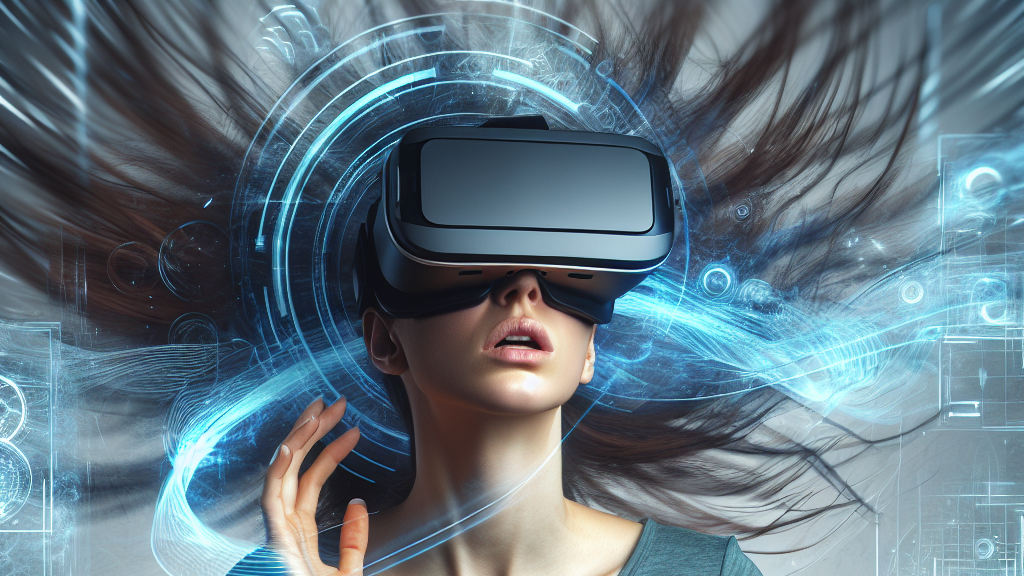
Quantum mechanics might seem like it’s straight out of a sci-fi movie, with its bewildering ideas like particles being in two places at once or being so connected they mirror each other, no matter how far apart. But what if you could walk through this surreal world and see it with your own eyes? That’s where Quantum Intuition XR comes in, using virtual reality to bring these mind-bending concepts down to Earth.
In this immersive experience, you wear a Mixed Reality headset and are transported into a space where you can not only see but also interact with qubits—the basic unit of quantum information. With simple hand gestures, you can explore their states, watch them entangle in confusing ways, and hear the changes through audio cues. This isn’t just a visual gimmick—it’s grounded in the actual physics of quantum mechanics, turning what’s usually only understood on paper or in complex math into something you can almost touch.
Think of the possibilities for students struggling with quantum physics. Instead of confusing equations, they get to play with the very building blocks of the universe like a digital sandbox. It’s like swapping a dry textbook for a thrilling ride that explains itself as you go. It’s not hard to imagine a future where classrooms around the world are transformed with virtual reality, turning abstract subjects into exciting adventures that stick with you for life.
Did you know? Qubits can hold a ‘1’ and ‘0’ state at the same time, thanks to superposition—something you can explore firsthand in Quantum Intuition XR!
FAQs
How does Quantum Intuition XR make quantum mechanics understandable?
Quantum Intuition XR uses virtual reality to let users visually and interactively experience complex quantum mechanics concepts like qubits, superposition, and entanglement, making these abstract ideas more accessible and intuitive.
What makes virtual reality effective in teaching quantum mechanics?
Virtual reality transforms learning by allowing users to explore quantum phenomena in a three-dimensional space, providing a tangible and immersive way to grasp how qubit states change and interact.
Can Quantum Intuition XR help beginners in quantum physics?
Absolutely, this tool is designed to simplify quantum physics for beginners by using interactive visuals and real-time feedback, bridging the gap between theoretical knowledge and practical understanding.
What future improvements are planned for Quantum Intuition XR?
Future enhancements include expanding multi-user interactions and improving the accuracy of quantum state visualizations, making the experience even more realistic and collaborative.
Why is Quantum Intuition XR considered innovative in science education?
Quantum Intuition XR revolutionizes science education by turning complex quantum mechanics into an engaging, hands-on experience that can inspire both students and educators to explore beyond traditional learning methods.
Background
Quantum mechanics is a branch of physics that describes the behavior of the smallest particles in the universe. It includes puzzling concepts such as superposition, where particles can exist in multiple states at once, and entanglement, where particles become interconnected in ways that defy classical physics. These principles are foundational for new technologies, including quantum computing. Typically, these ideas are difficult to visualize or understand without advanced mathematical training.
History
The journey to understand quantum mechanics began in the 20th century, with pioneers like Albert Einstein and Erwin Schrödinger. Over time, the field evolved with increasing complexity, leading to practical applications like quantum computing. Today, efforts like Quantum Intuition XR aim to demystify these advanced concepts, making them more accessible to the average person, and leveraging interactive technology to bridge the gap between theory and understanding.
Based on “Quantum Intuition XR: Tangible Quantum Mechanics using Interactive XR Experience” by Jamie Ngoc Dinh, Marven Wong, Matthew Brooks, Charles Tahan, Myungin Lee, available on arXiv (arxiv.org/abs/2504.08984), used under CC BY 4.0 (creativecommons.org/licenses/by/4.0/).