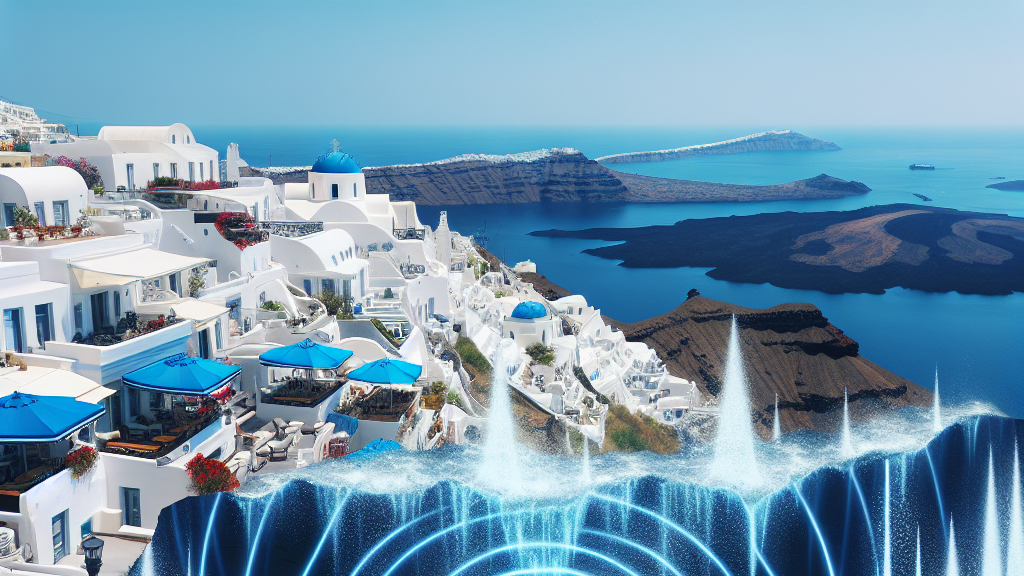
Imagine a world where volcanoes aren’t just fiery mountains but secret culprits behind major earthquakes! That’s right, beneath these majestic giants, hidden processes might be at work, shaking the ground more than you’d expect. A recent seismic event near the beautiful island of Santorini is unfolding this fascinating story.
In early 2025, scientists observed an unusual series of small quakes near Santorini. The intriguing part? These weren’t just random rumbles. They followed a pattern leading them to dig deeper (literally). Turns out, the quakes were likely triggered by fluids creeping through cracks beneath the island’s volcanic complex. It’s like nature playing a stealthy game of dominoes, causing a significant earthquake equivalent to a magnitude 6.2 event.
What if we could predict such seismic surprises in volcanic areas? Imagine being able to foresee such events and prepare better for their impact on the communities near these geological wonders. This research suggests that fluids beneath volcanoes could set off larger quakes, similar to the way tectonic plates do. Such findings could revolutionize how we predict and prepare for earthquakes, offering a new lens to view geological activity where we least expected it.
Santorini is famous not just for its breathtaking views but also for its ancient volcanic history, which includes the eruption that shaped its iconic caldera over 3,600 years ago.
FAQs
Can volcanic fluids really trigger earthquakes?
Yes, recent research suggests that fluid movements beneath volcanic areas can induce significant earthquakes. These fluids may infiltrate cracks, causing pressure and stress changes that lead to seismic events.
How did scientists discover this link between volcanic fluids and earthquakes?
In early 2025, unusual seismic activity was observed near Santorini. By analyzing seismic and ground deformation data, researchers linked the activity to fluid migration beneath the volcanic complex, culminating in a major earthquake.
What does this mean for people living near volcanoes?
This research could lead to better predictions of earthquake risks in volcanic regions, helping communities prepare and potentially mitigating damage from unexpected seismic events.
Are these fluid-induced earthquakes different from tectonic earthquakes?
While the causes differ, the effects can be similar. Fluid-induced events redistribute stress in ways that resemble tectonic earthquakes, challenging previous understanding of seismic activity near volcanoes.
Background
When we think of earthquakes, tectonic plates colliding and shifting often come to mind. However, beneath volcanoes, a different process can unfold. Fluids, like magma or water, can seep into cracks below a volcano. As these fluids move and accumulate, they change pressures and stresses in the rocks, potentially leading to seismic activity. Understanding how these processes work helps scientists predict earthquake risks connected to volcanic regions.
History
Research into the connections between volcanic activity and earthquakes is not new. Early studies focused on surface observations, like eruptions and lava flows. However, recent technological advances in seismic monitoring and ground deformation analysis have opened new avenues. This study builds upon decades of research by providing evidence linking fluid movements and underground processes to both volcanic and seismic events, challenging traditional views and offering new insights.
Based on “2025 Santorini-Amorgos crisis triggered by a transition from volcanic to regular tectonic activity” by E. Lippiello, G. Petrillo, C. Godano, E. Papadimitriou, V. Karakostas, V. Anagnostou, available on arXiv (arxiv.org/abs/2504.21371), used under CC BY 4.0 (creativecommons.org/licenses/by/4.0/).