Connect with us

Search by keyword

Physics

Can We Build Super-Powerful Muon Beam Cannons?

Scientists are working on creating incredibly intense beams of tiny particles called muons. These beams could power future colliders that might unravel the mysteries of the universe!

Can We Build Super Powerful Muon Beam Cannons
✨Researched by humans. Explained by robots. Learn more.

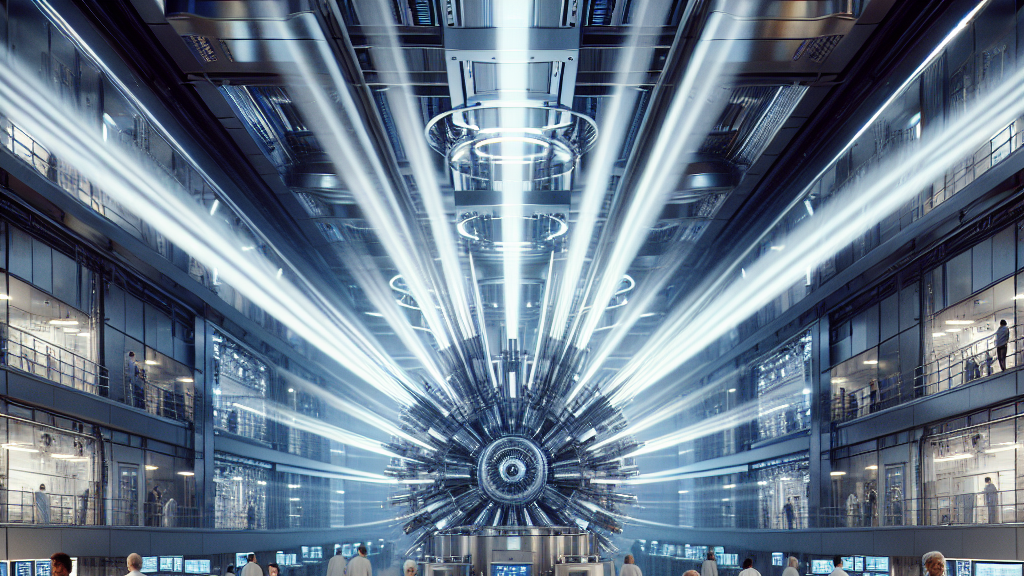
Imagine beams of light so powerful that they can unlock the mysteries of the universe. That’s what scientists are trying to create with muon beams, which are made of tiny particles called muons. These beams might one day power the high-tech science facilities of the future, providing breakthroughs beyond our wildest dreams.

Muon beams are being developed using a clever technique called BACKGAMMON, which uses existing technology to produce these super-intense beams. The Electron-Ion Collider at Brookhaven National Laboratory could potentially generate them. This method harnesses particles called gammas as they scatter off nucleons, resulting in the creation of muons, the elusive cousins of electrons.

In the future, these powerful muon beams might be used in mega-colliders to smash particles together, revealing the very fabric of the universe. This research could lead to breakthroughs in everything from energy production to space travel, making our science fiction fantasies closer to reality.

Muons are similar to electrons but 200 times more massive!

FAQs

What is a muon beam, and why are scientists interested in it?

Muon beams consist of a stream of muons, which are particles similar to electrons but heavier. Scientists are interested because these beams could potentially power future colliders that investigate the fundamental particles of the universe.

How does the BACKGAMMON technique produce muon beams?

The BACKGAMMON technique involves using backscattered gamma rays on nucleons to create muons. This method takes advantage of existing particle accelerator infrastructure, like the one at Brookhaven National Laboratory, to generate the muons.

What is the potential impact of using muon beams in colliders?

Using muon beams in colliders could allow physicists to conduct experiments with unprecedented precision and energy levels, paving the way for new discoveries about the universe’s fundamental building blocks and possibly leading to innovations in technology and energy production.

What is the significance of utilizing the Electron-Ion Collider at Brookhaven for this research?

The Electron-Ion Collider at Brookhaven provides an existing facility that can be adapted to produce muon beams, making it a cost-effective and efficient option for this research. It opens new possibilities for experiments in particle physics without the need to build entirely new infrastructure.

Background

Muons are particles similar to electrons; they’re part of the lepton family and have the symbol ‘μ’. They’re heavier than electrons, which gives them unique properties and makes them fascinating for particle physics. The goal of creating muon beams is to use these particles in experiments that could reveal much about the building blocks of the universe.

History

Muon research has roots in the study of cosmic rays, where muons were first discovered. Over time, scientists realized that their unique properties could make them ideal for collider experiments. This latest research is an evolution that leverages existing technology at places like the Electron-Ion Collider to produce muons more efficiently.

Based on “BACKGAMMON: A Scheme for Producing High Intensity Muon Beams for Future Colliders and Other Applications” by Armen Apyan, Peter Delfyett, Paul Guèye, Letrell Harris, Sokhna Bineta Lo Amar, Sekazi K. Mtingwa, available on arXiv (arxiv.org/abs/2504.21271), used under CC BY 4.0 (creativecommons.org/licenses/by/4.0/).


Trending

Latest

Can AI Save Water Discover How

Computers

AI is transforming the tech world, but it uses lots of water! A new tool, SCARF, helps us measure and reduce AI's water footprint,...

Whats a Forbush Decrease and Why Should We Care Whats a Forbush Decrease and Why Should We Care

Space

Scientists just observed the biggest solar storm event in years, revealing unexpected cosmic ray patterns. Understanding these changes could help us protect our technology...

Can Cars Spot Danger Faster Than Humans Can Cars Spot Danger Faster Than Humans

Computers

Think about how quickly you react when something unexpected happens on the road. This research brings us closer to creating self-driving cars that can...

Can Fear of the Other Stop Social Harmony Can Fear of the Other Stop Social Harmony

Physics

Fear of the unknown might make it harder for people to agree and get along. This study shows that when people have strong xenophobic...

Can AI Revolutionize Breast Cancer Diagnosis Can AI Revolutionize Breast Cancer Diagnosis

Electricity

This research introduces a groundbreaking AI model that can accurately assess HER2-positive breast cancer using widely accessible staining methods, potentially revolutionizing how we diagnose...

Can AI Transform Your Singing into a Choir Can AI Transform Your Singing into a Choir

Computers

Imagine singing solo and having AI turn you into a choir. This research unveils a groundbreaking AI tool that transforms your voice into rich...

You May Also Like

Physics

Discover how quantum tricks can reveal hidden secrets of particles, making our grasp on the universe even firmer. This research could revolutionize how scientists...

Physics

This research shows how a fun, web-based game helps high school students understand complex particle physics better than regular classroom lessons, suggesting that interactive...

Physics

This research reveals a surprising link between dark matter and proton decay—where dark matter might be causing protons to break down. This discovery could...

Physics

Scientists are exploring the possibility that certain strange particles, mesons, near 2 GeV might be exotic, made of four quarks instead of the usual...

Physics

Ever wondered if protons and neutrons are more than just tiny particles? Discover how their hidden dimensions—like charge, magnetic, and axial radii—reveal a complex...

Nuclear Theory

Imagine if teleportation wasn't just science fiction but a real phenomenon! New research suggests a third type of teleportation could change how we understand...

Physics

Discovering the secrets of pentaquarks might just be the key to unveiling new mysteries in particle physics. This research dives deep into their magnetic...

Physics

This research dives into the mysterious world of axions, tiny particles that could hold the key to understanding dark matter. Unraveling their secrets might...

Physics

This research hints at a game-changer in understanding dark matter. By using self-interactions from Higgs particles, scientists propose a new way that heavy dark...

Copyright © 2024 8ig8rain.

Disclaimer: The content on 8ig8rain.com consists of AI-generated summaries of scientific abstracts from arXiv. Please note that most arXiv abstracts are preprints and may not have undergone formal peer review. While these summaries aim to convey key ideas and potential applications, they are provided for informational purposes only and should not be interpreted as validated scientific findings or professional advice. The summaries are intended to educate, spark curiosity, and inspire further exploration of science.