Connect with us

Search by keyword

Physics

Could Gravitational Waves Reveal Hidden Universes?

Scientists believe that gravitational waves could carry hidden messages from the early universe, revealing secrets about how space transformed billions of years ago. This fascinating idea could help us unlock the mysteries of how the universe took shape and evolved.

Could Gravitational Waves Reveal Hidden Universes
✨Researched by humans. Explained by robots. Learn more.

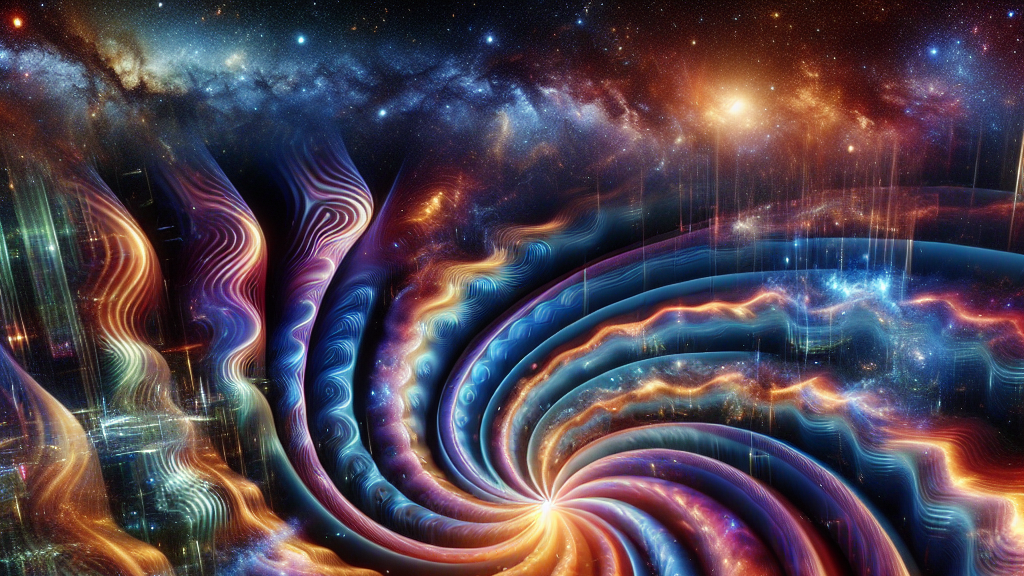
Imagine the early universe, a mysterious place where reality as we know it was just beginning to take shape. Scientists think that during this time, space itself went through dramatic changes, known as phase transitions, that could have left behind whispers in the form of gravitational waves. These waves, rippling through space, might carry hidden messages from back in those times.

Most known theories suggest that these changes, or phase transitions, weren’t super ‘cool’ enough to make waves powerful enough for us to detect today. But a special type of theory, inspired by a concept called the Randall-Sundrum model, suggests some exceptions. This idea involves an alternate universe where forces act very differently, and such a setup could have made the kind of strong gravitational waves we’re looking for. Scientists constructed a simplified model that gives us clues on how these waves could look based on the activity of forces in this different reality.

So why does this matter? If we can detect these gravitational waves and decode their secrets, we might understand more about how the universe formed. It would be like finding a cosmic Rosetta Stone, helping us align what we know with what was happening in those early moments of creation. This could revolutionize our understanding of cosmology and even give us glimpses into alternate universes or dimensions.

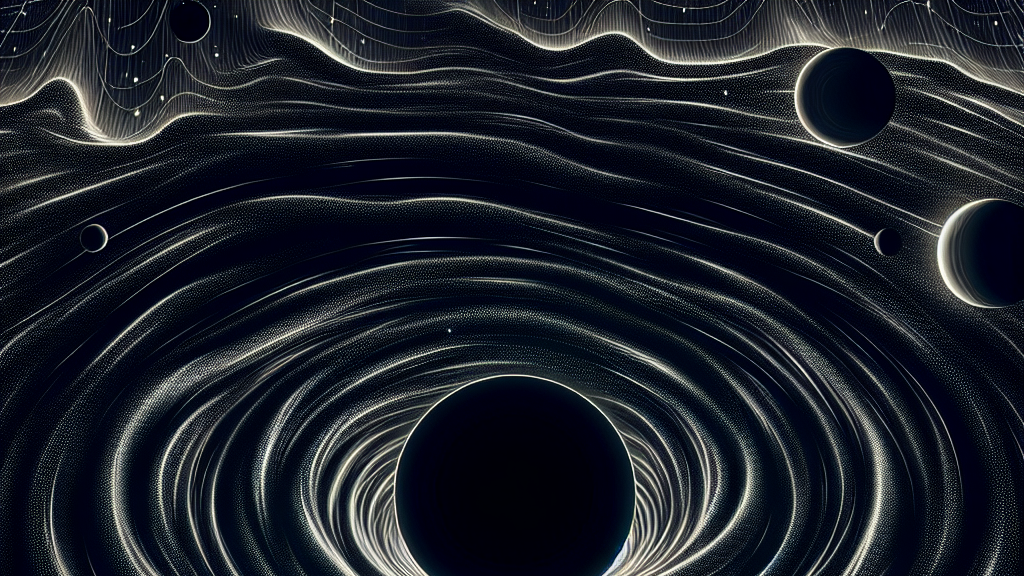
Gravitational waves are ripples in space-time predicted by Albert Einstein over a century ago, but they were only directly detected for the first time in 2015!

FAQs

What are gravitational waves and why are they important?

Gravitational waves are ripples in the fabric of space-time itself, caused by immense cosmic events. They are important because they offer a new way to observe the universe, much like how a radio gives a different insight than a camera.

How do gravitational waves relate to the early universe?

During the early universe, various phase transitions may have left behind gravitational waves. These waves can give us clues about the events that shaped the cosmos as we know it today.

What is supercooling, and why is it needed for strong gravitational waves?

Supercooling refers to a state where a material cools below its normal phase transition temperature without yet changing its state. It is needed for strong gravitational waves because it creates more dramatic cosmic events, leaving stronger ‘ripples’ in space-time.

How could detecting gravitational waves change our understanding of the universe?

If we can detect and understand gravitational waves from the early universe, it could reveal unknown aspects of how the universe evolved and formed. This would offer new insights into fundamental physics and cosmology.

What is the Randall-Sundrum model and its role in this research?

The Randall-Sundrum model is a theoretical model that suggests a universe with extra spatial dimensions. It plays a crucial role in this research as it proposes a scenario where supercooling and significant gravitational waves could occur.

Background

In physics, a phase transition is when a substance changes state, like water to ice. Similarly, in the early universe, shifting forces and energy structures changed its ‘phase’ drastically. Gravitational waves are like cosmic waves that these transitions might have created, and scientists are trying to hear them to unlock universe secrets.

History

Our understanding of gravitational waves began with Einstein’s theory of relativity. Decades of theoretical development and recent advances in technology have finally allowed us to detect these waves, confirming Einstein’s predictions. This research builds upon those theoretical foundations and explores new realms where these waves might originate.

Based on “Supercooled Confinement” by Prateek Agrawal, Gaurang Ramakant Kane, Vazha Loladze, Mario Reig, available on arXiv (arxiv.org/abs/2504.00199), used under CC BY 4.0 (creativecommons.org/licenses/by/4.0/).

Trending

Latest

Can AI Save Water Discover How

Computers

AI is transforming the tech world, but it uses lots of water! A new tool, SCARF, helps us measure and reduce AI's water footprint,...

Whats a Forbush Decrease and Why Should We Care Whats a Forbush Decrease and Why Should We Care

Space

Scientists just observed the biggest solar storm event in years, revealing unexpected cosmic ray patterns. Understanding these changes could help us protect our technology...

Can Cars Spot Danger Faster Than Humans Can Cars Spot Danger Faster Than Humans

Computers

Think about how quickly you react when something unexpected happens on the road. This research brings us closer to creating self-driving cars that can...

Can Fear of the Other Stop Social Harmony Can Fear of the Other Stop Social Harmony

Physics

Fear of the unknown might make it harder for people to agree and get along. This study shows that when people have strong xenophobic...

Can AI Revolutionize Breast Cancer Diagnosis Can AI Revolutionize Breast Cancer Diagnosis

Electricity

This research introduces a groundbreaking AI model that can accurately assess HER2-positive breast cancer using widely accessible staining methods, potentially revolutionizing how we diagnose...

Can AI Transform Your Singing into a Choir Can AI Transform Your Singing into a Choir

Computers

Imagine singing solo and having AI turn you into a choir. This research unveils a groundbreaking AI tool that transforms your voice into rich...

You May Also Like

Space

This research is changing the game for how we see the universe using radio waves! It enlists the help of regular people and smart...

General Relativity and Quantum Cosmology

This study explores the possible fate of our universe—revealing that under certain conditions, it might one day collapse into a Big Bang-like singularity or...

Physics

Scientists are on a mission to discover if ghost-like particles called neutrinos could reveal astonishing insights about the universe. Using cutting-edge technology, they searched...

General Relativity and Quantum Cosmology

Researchers have uncovered a potential connection between the behavior of black holes and elusive dark matter particles. This exciting discovery may change how we...

Space

Scientists are puzzled by the universe's changing speed, as it seems to be accelerating quickly at some points and slowing down at others. This...

Space

Dark matter around black holes might help us detect subtle cosmic signals, leading to new discoveries about the universe with advanced space technology.

Space

Our understanding of the universe's uniformity faces a serious challenge, as new findings suggest our cosmos might not be as smooth and even as...

Space

Tiny blue galaxies, like the one studied, may hold clues to the early universe, but there's a puzzling twist: their high-energy emissions hint at...

Physics

Scientists explore the fascinating possibility that our entire universe may have originated as a 'baby' universe. This intriguing idea not only aligns with existing...

Copyright © 2024 8ig8rain.

Disclaimer: The content on 8ig8rain.com consists of AI-generated summaries of scientific abstracts from arXiv. Please note that most arXiv abstracts are preprints and may not have undergone formal peer review. While these summaries aim to convey key ideas and potential applications, they are provided for informational purposes only and should not be interpreted as validated scientific findings or professional advice. The summaries are intended to educate, spark curiosity, and inspire further exploration of science.