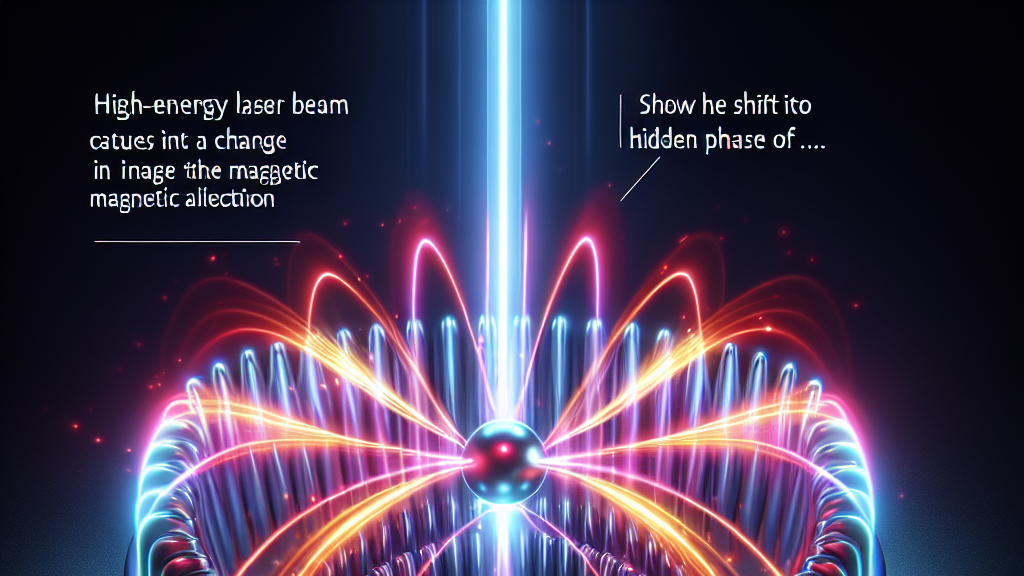
Imagine a world where a little flash of light, something as common as what lasers produce, could help solve one of the most pressing issues of our time: clean energy. That’s precisely what researchers are investigating with metal nanoparticles, which are so tiny you can’t even see them with the naked eye! These particles have an amazing ability to amplify light, pushing it to levels that can cause remarkable things to happen—like sparking nuclear fusion.
The key lies in a special process called plasmonic confinement, where lasers shine onto hollow metal nanoshells filled with heavy water. This setup makes the particles inside bounce around at incredible speeds, creating conditions similar to those in our sun! The result? Deuteron nuclei, a type of hydrogen’s heavy cousin, are accelerated to energies normally found in super-hot thermonuclear plasmas. These high speeds can potentially trigger nuclear fusion, releasing vast amounts of energy in the process.
If this idea works out, it could revolutionize how we generate power, making it sustainable and environmentally friendly. Imagine fusion reactors powered by tiny nanoparticles, offering a virtually limitless energy source without the harmful byproducts of traditional methods. It’s like a science fiction story unfolding right here on Earth and could be our ticket to an energy revolution that secures our planet’s future.
Did you know? The energy within a single metal nanoparticle can be amplified a billion times with just a laser!
FAQs
How do metal nanoparticles help in nuclear fusion?
Metal nanoparticles can amplify the light from a laser by a billion times, creating powerful electric fields that accelerate deuteron nuclei and potentially trigger nuclear fusion.
What is plasmonic confinement?
Plasmonic confinement is when a laser’s light causes particles within a metal nanoshell to vibrate energetically, creating conditions suitable for nuclear fusion.
Why is laser-driven fusion important?
Laser-driven fusion could provide a cleaner, sustainable energy source by mimicking the process that powers the sun, without producing harmful waste.
What role does heavy water play in this fusion process?
Heavy water, composed of deuterium, fills the nanoshells and provides the deuteron nuclei that are essential for triggering the nuclear fusion reactions under plasmonic confinement.
Can this technique generate enough energy for practical use?
Scientists are still investigating the feasibility, but the potential for high energy output from laser-driven fusion makes this a promising area for sustainable energy research.
Background
The concept revolves around plasmonics, a field of science focused on how metals interact with light at the nanoscale. These interactions can amplify light dramatically. By integrating this with nuclear fusion research, scientists aim to harness the immense power of tiny light-enhanced electric fields to cause nuclear reactions in ways akin to processes in stars, potentially offering sustainable energy solutions.
History
The journey to achieve clean energy via fusion has been long and complex. While traditional nuclear fusion research has focused on replicating the intense heat and pressure found in stars, this new direction banks on recent advances in nanotechnology and optics. Past breakthroughs in laser technology and metal nanoparticle study have paved the way for this innovative approach of using ultra-fast lasers to create conditions for fusion within nanoscale materials.
Based on “Fusion in a nanoshell: Harnessing plasmonic fields for nuclear reactions” by Dmitri E. Kharzeev, Jacob Levitt, Carlos Trallero-Herrero, available on arXiv (arxiv.org/abs/2503.15531), used under CC BY 4.0 (creativecommons.org/licenses/by/4.0/).