Imagine if your smartphone could think a billion times faster. That’s the potential when quantum computing teams up with artificial intelligence. This isn’t sci-fi; it’s the frontier of exploring how these two advanced technologies could intertwine to reshape our future. By engaging quantum computing, which processes data in a fundamentally different way than traditional computers, AI could make life-changing strides in how it learns and solves problems.
Here’s the exciting part: AI already helps us with tasks like voice recognition and navigation. But with quantum computing, AI could tackle problems and analyze data in ways that are currently impossible. By using the unique properties of quantum bits, which can exist in multiple states simultaneously, researchers hope to develop AI that operates exponentially more efficiently and intelligently. This blend of AI and quantum computing opens the door to faster, more accurate decision-making processes in numerous fields, from healthcare to finance.
So, what does this mean for you? Imagine a future where AI-driven tech responds instantly, optimizing your daily routine and even improving energy consumption in industries. By aligning AI advancements with quantum hardware progress, Europe could take a lead in this tech transformation, enhancing competitiveness while considering societal and environmental impacts. This hybrid approach could redefine how industries work, leading to smarter, greener solutions that benefit everyone.
Quantum computers can perform calculations in seconds that would take classical computers thousands of years!
FAQs
What is the core idea behind combining quantum computing and AI?
The core idea is that quantum computing could drastically increase the efficiency and problem-solving capabilities of AI by allowing it to process data in ways that classical computers cannot, leading to smarter and faster AI solutions.
How could quantum computing enhance AI?
Quantum computing can handle complex data and calculations much faster than traditional computers, which means AI can learn and make decisions much quicker, potentially transforming industries like healthcare, finance, and energy management.
What are the societal implications of merging AI and quantum computing?
The merge could lead to more efficient energy usage, greener technologies, and improved industrial competitiveness, while also raising ethical considerations about privacy, job displacement, and technology access.
What challenges does the integration of AI and quantum computing face?
Challenges include aligning theoretical AI developments with quantum hardware advancements, estimating resource needs, and ensuring optimal energy consumption while safeguarding societal interests.
Why is Europe focusing on this technological integration?
Europe aims to enhance industrial competitiveness and lead in tech innovations that also consider societal impacts, aligning with its goals for sustainability and economic growth in the digital age.
Background
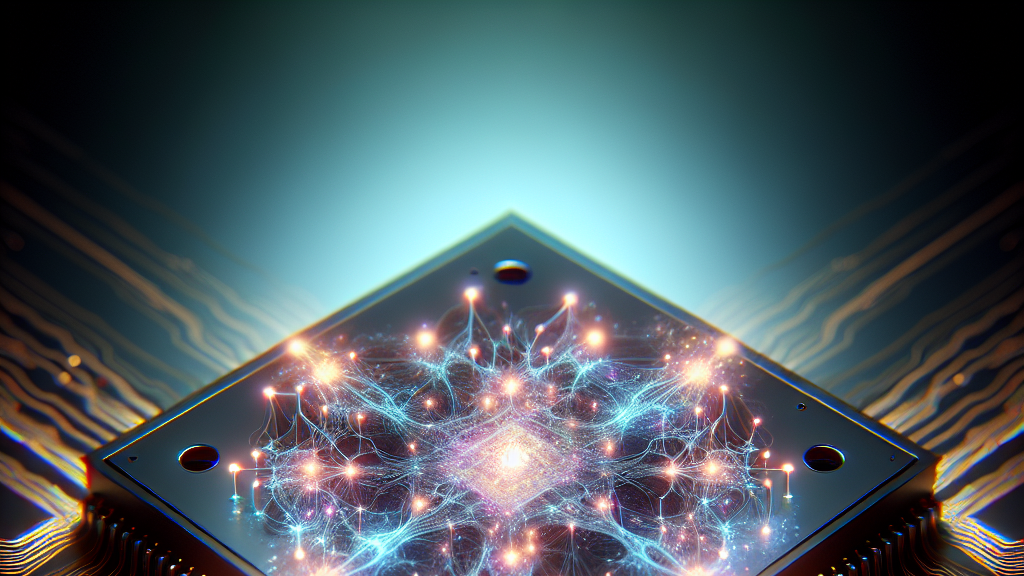
Quantum computing operates on quantum bits, which, unlike the classical binary bits, can exist in multiple states at once (thanks to quantum superposition). This allows quantum computers to process massive amounts of data simultaneously, making them potentially much more powerful than conventional computers. When combined with AI, which relies on large data sets and complex algorithms to learn and make decisions, quantum computing could significantly boost AI’s performance and efficiency.
History
Quantum computing has been a topic of research since the 1980s, but it wasn’t until the early 21st century that significant progress was made, leading to the development of quantum processors. Concurrently, AI continues to evolve from its inception in the mid-20th century, with machine learning and neural networks becoming mainstream tools. Recent studies highlight how these two fields can complement each other, paving the way for a new era of technological innovation.
Based on “Quantum computing and artificial intelligence: status and perspectives” by Giovanni Acampora, Andris Ambainis, Natalia Ares, Leonardo Banchi, Pallavi Bhardwaj, Daniele Binosi, G. Andrew D. Briggs, Tommaso Calarco, Vedran Dunjko, Jens Eisert, Olivier Ezratty, Paul Erker, Federico Fedele, Elies Gil-Fuster, Martin Gärtner, Mats Granath, Markus Heyl, Iordanis Kerenidis, Matthias Klusch, Anton Frisk Kockum, Richard Kueng, Mario Krenn, Jörg Lässig, Antonio Macaluso, Sabrina Maniscalco, Florian Marquardt, Kristel Michielsen, Gorka Muñoz-Gil, Daniel Müssig, Hendrik Poulsen Nautrup, Evert van Nieuwenburg, Roman Orus, Jörg Schmiedmayer, Markus Schmitt, Philipp Slusallek, Filippo Vicentini, Christof Weitenberg, Frank K. Wilhelm, available on arXiv (arxiv.org/abs/2505.23860), used under CC BY 4.0 (creativecommons.org/licenses/by/4.0/).