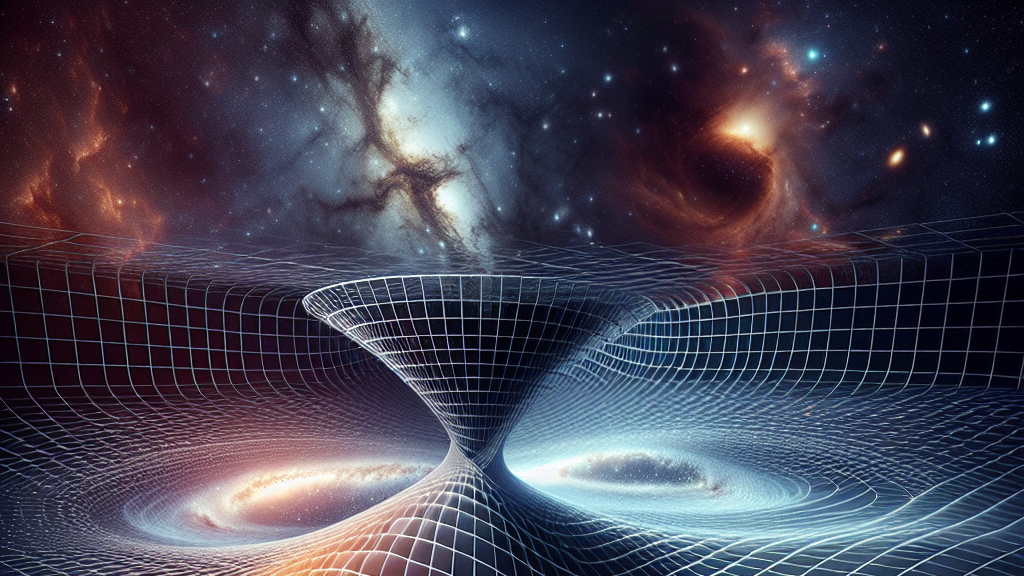
Could our universe be both curved and flat at the same time? This mind-boggling question arises from two competing theories that describe the nature of space itself. While we’re used to hearing about spacetime being curved due to Einstein’s general relativity, there’s another theory that suggests spacetime could be flat but with a twist—it involves something called torsion. It’s like imagining a sheet of paper that, while remaining flat, is twisted to give it a different shape. This intriguing possibility challenges our fundamental views and asks us to rethink what we know about the universe.
The research compares general relativity, where spacetime is curved, with a theory called the teleparallel equivalent of general relativity, where spacetime is flat but incorporates torsion. Both theories make the same predictions, meaning they fit all the data scientists currently have. However, they portray radically different pictures of the universe. The debate is heated because it challenges what it means to ‘see’ spacetime. Is one theory more ‘real’ than the other? Or can both coexist in a strange scientific harmony?
Imagine if we could solve this mystery: it would mean unlocking a new way of thinking about everything, from the way planets orbit stars to how the universe began. In practical terms, this insight could lead to groundbreaking technologies that harness the subtle differences in these theories. Instead of choosing between two realities, we could find new ways to blend them, opening doors to innovations we haven’t even imagined yet.
General relativity and its alternative both describe the universe perfectly, yet one claims space is flat and the other claims it’s curved!
FAQs
What is the teleparallel equivalent of general relativity?
The teleparallel equivalent of general relativity is a theory that explains gravity without assuming space is curved. Instead, it describes space as flat but twisted using torsion, offering a fresh perspective on how we understand the universe.
Why does it matter if spacetime is curved or flat?
This distinction challenges our fundamental understanding of the universe and could lead to new technological advancements. It’s like debating whether the earth is flat or round; each belief leads to different technological paths and understanding.
Does this mean general relativity is wrong?
No, it means that we might have different equally valid ways to describe the universe. Both theories provide the same predictions based on current data, allowing room for broader interpretation and understanding in physics.
How could these theories impact future technologies?
If one theory offers insights or efficiencies the other doesn’t, it could inspire new technological developments, potentially leading to advancements in space travel, energy, and more.
Why is visualizing torsion in spacetime so challenging?
Our minds are conditioned to see space in three dimensions, so imagining a property like torsion, which implies twisting within flat space, is abstract and requires new ways of thinking.
Background
General relativity, a theory proposed by Einstein, describes how gravity works by asserting that mass curves spacetime. This is the foundation of how we understand gravity. The teleparallel equivalent of general relativity provides an alternative view by maintaining that spacetime remains flat but is permeated with torsion, an idea akin to twisting rather than curving.
History
Einstein revolutionized physics with general relativity over a century ago, explaining gravity through the curvature of spacetime. Since then, physicists have sought to understand the underlying nature of this curvature. The teleparallel equivalent of general relativity emerged as a rival, offering a different perspective by introducing torsion in flat spacetime—challenging traditional ideas and sparking considerable debate within the field.
Based on “Is spacetime curved? Assessing the underdetermination of general relativity and teleparallel gravity” by Ruward Mulder, James Read, available on arXiv (arxiv.org/abs/2505.04632), used under CC BY 4.0 (creativecommons.org/licenses/by/4.0/).