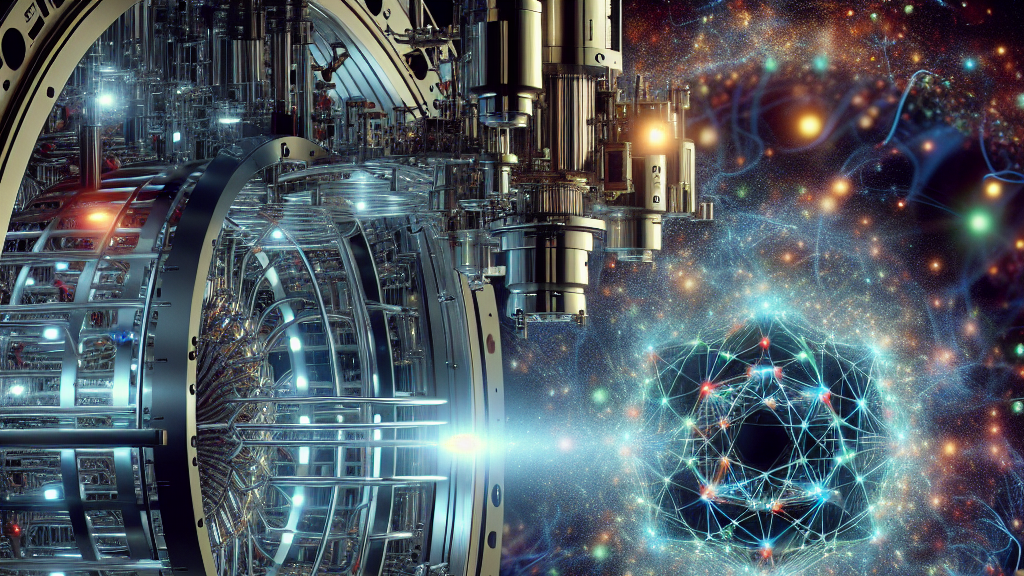
Imagine a tiny creature stirring up a storm of debate among scientists for over a century! This curious being, known as Maxwell’s demon, is nothing more than a thought experiment, but it has kept some of the greatest minds busy trying to understand the link between heat, information, and computation. It’s like a ghost haunting the world of thermodynamics, refusing to rest and constantly challenging our understanding of how the universe works.
Maxwell’s demon is a fascinating concept that brought together ideas from various scientific fields, including thermodynamics, the study of heat and energy transfer, and information theory, which deals with data and communication. The demon was proposed as a creature capable of sorting fast-moving molecules from slow ones, theoretically defying the laws of thermodynamics by creating energy from nothing. This seemingly magical ability has sparked conversations around how information and computation can influence physical systems, even laying the groundwork for advancements in quantum mechanics.
Picture a future where your phone can charge itself using the principles inspired by Maxwell’s demon or new computers that operate more efficiently than ever imagined. The research surrounding this theoretical creature could lead to innovations in how we understand and utilize energy, potentially reducing waste and creating more sustainable technology. Its implications reach far beyond the laboratory, possibly impacting everything from how we manage digital data to how we design renewable energy solutions.
The concept of Maxwell’s demon was first introduced in 1867, long before the idea of computers or digital information as we know it existed!
FAQs
What is Maxwell’s demon and how did it start?
Maxwell’s demon is a thought experiment devised in 1867 by physicist James Clerk Maxwell. It imagines a tiny creature that can sort molecules based on their speed, seemingly defying the second law of thermodynamics, which states that entropy, or disorder, should always increase in a closed system.
How does Maxwell’s demon relate to information theory?
Maxwell’s demon challenges the idea that physical processes, like sorting molecules, require energy. It inspired discussions about the role of information processing in physical systems, leading to important developments in information theory, which studies how data is measured, transmitted, and processed.
Why is Maxwell’s demon still important in modern science?
Despite being a thought experiment, Maxwell’s demon continues to influence scientific research in fields such as quantum mechanics and computing. It encourages scientists to explore the relationship between energy and information, uncovering new possibilities for technological innovation and deeper understanding of the universe.
Background
Central to understanding Maxwell’s demon is the second law of thermodynamics, which states that in any natural process, the total entropy, or disorder, of a system will always increase over time. This law explains why we can’t create perpetual motion machines, as some energy is always lost as heat. Maxwell’s demon challenges this idea by suggesting a way to decrease entropy without expending energy, raising questions about the role of information in physical processes.
History
Maxwell’s demon originated from physicist James Clerk Maxwell in 1867 as a way to explore the limits of thermodynamics. The concept fueled debates over the nature of entropy and the role of information in physics, eventually influencing emerging fields like information theory and quantum mechanics. Over time, researchers have expanded on the idea, exploring its implications and uncovering connections with modern science, leading to new technological and theoretical insights.
Based on “A friendly guide to exorcising Maxwell’s demon” by A. de Oliveira Junior, Jonatan Bohr Brask, Rafael Chaves, available on arXiv (arxiv.org/abs/2503.07740), used under CC BY 4.0 (creativecommons.org/licenses/by/4.0/).