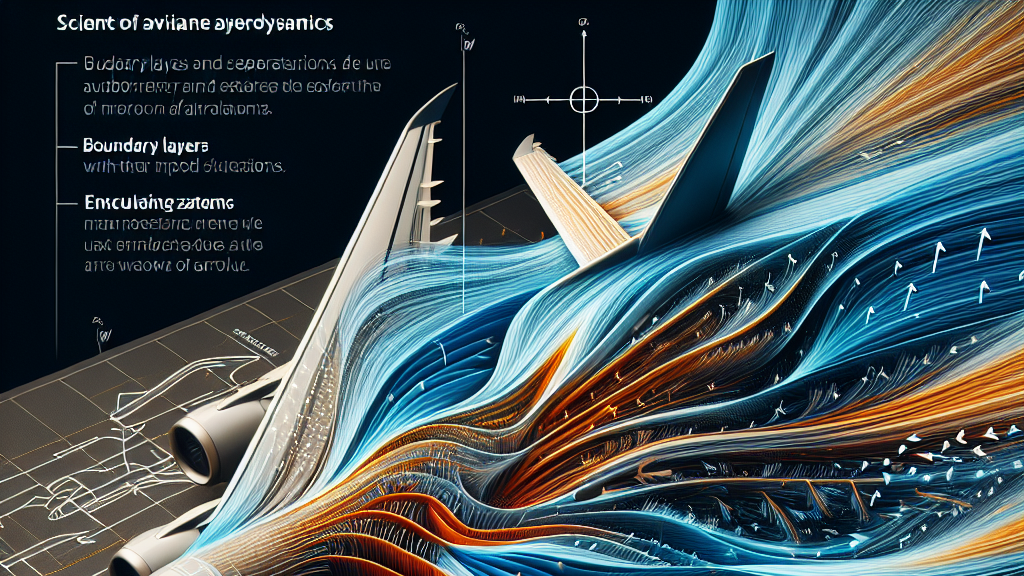
Airplanes cut through the skies thanks to their wings, but not all flights are created equal. Sometimes, tiny air flows that you can’t even see with your eyes can throw a wrench into the smoothness of a flight. When these flows misbehave, they can cause turbulence or reduce how efficiently a plane flies. Amazingly, these small but mighty forces are the very focus of exciting new research on wing performance at low speeds.
This study looks at the special dance of air across small wings, pinpointing where air separates and swirls back around. It turns out, when these air flows fall below a certain speed, things get interesting! The wings can become super sensitive, meaning the flow of air around them changes character completely. By tweaking speeds and how the wing is angled, scientists can track these elusive air patterns. This research used a NACA 65(1)-412 model wing, specifically chosen because it’s good at showing these air tricks across its full length.
So, why should you care about these tiny air dances? Well, if you’re a frequent flyer, this research could mean more stable, efficient, and fuel-friendly flights for you in the future. Imagine a world where planes are designed to sip fuel and glide more silently through the air, all thanks to understanding these hidden, swirling patterns. It’s a small change with potential for big improvements in air travel!
Did you know? Just like how a tiny pebble can disrupt a calm pond, small changes in airflow can revolutionize aviation efficiency!
FAQs
What is the significance of wing performance at low Reynolds numbers?
The performance of wings at low Reynolds numbers, typical of small or slow-flying aircraft, is crucial because it affects flight efficiency and stability. Understanding this can help engineers design better-performing airplanes.
Why does angle of incidence matter in the study of wing airflow?
The angle of incidence influences how air flows over a wing, affecting lift and drag. By studying it, researchers can gain insights into optimizing wing designs for various flight conditions.
How can understanding boundary layer separation improve aircraft design?
Boundary layer separation can lead to increased drag and instability. By understanding it, engineers can design wings that minimize these issues, leading to more efficient and smoother flying aircraft.
Why was the NACA 65(1)-412 wing section used in this study?
The NACA 65(1)-412 was used for its ability to clearly demonstrate air flow patterns, especially in terms of separation and recirculation, making it ideal for studying the phenomena under investigation.
How does this research affect everyday air travel?
By improving our understanding of wing aerodynamics, this research could lead to the development of airplanes that are more fuel-efficient, stable, and environmentally friendly.
Background
In aerodynamics, the Reynolds number is a crucial concept. It essentially measures the ratio between inertial forces and viscous forces in a fluid flow, helping to predict how flows will behave. At lower Reynolds numbers, like those found in small or slow-moving planes, air behaves differently, often becoming sensitive to separation and recirculation. Boundary layer separation occurs when the smooth flow of air breaks away from the surface of the wing, which can lead to increased drag and reduced performance.
History
The study of wing aerodynamics has a rich history, beginning with the Wright brothers’ experiments with lift and drag in the early 1900s. Over the decades, researchers like NACA have developed standardized wing shapes, such as the NACA 65(1)-412 used in this study, to systematically investigate airflow patterns. This research builds on these foundations by using modern measurement and simulation techniques to better understand airflow at low Reynolds numbers, a less studied but critical area for aviation.
Based on “The Footprint of Laminar Separation on a Wall-Bounded Wing Section at Transitional Reynolds Numbers” by Charles Klewicki, Bjoern F. Klose, Gustaaf B. Jacobs, Geoffrey R. Spedding, available on arXiv (arxiv.org/abs/2411.05926), used under CC BY 4.0 (creativecommons.org/licenses/by/4.0/).