





































































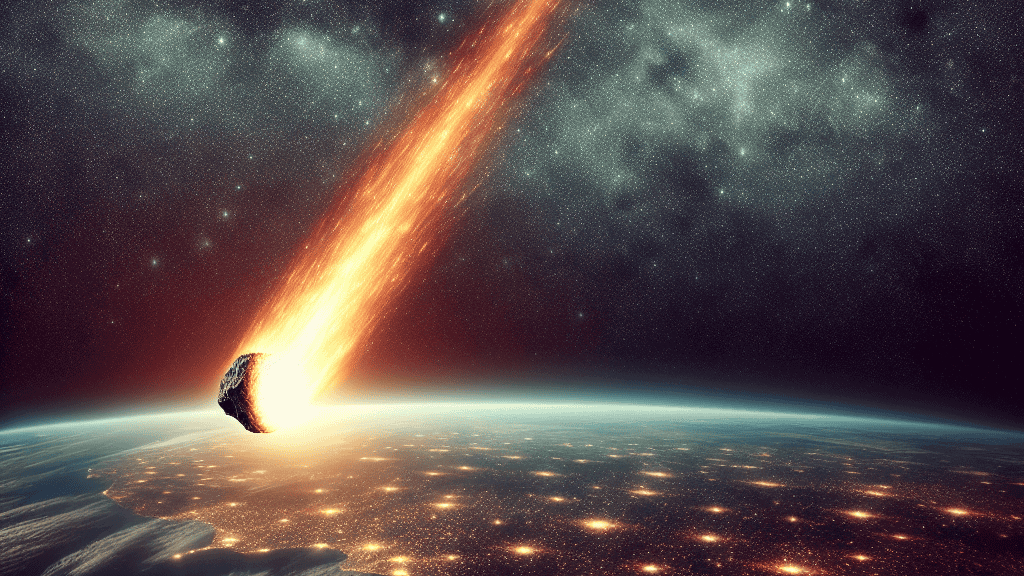
Imagine looking up at the night sky and knowing that Earth is constantly being visited by mini-asteroids larger than a few cars. These small, fiery visitors can release energy equivalent to hundreds of thousands of tons of TNT as they meet our planet. But what’s really fascinating is how often they strike—much more frequently than scientists originally predicted.
By using new data from US government satellite sensors, researchers have started unraveling the mystery of why we see more of these fireballs than anticipated. Traditional telescopes estimate the impacts should happen once every 20 to 40 years, but actual observations suggest every 2 to 3 years. The hypothesis is that a larger asteroid may have broken apart, providing a stream of these mini-asteroids that head our way. However, this theory lacks solid evidence of recent disruptions, meaning the mystery still isn’t solved. Most of these fragments likely come from specific zones in the asteroid belt, including areas influenced by Jupiter’s gravity.
Why does this matter to you? Well, if you live in a bustling city, understanding these mini-asteroids could help scientists predict and prepare for potential impacts. Imagine technologies that warn us about incoming space rocks, reducing risks to our communities and infrastructures. By unlocking these cosmic secrets, we can better protect our planet from these spectacular—and sometimes dangerous—fireball visits.
Did you know? The bright fireball from an asteroid impact can be as bright as the sun, sometimes lighting up the night sky for miles!
FAQs
What unexpected discovery did scientists make about mini-asteroids?
Scientists found that mini-asteroids impact Earth more frequently than previously thought, about every 2-3 years instead of 20-40 years.
Why is there a discrepancy in asteroid impact rates?
The discrepancy might be due to tidal disruption, where a larger asteroid breaks apart, but there’s no solid evidence for this yet.
How does this research help us in real life?
Understanding frequent mini-asteroid impacts could lead to better prediction and preparation for potential impacts, safeguarding populated regions.
Where do these mini-asteroids typically come from?
They mostly originate from the main asteroid belt, specifically areas affected by gravitational influences like the 3:1 Jupiter resonance.
How does USG satellite data improve asteroid research?
The USG satellite data provides detailed insights into asteroid impacts, complementing traditional observations and revealing a more frequent impact rate.
Background
Asteroids are rocky bodies orbiting in space, mostly in the asteroid belt between Mars and Jupiter. When they enter Earth’s atmosphere, they become meteors or ‘fireballs.’ The impact of these space rocks is measured in terms of energy release, often compared to TNT explosions. Scientists aim to predict these impacts to prevent potential hazards, examining both their origins and frequencies.
History
Asteroid studies date back to the discovery of Ceres in 1801. Over centuries, telescopic technology has improved, leading to estimates of the number and size of near-Earth asteroids. The use of satellite data has recently provided deeper insights into actual impact frequencies, challenging earlier predictions and requiring the scientific community to rethink asteroid impact dynamics.
Based on “Decameter-sized Earth impactors — I: Orbital properties” by Ian Chow, Peter G. Brown, available on arXiv (arxiv.org/abs/2501.03308), used under CC BY 4.0 (creativecommons.org/licenses/by/4.0/).
