





































































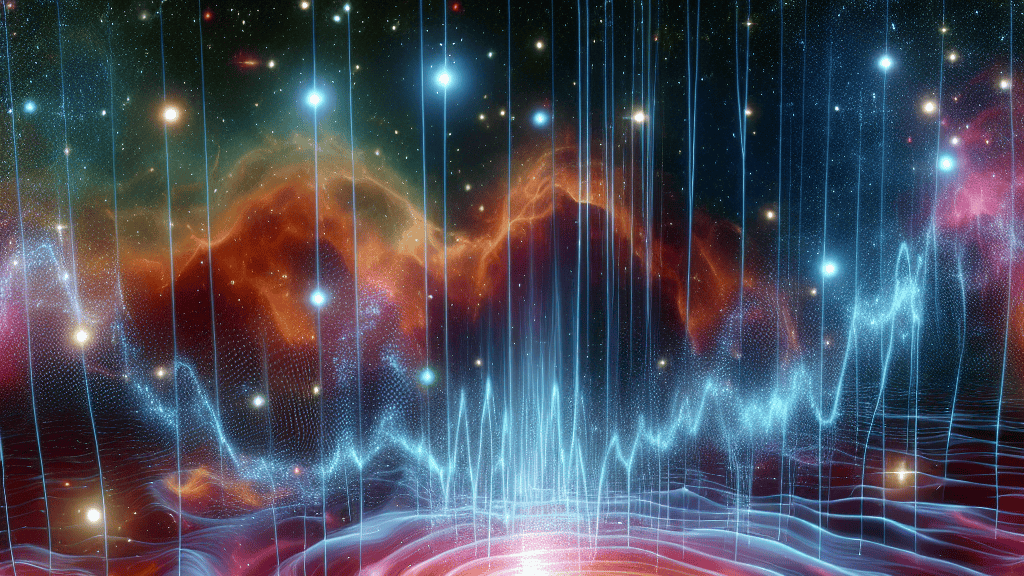
**Imagine a storm, not in the sky, but in the vast expanse of space.** Scientists are exploring how, right after the explosive event known as the Big Bang, energy ripples spread out, shaking up the universe like a giant cosmic earthquake. These ripples dance around different points and grow stronger, creating areas with intense energy spikes, not unlike the eye of a hurricane. But this isn’t just any storm; it’s one that might forge tiny black holes! These cosmic wonders could reveal secrets of how galaxies started forming and even bring us closer to grasping how our universe expanded into such a vast, intricate place.
**But how do these cosmic tempestuous events occur?** Researchers have been investigating a phenomenon called ‘oscillons’—areas where the storm is most intense. They used fancy computer simulations to picture how these energy ripples behave in space. Their findings suggest that under the right conditions, these ripples can come together to create tiny, intense spots of energy. These spots, rich in energy, might eventually collapse into what we call primordial black holes. So, even from something as fleeting as a ripple in space’s fabric, a mighty cosmic feature can emerge!
**What could this mean for us back on Earth?** The ripple effect could generate gravitational waves, similar to the cosmic echoes that the LIGO observatory detects on Earth, but at ranges we’ve never detected before. If we can find these ripples, it might mean we’re on the brink of a cosmic discovery that could change how we understand the universe. Imagine learning about cosmic events that might have influenced even the structure of galaxies. Such knowledge could help scientists refine our models of the universe’s birth and evolution, potentially leading to technological advances we can only dream about today.
Did you know that these cosmic ripples could be creating mini black holes that last just a tiny fraction of a second?
FAQs
What are these cosmic energy ripples?
Cosmic energy ripples are fluctuations in the energy field of the universe that occurred shortly after the Big Bang, influencing the expansion and evolution of the cosmos.
How are these ripples connected to black holes?
The ripples can create intense spots of energy that may collapse into small black holes, called primordial black holes, which could hold clues about early universe conditions.
Could these ripples affect Earth?
While the ripples themselves won’t affect Earth directly, they could help us detect new types of gravitational waves, revealing more about the universe’s formation and evolution.
What are oscillons?
Oscillons are concentrated regions of space where these energy ripples are most intense, creating potential sites for primordial black hole formation.
Can we detect these cosmic ripples?
Detecting these ripples can be challenging, but scientists are working on ways to observe their effects, like gravitational waves, which might offer a glimpse into the mysterious early universe.
Background
The research hinges on understanding what happens after the Big Bang—specifically, during the ‘reheating’ phase as the universe cools and particles take form. In this cosmic setting, the movement of a field called the ‘inflaton’ can cause energy to fluctuate wildly, leading to dense regions. The Floquet theorem helps scientists analyze how these fluctuations grow over time. In particular, these areas of high energy could, under certain conditions, form ‘oscillons,’ or localized high-density spots, which some theorists suspect could lead to primordial black holes.
History
For decades, cosmologists have pondered how the universe evolved from the Big Bang. Initially, scientists believed the universe expanded uniformly, but recent models suggest complexities like inflaton dynamics and energy field fluctuations. Earlier research laid the groundwork for understanding cosmic inflation, but the role of non-trivial dynamics, where the field behaves irregularly due to its potential’s shape, is a newer frontier. This study builds on theoretical works that have explored the connections between energy field dynamics and structure in the universe, providing novel insights into the potential consequences, like tiny black holes or gravitational waves.
Based on “Inflaton Self Resonance, Oscillons, and Gravitational Waves in Small Field Polynomial Inflation” by Manuel Drees, Chenhuan Wang, available on arXiv (arxiv.org/abs/2501.13811), used under CC BY 4.0 (creativecommons.org/licenses/by/4.0/).
