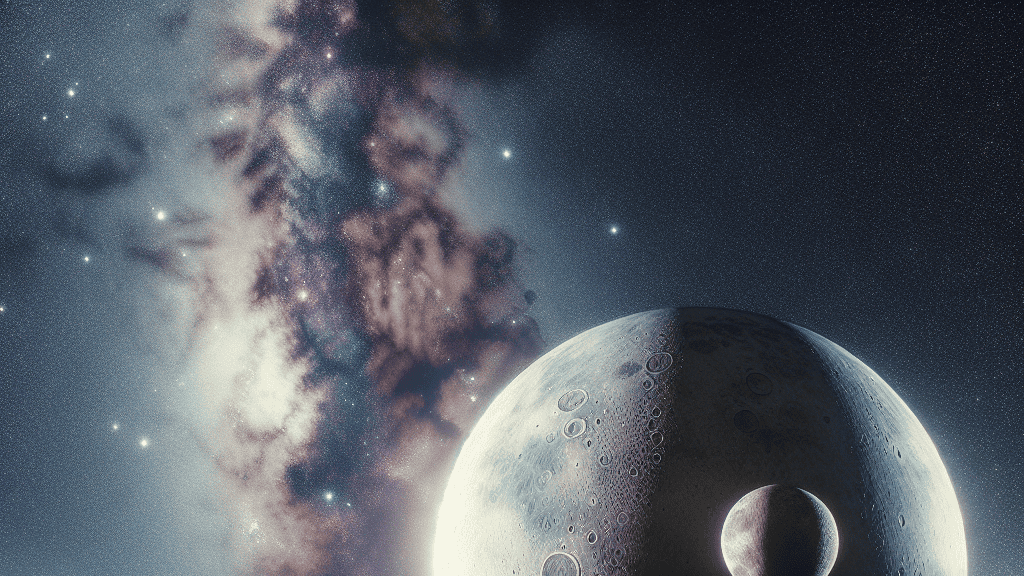
Imagine planets drifting alone in the vastness of space, no longer orbiting a parent star. This isn’t science fiction but a reality that scientists are exploring with new space telescopes like the Chinese Space Station Telescope (CSST) and the Roman Space Telescope. These projects are on a search mission to find moons that might still be clinging to these free-floating planets, having been ejected from their star systems due to cosmic interactions.
But how does this work, and why is it important? When planets get thrown out of their original systems, they might take their moons along for the ride, orbiting one another through the dark void of space. By employing a method called microlensing, which measures how a planet and its moon bend light from a distant star as they pass in front of it, these telescopes can detect even the smaller, Earth-sized, or Moon-sized moons that orbit free-floating planets. Discovering these hidden moons could provide clues about the formation and evolution of planetary systems and help us understand the universe’s hidden architecture.
Imagine one day using this knowledge to precisely locate and study these free-floating planets and moons. This could offer new targets for space missions or even, one day, human exploration. Perhaps these moons could harbor conditions suitable for life, or valuable natural resources for our expanding extraterrestrial ventures. It’s a cosmic game of hide and seek, and with each new discovery, we learn a bit more about our own cosmic neighborhood.
Did you know that a planet can continue to have moons even after it gets kicked out of its solar system?
FAQs
What unexpected discovery did scientists make?
Scientists have found that moons can remain with their planets even after being ejected from star systems. This challenges our understanding of how celestial bodies interact in space.
How do telescopes find these hidden moons?
Telescopes like the CSST and Roman use microlensing, a method that detects changes in starlight when a planet and its moon pass in front, to find these elusive moons.
Why does it matter if we find these moons?
Finding these moons helps us understand the complex dynamics of planetary systems and could reveal new targets for exploration or potential resources for future space missions.
What kind of planets can have hidden moons?
Free-floating planets, often ejected from their original systems, can still host moons. These can include planets similar to Neptune or even Earth in mass.
Can these moons support life?
While unlikely, it’s possible some moons could have conditions conducive to life, especially if they experience tidal heating, which could keep them geologically active.
Background
The concept of free-floating planets revolves around planets that have been ejected from their original star systems, potentially retaining any moons that were orbiting them. These planets and moons are detected using a special technique called microlensing, which takes advantage of the gravitational pull of a planet or moon to bend the light from background stars, indicating the presence of these celestial bodies.
History
The study of free-floating planets has been evolving over the past few decades. The first real insights came when astronomers observed stars with unusual movements, suggesting the presence of unbound planets. The advent of space telescopes with advanced capabilities like microlensing has significantly improved our ability to detect these wandering planets and their moons, pushing the boundaries of our understanding of the cosmos.
Based on “Detecting Exomoons in Free-Floating-Planet Events from Space-based Microlensing Surveys” by Hao-Zhu Fu, Subo Dong, available on arXiv (arxiv.org/abs/2501.04083), used under CC BY 4.0 (creativecommons.org/licenses/by/4.0/).