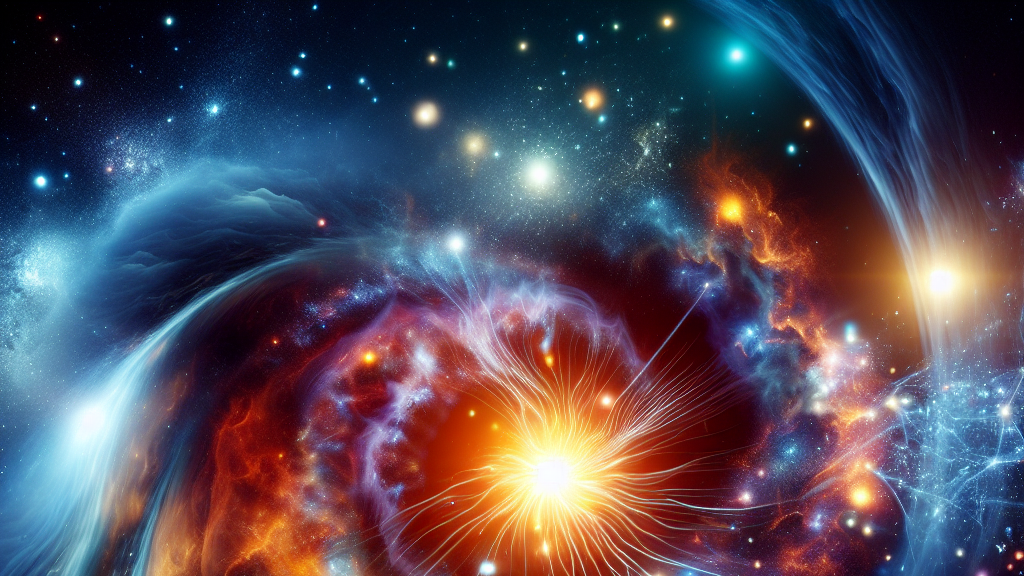
Imagine if we could peer back in time to when the very first stars and galaxies began to form. Using the cosmic microwave background, the afterglow of the Big Bang, scientists are trying to do just that! They are examining two special effects, the kinetic Sunyaev-Zel’dovich effect and patchy screening, to understand the early universe better.
These cosmic effects offer different clues about the reionization era, a time when the universe was so young the first galaxies were just beginning to light up. The kinetic Sunyaev-Zel’dovich effect gives a strong yet tricky signal, mingled with other cosmic noises, while the patchy screening effect offers a clearer path through the clutter by using cleaner polarization data. The goal? To pinpoint when and how the universe changed from being mostly opaque to allowing light to travel freely.
What makes this research particularly exciting is that it’s bringing us closer to understanding how parts of the universe became the way they are now. With new, more advanced CMB surveys like CMB-S4 and CMB-HD on the horizon, we can expect clearer pictures and patterns of the reionization process, enhancing our grasp of cosmic history and possibly leading to discoveries about galaxy formation that directly impact technologies and observations we rely on today.
The cosmic microwave background was discovered by accident in 1965 when scientists were trying to eliminate noise from a radio antenna!
FAQs
What unexpected discovery did scientists make?
They found a way to see early universe changes by studying cosmic signals linked to reionization.
How does this research affect our understanding of the universe?
It helps scientists pinpoint when and how the universe became clear, aiding in understanding galaxy formation.
What tools are being used for this discovery?
Advanced cosmic microwave background surveys like CMB-S4 and CMB-HD.
Why is this research important?
It provides unique insights into the universe’s history and helps explain how galaxies and stars originally formed.
How might this impact future technologies or observations?
Improved understanding could refine astronomical techniques and influence technologies reliant on cosmic observations.
Background
The cosmic microwave background is a faint glow left over from the Big Bang, giving us a snapshot of the early universe. During the reionization era, the first stars and galaxies formed and ionized the neutral hydrogen, making the universe transparent. Scientists study this era to understand the transitions that led to the universe’s current state. Key effects that reveal information about this period are the kinetic Sunyaev-Zel’dovich effect and the patchy screening effect, which require advanced data collection and analysis techniques.
History
The exploration of the cosmic microwave background began with its accidental discovery in the 1960s, which led to a deep insight into the universe’s early moments. Subsequent studies focused on understanding the structures and fluctuations within this background blanket, peeling back layers of cosmic history. The current study builds upon this foundation, using simulations and sophisticated models to extract new data about the elusive reionization era.
Based on “Cross-correlating the patchy screening and kinetic Sunyaev-Zel’dovich effects as a new probe of reionization” by Darby Kramer, Alexander van Engelen, Christopher Cain, Niall MacCrann, Hy Trac, Skylar Grayson, Evan Scannapieco, Blake Sherwin, available on arXiv (arxiv.org/abs/2501.07623), used under CC BY 4.0 (creativecommons.org/licenses/by/4.0/).