





































































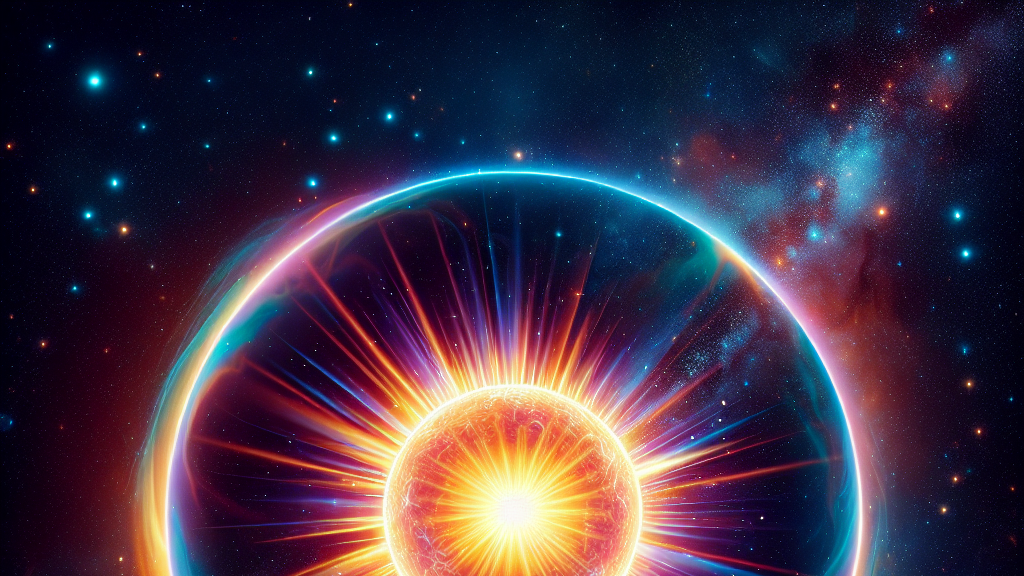
The Sun isn’t just a ball of fiery gas lighting up our days—it’s got a mysterious halo! This ethereal glow isn’t something you’d see from your backyard. It’s a cosmic dance that has only been revealed by 15 years of intense observation with the Fermi LAT telescope. Think of it as the Sun’s invisible ring, shining with the light of gamma rays, giving astrophysicists a new way to peek into the unknown corners of our universe.
Scientists have taken all those gamma rays and figured out that they’re coming from cosmic-ray electrons and positrons—tiny particles zipping through space—crashing into sunlight and causing a glow. This glow, or solar halo, extends up to an incredible 45 degrees from the Sun, helping us study parts of space we can’t directly measure. By diving into this data, researchers have started to unlock cosmic puzzles, like how the Sun’s activities might change over time and impact cosmic rays.
Imagine if this knowledge could lead to better predictions of solar storms that might affect our satellites or communication systems on Earth. Or think about how understanding these cosmic ray interactions could one day help us explore new physics beyond our current models. The Sun’s halo might just be the key to unlocking secrets about both our solar neighborhood and the vast universe beyond.
Did you know the Sun’s halo of gamma rays can stretch as far as 45 degrees from the Sun?
FAQs
What is the solar halo in cosmic terms?
The solar halo is a glow of gamma rays around the Sun, formed by cosmic-ray particles interacting with sunlight. It’s not visible to the naked eye and requires instruments like the Fermi LAT telescope to detect.
Why is studying the solar halo important?
Studying the solar halo helps scientists understand regions of space where we can’t directly measure cosmic-ray flux. It’s crucial for learning how these particles behave and for observing time-dependent changes in solar activity.
How might understanding the solar halo impact everyday life?
By understanding the solar halo and solar activity, scientists can improve predictions of solar storms, which can affect satellite operations and communication systems on Earth, potentially safeguarding our technology-driven world.
What new information did the study of the solar halo reveal?
The study revealed the time-variation and azimuthal asymmetry of the solar modulation potential, offering insights into how these factors change over time both parallel and perpendicular to the ecliptic plane.
Could the solar halo lead to discoveries beyond standard physics models?
Yes, studying the solar halo might lead to breakthroughs in understanding astrophysical processes and uncovering phenomena beyond our current physics models, opening doors to new scientific frontiers.
Background
The solar halo is a fascinating light show caused by cosmic-ray electrons and positrons when they interact with sunlight. These particles are constantly bombarding our solar system, and when they collide with particles from the Sun, they produce gamma rays—a high-energy form of light. This interaction creates a halo effect around the Sun, which is invisible to the human eye but detectable with special instruments like the Fermi LAT telescope. By studying these gamma rays, scientists can learn about the cosmic-ray flux—how many of these particles are present and how they behave in space.
History
The study of gamma rays and cosmic-ray interactions with the Sun has evolved over decades. Early observations focused on nearby cosmic phenomena, but advancements in telescope technology, such as the Fermi LAT, have allowed for precise measurements of gamma rays emanating from the solar halo. This research builds on decades of cosmic-ray studies and solar observation, offering new insights into the ever-changing nature of solar modulation and its effects on cosmic rays.
Based on “First Observations of Solar Halo Gamma Rays Over a Full Solar Cycle” by Tim Linden, Jung-Tsung Li, Bei Zhou, Isabelle John, Milena Crnogorčević, Annika H. G. Peter, John F. Beacom, available on arXiv (arxiv.org/abs/2505.04625), used under CC BY 4.0 (creativecommons.org/licenses/by/4.0/).
