





































































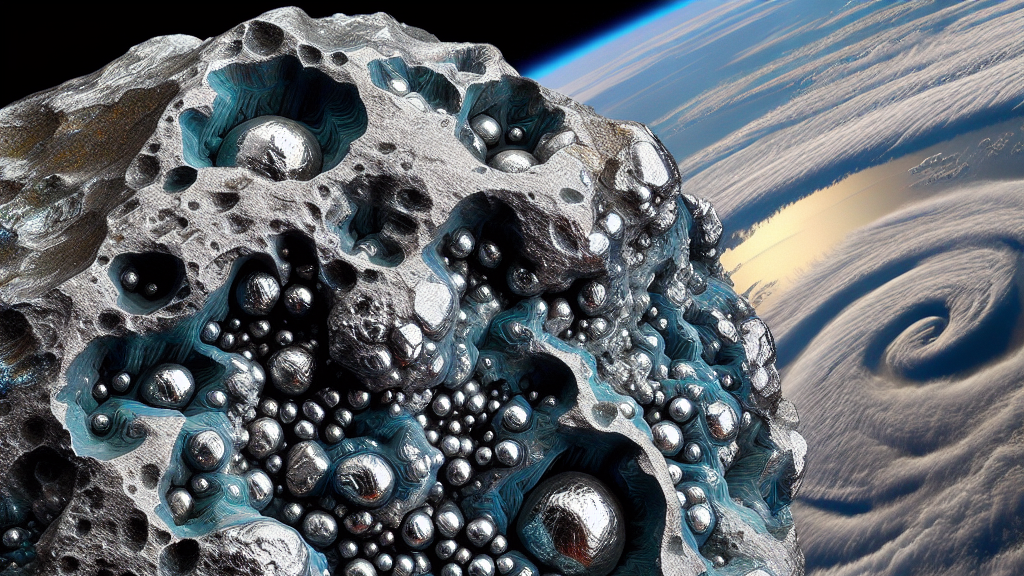
Imagine if the water that covers over 70% of our planet didn’t originate here. Recent discoveries are shaking up our understanding of Earth’s water supply, and the answer might be hidden within ordinary-looking meteorites that crash-landed from space!
Scientists have long puzzled over how Earth accumulated its hydrogen—essentially the building block of water. Until now, the enstatite chondrites, a group of meteorites closely resembling Earth’s early building materials, were considered unlikely hydrogen sources. But new findings utilizing advanced spectroscopy techniques have revealed that these meteorites contain much more hydrogen than we thought, cleverly hidden in specific mineral bonds.
So, why does this matter to you? Well, discovering that our planet’s water might have come from meteorites means rethinking Earth’s formation in a big way. Imagine future space exploration or resource extraction that could harness similar meteorites, potentially unlocking new water sources for space colonization. Who knew those rocky visitors from space could hold the secrets to Earth’s—and maybe humanity’s—future?
Enstatite chondrites, once thought to be ‘dry,’ may contain enough hydrogen to explain Earth’s water!
FAQs
How could meteorites like enstatite chondrites explain Earth’s water supply?
Research suggests enstatite chondrites, a type of meteorite, contain more hydrogen than previously believed. This could mean they delivered significant hydrogen to early Earth, potentially playing a key role in forming its water.
What makes hydrogen in enstatite chondrites special compared to other rocks?
Hydrogen in enstatite chondrites is bonded with sulfur, forming H-S bonds more commonly than in terrestrial rocks. This unique bonding suggests these meteorites may have systematically contributed to Earth’s hydrogen and water content over time.
How are scientists uncovering hydrogen’s presence in these meteorites?
Researchers use sulfur X-ray absorption near edge structure spectroscopy to detect hydrogen bonded with sulfur within enstatite chondrites. This method helps reveal the hidden hydrogen not detectable by traditional means.
What is pyrrhotite’s role in the hydrogen presence of enstatite chondrites?
Pyrrhotite, a mineral found in enstatite chondrites, can catalyze reactions that release hydrogen in the form of H2S gas during high-temperature conditions. This process increases the meteorite’s hydrogen content, potentially influencing Earth’s total hydrogen budget.
Why is understanding these hydrogen processes important for Earth’s history?
By revealing how enstatite chondrites might have contributed to Earth’s water, scientists can better understand the planet’s formation history and refine models of how terrestrial planets accumulate critical resources like water.
Background
The study revolves around understanding how hydrogen, an essential component of water, was incorporated into Earth’s early formation. Key to this is the role of enstatite chondrites, a type of meteorite believed to be part of Earth’s initial building blocks. These meteorites, initially thought to be almost devoid of hydrogen, are now found to contain significant amounts bonded with sulfur. This discovery was made possible through advanced spectroscopy techniques, which reveal the hidden chemical structures within these space rocks.
History
For a long time, researchers believed that Earth’s water came from icy comets or wet meteorites from the outer solar system. However, new studies show enstatite chondrites, previously considered dry, may contain hidden hydrogen. This revelation could redefine our theories on planetary formation and the early solar system, building on years of meteorite research and the study of Earth’s geochemical processes.
Based on “The Source of Hydrogen in Earth’s Building Blocks” by Thomas J Barrett (University of Oxford, Department of Earth Sciences), James F. J. Bryson (University of Oxford, Department of Earth Sciences), Kalotina Geraki (Diamond Light Source), available on arXiv (arxiv.org/abs/2406.13637), used under CC BY 4.0 (creativecommons.org/licenses/by/4.0/).
