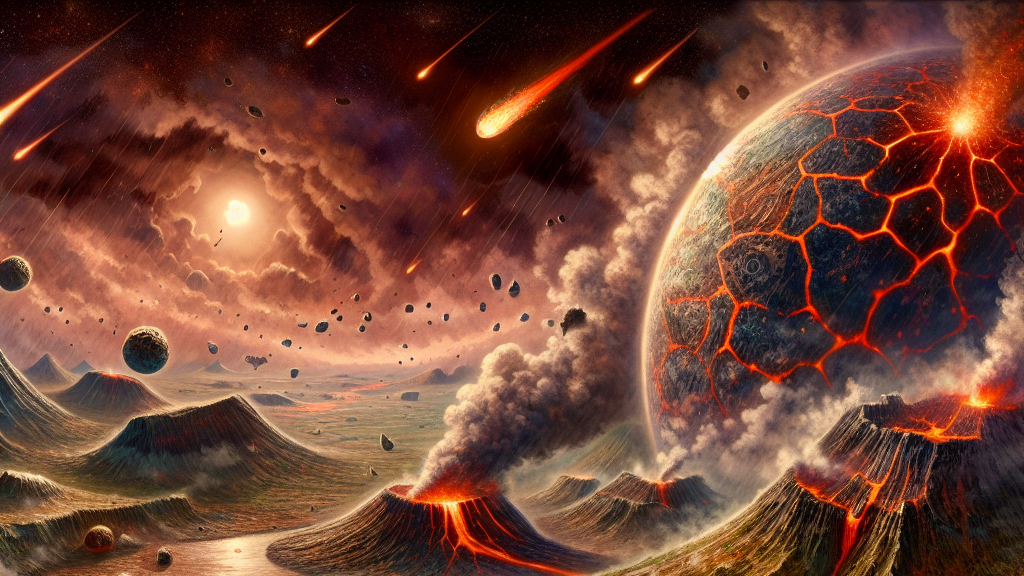
Imagine a time when Earth was a wild and untamed place, bombarded by space rocks and dominated by volcanic activity. Scientists are on a quest to understand if this chaotic environment during the Hadean eon was actually the perfect mix for life’s building blocks to form. This is no minor question—it’s about whether the origins of life as we know it were written into the very fabric of Earth’s early history.
The researchers are exploring processes like serpentinization and cosmic bombardment, which could have created a reducing atmosphere rich in hydrogen. This setting may have allowed for the photochemical production of hydrogen cyanide (HCN), a molecule that can snowball into forming nucleobases—parts of RNA crucial for life. By simulating early Earth’s conditions, they found that these molecules likely gathered in warm little ponds, creating a hotbed for life’s ingredients to mix and mingle.
But why should this matter to us today? Well, these findings suggest that Earth had the right conditions for life to spark not long after it cooled down. This means that the fundamental chemistry of life might not be as rare as we think! If these processes occurred here, it stands to reason they could happen elsewhere in the universe, altering our understanding of life’s potential beyond Earth.
Did you know? Hydrogen cyanide, which sounds deadly to us, might have been key to sparking life on early Earth!
FAQs
What makes the early Earth’s atmosphere important for understanding the origins of life?
The early Earth’s atmosphere could have been rich in reducing gases like hydrogen, thanks to processes like serpentinization and cosmic bombardment, allowing for the formation of key prebiotic molecules essential for life’s origins.
How does hydrogen cyanide contribute to the origin of life?
In early Earth conditions, hydrogen cyanide could have accumulated and interacted with other molecules to form nucleobases and sugars, vital components of RNA, which are critical to life.
Why are warm little ponds significant in this research?
Warm little ponds could have served as concentrated pools of prebiotic molecules, providing the necessary environment for crucial chemical reactions to occur, paving the way for the creation of life’s building blocks.
How long after Earth became habitable could life have started?
Life could have begun on Earth soon after it cooled down, roughly 100 million years after the Moon-forming impact, according to this study.
What are the implications of this research for finding life elsewhere in the universe?
Understanding how life’s ingredients formed on early Earth suggests similar processes could occur elsewhere, implying that life might be more common across the universe than previously thought.
Background
To understand the origins of life, scientists look back to a time known as the Hadean eon, when Earth was young and dynamic. Processes like serpentinization, involving rock-water reactions, and cosmic bombardment filled the atmosphere with gases like hydrogen. These conditions could lead to the formation of hydrogen cyanide, a precursor to life-building molecules like RNA.
History
Earlier studies have long speculated on how life’s basic ingredients formed on Earth. Serpentinization was known to create hydrogen, but determining the specific conditions that led to prebiotic molecule production has been an ongoing puzzle. Recent models combining atmospheric studies and geophysical processes have now provided new insights into these ancient conditions.
Based on “Deep Mantle-Atmosphere Coupling and Carbonaceous Bombardment: Options for Biomolecule Formation on an Oxidized Early Earth” by Klaus Paschek, Thomas K. Henning, Karan Molaverdikhani, Yoshinori Miyazaki, Ben K. D. Pearce, Ralph E. Pudritz, Dmitry A. Semenov, available on arXiv (arxiv.org/abs/2503.15479), used under CC BY 4.0 (creativecommons.org/licenses/by/4.0/).