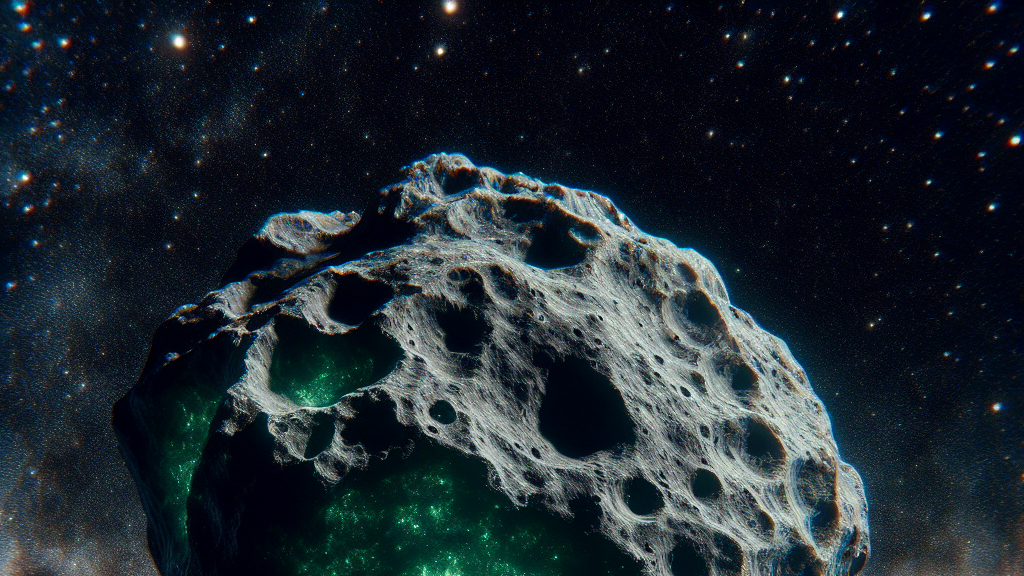
Have you ever wondered how life might have started on our planet? Imagine a giant space rock, traveling through the cosmos, carrying the very ingredients for life itself! That’s what scientists are exploring with the asteroid Ryugu. They’re discovering that space rocks could have delivered the building blocks of life to a young Earth, sparking the creation of all the diverse life we see today.
Researchers recently found some intriguing organic molecules on samples from Ryugu, an asteroid with a storied past. By analyzing this space traveler using advanced techniques, they’ve detected unique compounds that contain nitrogen and hydrogen. These mysterious molecules might have been formed in the icy depths of space and potentially landed on Earth, providing the raw materials for life to kick-start in our waters and soils billions of years ago.
Imagine the potential of these discoveries. If space rocks like Ryugu brought the seeds of life to our planet, they might also show us how life could develop on other planets. This is not just about understanding our past; it’s about imagining the future of life beyond Earth. Who knows, maybe one day we’ll find similar clues on Mars or even beyond our solar system, greatly expanding our understanding of life in the universe.
The asteroid Ryugu’s organic molecules are rich in nitrogen, a key element in amino acids, which are the building blocks of proteins found in all life on Earth!
FAQs
What are the NH-rich compounds found on the asteroid Ryugu?
Researchers have found NH-rich compounds in Ryugu’s samples, specifically in particle C0052, which contain nitrogen and hydrogen in amide-related forms, possibly forming from carboxylic acids and amines precursors or from the irradiation of ice in space.
Why is the discovery of NH-rich organic compounds on Ryugu important?
The discovery is crucial because it suggests that space rocks like Ryugu could have delivered essential ingredients for life’s origins on Earth, potentially initiating prebiotic chemistry that led to the development of life.
How could these compounds have arrived on Earth?
These NH-rich organic molecules could have traveled aboard space rocks like asteroids, landing on the early Earth and providing the necessary building blocks for life, thus playing a pivotal role in prebiotic chemistry.
What techniques did scientists use to study Ryugu’s samples?
Scientists used multi-scale infrared techniques (mm-reflectance, micro-FTIR, and nano-AFM-IR) and NanoSIMS to analyze Ryugu’s particles, revealing the unique NH-rich compounds and their potential origins and roles in early chemistry.
Could similar findings be made on other celestial bodies?
Yes, the discovery of these compounds on Ryugu opens the possibility of finding similar molecules on other asteroids or even Mars, which can provide insights into the potential for life elsewhere in the universe.
Background
The study of organic compounds in space involves looking at molecules that contain carbon and hydrogen, often along with other elements like nitrogen. These compounds could form in various cosmic environments and might play essential roles in the formation of life by serving as precursors to more complex molecules such as amino acids and proteins. Amides, specifically, are among these important compounds, as they form the backbone of proteins.
History
The interest in space-borne organic compounds dates back to the discovery of amino acids in meteorites, which suggested extraterrestrial sources for these life-building molecules. This new study focuses on samples from Ryugu, a near-Earth asteroid, building on previous findings and using advanced technology for even finer analysis, showing a continuous advancement in the understanding of how life’s building blocks might be widespread in the universe.
Based on “NH-rich organic compounds from the carbonaceous asteroid (162173) Ryugu: nanoscale spectral and isotopic characterizations” by L. G. Vacher, V. T. H. Phan, L. Bonal, M. Iskakova, O. Poch, P. Beck, E. Quirico, R. C. Ogliore, available on arXiv (arxiv.org/abs/2503.11471), used under CC BY 4.0 (creativecommons.org/licenses/by/4.0/).