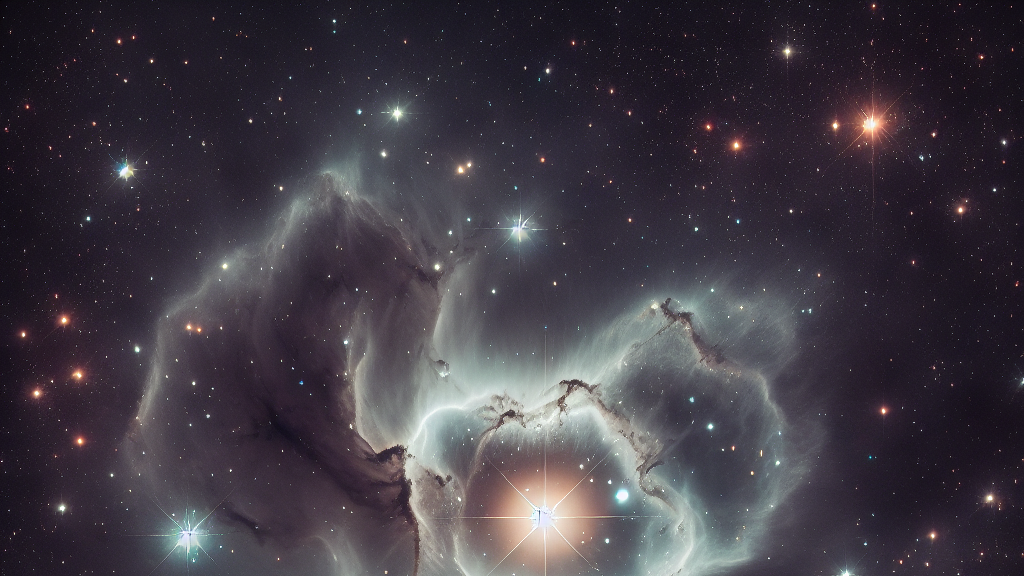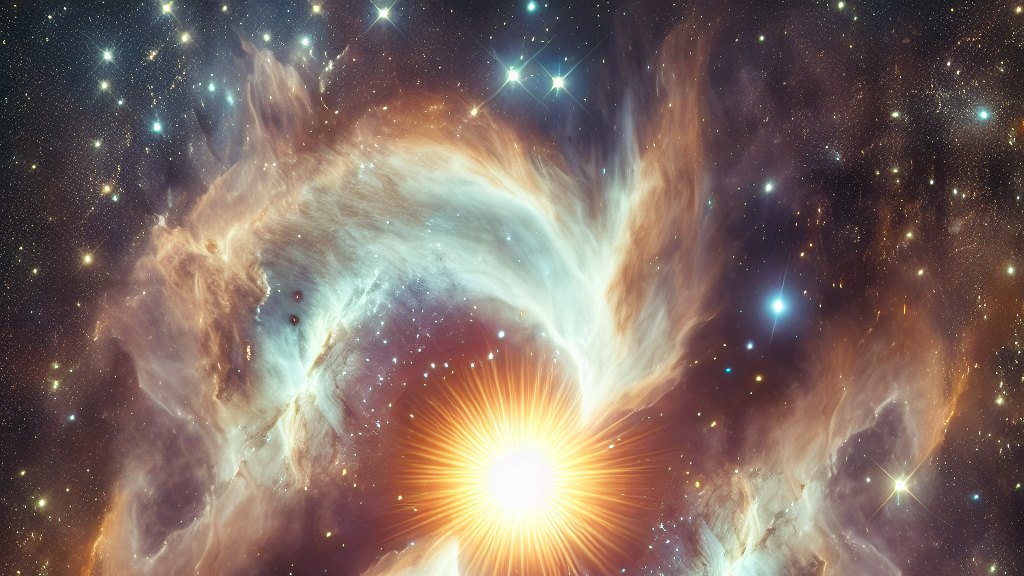
Imagine finding a star that holds secrets of past celestial explosions, seemingly quiet now but with signs pointing to a dramatic history. That’s exactly what’s puzzling astronomers about ASASSN-19ds, a star hiding in the constellation Antlia. It not only dims and brightens in a predictable eclipse pattern, but also displays a quirky ‘sawtooth’ light curve, making it an intriguing puzzle in the night sky.
Research reveals that ASASSN-19ds is a cataclysmic variable star, meaning it’s part of a binary system where one star ‘feeds’ off its neighbor. It’s classified as a Z Camelopardalis-type, known for its unique light variations. Adding to the mystery, deep space images have uncovered a faint nebula encircling the star, boasting a bipolar structure that suggests interaction with cosmic material. But what’s the origin? Was it created by a dramatic nova explosion, or is it the remnants of an ancient planetary nebula? The truth remains hidden, waiting to be unlocked by future observations.
This discovery is more than just an astronomical curiosity; it has the power to captivate sky watchers and scientists alike, inviting us to imagine a time when a nova eruption might have lit up the night sky. With the star situated relatively close in cosmic terms, any past explosion would have been visible to the naked eye, sparking wonder across the globe. Researchers are eager for more clues to piece together this cosmic mystery and perhaps predict future spectacles above us.
If ASASSN-19ds had erupted in a nova event centuries ago, it would have been visible without any telescopes!
FAQs
What is the ASASSN-19ds star, and why is it special?
ASASSN-19ds is a variable star surrounded by a faint nebula, which hints at a possible explosive past, making it particularly intriguing for astronomers.
Why is the light from ASASSN-19ds star so unusual?
The star exhibits a ‘sawtooth’ light curve that varies every few weeks, alongside its regular dimming and brightening, classifying it as a Z Camelopardalis-type cataclysmic variable.
Could the nebula around ASASSN-19ds be from a nova explosion?
It’s possible; the nebula’s structure suggests it could be the aftermath of a nova explosion or an ancient planetary nebula, but more observations are needed to confirm its origin.
What would have happened if ASASSN-19ds experienced a nova eruption?
Such an eruption would have been so bright that it could be seen with the naked eye from Earth, making it a dazzling spectacle.
How far away is the ASASSN-19ds star?
The star is approximately 557 parsecs from Earth, which is considered relatively close in astronomical terms.
Background
In astronomy, a variable star is one whose brightness as seen from Earth fluctuates over time. ASASSN-19ds is a particular type of variable star known as a cataclysmic variable, where two stars orbit each other with one star accreting material from its companion. The study of these stars can reveal important information about stellar evolution and the nature of explosive events in space.
History
The exploration of variable stars has a rich history. Cataclysmic variables have been of interest since the early 20th century, with key discoveries leading to a better understanding of binary star systems and the mechanics of mass transfer between stars. Z Camelopardalis stars, in particular, are noted for their unique light variations, famously showing sudden luminosity changes. The discovery of ASASSN-19ds adds another layer to this growing field of stellar phenomena, as it showcases both unusual light patterns and a surrounding nebula that hints at a potentially explosive past.
Based on “Discovery of Faint Nebulosity Around a Z Camelopardalis-type Cataclysmic Variable in Antlia: Nova Shell or Ancient Planetary Nebula?” by Howard E. Bond (Penn State University, STScI), Dana Patchick (Deep Sky Hunters Consortium), Daniel Stern (MEA Observatory), Jonathan Talbot (Stark Bayou Observatory), John R. Thorstensen (Dartmouth), available on arXiv (arxiv.org/abs/2506.11306), used under CC BY 4.0 (creativecommons.org/licenses/by/4.0/).