





































































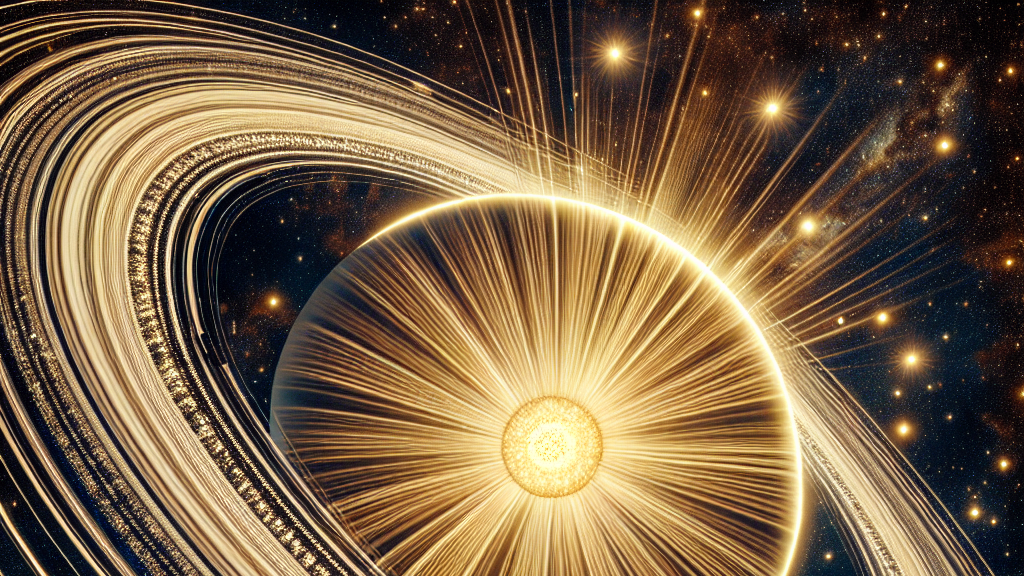
Have you ever looked up at the night sky and marveled at the rings around planets like Saturn? These rings aren’t just floating there by luck; they’re in a cosmic dance, influenced by the sun and their orbit around their host planet. It’s like a perfectly choreographed ballet where the dancers (the ring particles) follow the light of the sun as it sets the rhythm of the dance.
In a recent study, scientists explored why some space objects, like the Centaur Chariklo and the dwarf planet Haumea, have rings while others do not. It turns out, the key lies in the tilt of the rings and the size of the particles making them up. Using high-tech simulations that are like something out of a sci-fi movie, researchers found that slightly tilted rings are unstable if their particles are too small, while highly tilted rings can be stable or unstable depending on the particle size—like a cosmic balancing act!
Imagine in the future harnessing this unique behavior of ring systems for space technologies. For example, designers of satellites or space stations could model their positioning and movement after the stable rings, ensuring they remain perfectly attuned to the sun’s influence. As humans venture further into space, understanding these dances could make our journeys safer and more efficient, with technology that mimics the natural elegance of nature’s designs.
The rings’ planes can rotate like a sunflower that always turns to face the sun!
FAQs
Why do some planets, like Saturn, have rings while others do not?
Rings form around some planets due to the specific dynamics between the planet’s gravity, particle size, and the angle of the rings. The stability of these rings is influenced by their tilt and how they interact with solar radiation.
How do solar radiation and tilt angles affect planetary rings?
Solar radiation can destabilize planetary rings, especially when the particles are at certain sizes and tilt angles. Highly tilted rings can rotate to always face the sun, stabilizing in a way that resembles a sunflower following sunlight.
What practical applications could come from understanding planetary rings?
This research could inspire new technologies in space travel, helping to design satellites or space stations that align with the sun for stability, drawing lessons from these natural celestial configurations.
Can rings exist around objects other than planets, like asteroids or dwarf planets?
Yes, rings can form around a variety of celestial bodies, including dwarf planets like Haumea and centaur objects like Chariklo, depending on the conditions similar to those affecting planetary rings.
What did this study use to explore the behavior of these rings?
Researchers used a GPU-based N-body integrator with an 8th-order Hermite scheme to simulate the dynamics of rings over thousands of years, allowing them to observe the long-term effects of gravity and solar radiation.
Background
In our solar system, giant planets commonly have rings; these are collections of ice, rock, and dust particles held together by the planet’s gravity. The stability of these rings can be affected by several factors, including solar radiation pressure, which pushes on the particles, and the tilt of the rings relative to the planet’s orbit. A critical aspect is understanding how differences in particle size and angle of tilt can either stabilize or destabilize these rings.
History
Planetary rings have fascinated scientists and astronomers for centuries, with discoveries initially focused on Saturn’s prominent rings. As telescopic technology improved, we discovered that other planets like Jupiter, Uranus, and Neptune also possess ring systems. More recent advancements have identified rings around smaller celestial bodies, such as the dwarf planet Haumea. This study builds on previous work by focusing on the less understood dynamics of rings around these smaller objects, investigating how various factors contribute to their formation and persistence.
Based on “Celestial sunflowers — Survival of rings around small planetary bodies under solar radiation pressure” by Zs. Regály, V. Fröhlich, Cs. Kiss, available on arXiv (arxiv.org/abs/2503.17218), used under CC BY 4.0 (creativecommons.org/licenses/by/4.0/).
