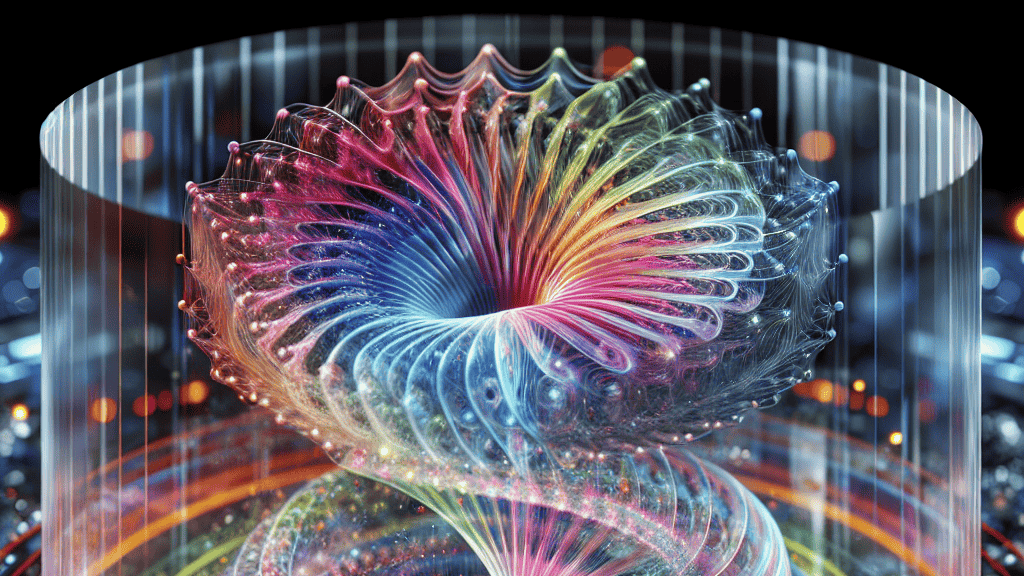
**Imagine a world where the flow of information is as dynamic and intricate as a swirling vortex.** That’s the kind of future scientists are envisioning with the discovery of high-dimensional vortex structures. These complex formations go beyond the usual two-dimensional vortices you might see in smoke rings or whirlpools, reaching into three, four, or even more dimensions, potentially transforming how we process and control information. This means we could soon have photonic devices that can handle vast amounts of data more efficiently than ever before. It’s not just science fiction; it’s happening now in cutting-edge labs around the globe.
High-dimensional vortex structures are formed by controlling the interactions in special optical cavities. Imagine layers of different materials stacked in such a way that light waves bounce around inside, creating intricate patterns. These patterns aren’t just pretty—they’re topological, meaning they’re stable and can handle disturbances without falling apart. This makes them perfect for robust information processing systems where reliability is key. Researchers have proven their existence by using optical techniques to visualize these structures, which they found could exist in three dimensions or beyond.
Picture this: a future smartphone or computer that can process data at unprecedented speeds thanks to these vortex sheets. They’d not only enhance the performance but also open up new ways of controlling devices, potentially revolutionizing everything from weather forecasting to virtual reality experiences. By manipulating light in such advanced ways, these optical devices could serve as the backbone for next-generation technology, improving how efficiently we handle data and manage turbulent systems in real life.
High-dimensional vortex structures can handle disturbances without losing their information processing capabilities, making them incredibly robust.
FAQs
What unexpected discovery did scientists make?
Scientists discovered high-dimensional vortex structures, which can exist in three, four dimensions, or more, greatly enhancing the potential for data processing and control.
How do these vortex structures form?
These vortex structures form within optical cavities using layered materials that create topological patterns of light interactions across multiple dimensions.
Why are these structures important for technology?
They are highly stable and can manage immense amounts of data efficiently, making them ideal for future photonic devices and various technological advancements.
What are optical vortex sheets?
Optical vortex sheets are a type of high-dimensional vortex structure found in four dimensions, allowing for programmable dynamics in real-world applications.
How might this research impact daily life?
By improving data processing and turbulence control, this research could lead to faster computers, better weather predictions, and more immersive virtual experiences.
Background
The study focuses on vortical structures, which are patterns that occur in fluids (like whirlpools) or optical fields, now extended into higher dimensions. These structures leverage topological properties, meaning they maintain stability and integrity despite external changes, crucial for advanced information processing systems.
History
Topological photonics, the field this research belongs to, evolved from earlier discoveries in topological physics. Initially focused on two-dimensional systems, advances in materials science and optical technologies have allowed scientists to explore and manipulate vortices in higher dimensions, building upon previous breakthroughs in wave interference and electromagnetic field interactions.
Based on “Dynamic realization of emergent high-dimensional optical vortices” by Dongha Kim, Geonhyeong Park, Yun-Seok Choi, Arthur Baucour, Jisung Hwang, Sanghyeok Park, Hee Seong Yun, Jonghwa Shin, Haiwen Wang, Shanhui Fan, Dong Ki Yoon, Min-Kyo Seo, available on arXiv (arxiv.org/abs/2501.01550), used under CC BY 4.0 (creativecommons.org/licenses/by/4.0/).