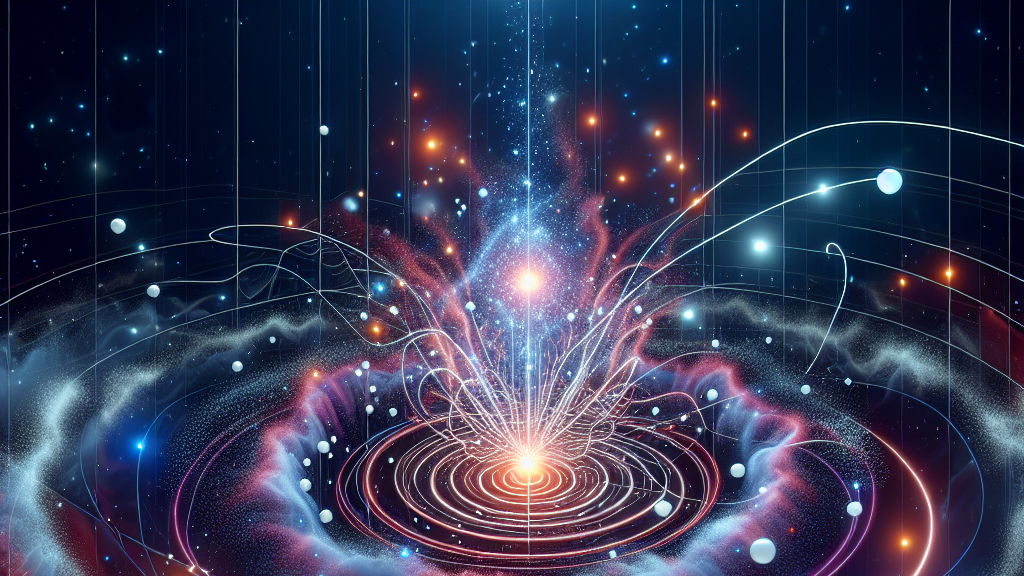
Imagine if the mysterious Dark Matter, the elusive substance making up most of our universe, was hidden in something as familiar as waves. Yes, the same kind of energy that ripples through water or sound might be holding the secrets of the cosmos. Researchers are delving into the potential of these waves, specifically bi-frequency solitary waves, to help us understand the grande mysteries of the universe.
Bi-frequency solitary waves exist in special systems known as fermionic systems, where particles interact in a unique way. By looking at systems like the Dirac-Klein-Gordon system and the Soler model, scientists discovered these waves could remain stable, meaning they don’t just fizzle out. This stability is crucial because it suggests these waves can store energy or matter, maybe even the mysterious Dark Matter itself.
If proven right, this research could revolutionize our understanding of Dark Matter. Imagine future technologies that could harness these waves, allowing us to trap or observe Dark Matter. It’s a thrilling thought that these invisible waves visibly affect our universe, potentially changing our grasp of physics and technology for good.
Did you know that Dark Matter makes up about 27% of the universe, yet we have never seen it?
FAQs
What unexpected discovery did scientists make?
They found stable bi-frequency solitary waves in fermionic systems, which might store Dark Matter.
How could this research affect our understanding of the universe?
If these waves can hold Dark Matter, it would revolutionize our understanding of its role in the universe.
What are fermionic systems?
They are systems where particles interact through scalar self-interactions, like in the Dirac-Klein-Gordon and Soler models.
Why is the stability of these waves important?
Stable waves could hold energy or matter like Dark Matter without dissipating, making them crucial for new scientific insights.
Could this lead to new technology?
Yes, it could lead to technologies that trap or use Dark Matter, potentially transforming physics and technology fields.
Background
In the realm of theoretical physics, fermionic systems involve particles like fermions interacting with each other, often through scalar interactions. The Dirac-Klein-Gordon system and the Soler model describe how these particles behave and interact mathematically. Bi-frequency solitary waves refer to waves with two frequencies that remain coherent and stable, a rare property in such systems.
History
Research in fermionic systems has long aimed to understand fundamental particles and interactions. The Dirac-Klein-Gordon system is a cornerstone in studying particle dynamics, while the Soler model offers frameworks for describing particle interactions with fields. Building on these foundations, the current study integrates wave stability, proposing new roles for Dark Matter.
Based on “Stable bi-frequency spinor modes as Dark Matter candidates” by Andrew Comech, Niranjana Kulkarni, Nabile Boussaïd, Jesús Cuevas-Maraver, available on arXiv (arxiv.org/abs/2501.04027), used under CC BY 4.0 (creativecommons.org/licenses/by/4.0/).