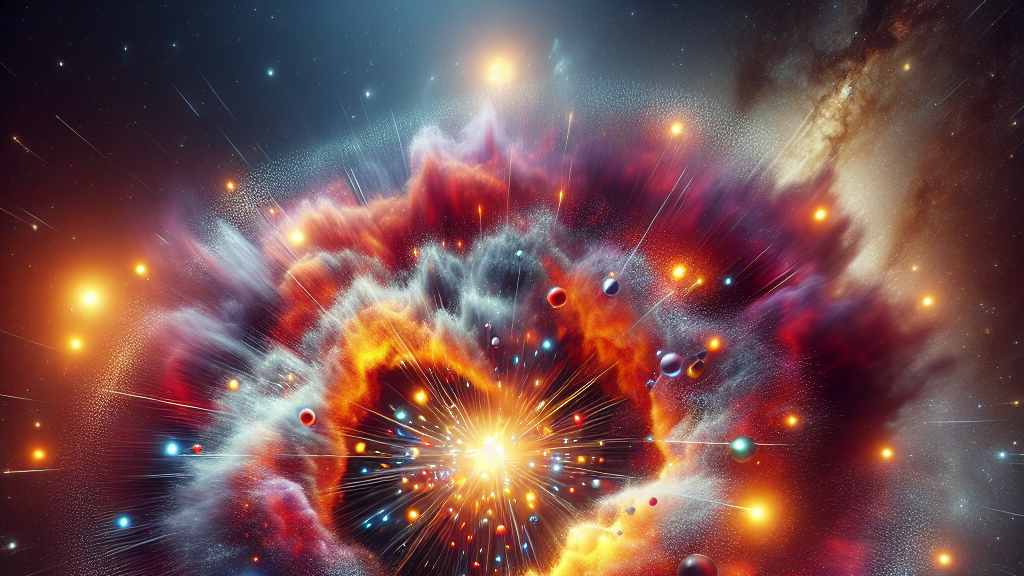
Imagine a cosmic event so powerful and mysterious that it could hold the secrets to the very nature of our universe! This is what scientists are probing with cosmic reheating, a phase where the universe’s energy was redistributed into known matter after the Big Bang. It’s like figuring out how the leftovers from a cosmic fireworks show became the ingredients for everything we know today.
Researchers are zeroing in on how energy from a particle called the inflaton, set the stage for the universe’s ‘standard model’ particles—the building blocks of everything from stars to us. But it doesn’t end there; they’re also digging into dark matter’s origins, the invisible glue that holds galaxies together. By studying how it might have formed during this fiery cosmic reheating period, scientists are unraveling its secrets using a new framework that accounts for various cosmic scenarios and constraints from cosmic microwave background observations.
Why does this matter to us, you might wonder? Well, understanding dark matter isn’t just an esoteric quest; it could revolutionize everything we know about space, time, and matter. Think of future technologies powered by this elusive substance or new ways of observing the universe thanks to these discoveries. As scientists continue to piece together this cosmic puzzle, we inch closer to understanding the universe’s grand designs and how we fit into its celestial architecture.
Dark matter makes up about 27% of the universe, yet it doesn’t emit, absorb, or reflect light, making it visible only through its gravitational effects.
FAQs
What unexpected discovery did scientists make?
Scientists found that the way dark matter forms might be heavily influenced by cosmic reheating, which occurs when energy is distributed post-Big Bang.
Why is cosmic reheating important?
Cosmic reheating explains how the universe’s energy transformed into particles we know and sets the stage for dark matter formation.
How does this affect our understanding of the universe?
This research could redefine our knowledge of dark matter creation, offering new insights into the universe’s composition and history.
What role does the inflaton play in this process?
The inflaton is believed to redistribute energy across the universe during reheating, playing a crucial role in forming both standard model particles and dark matter.
Are there practical uses for dark matter research?
Though primarily theoretical, understanding dark matter could lead to technological innovations and deeper insights into cosmic laws affecting future scientific advancements.
Background
Cosmic reheating is a period following the Big Bang where the universe suddenly expands and cools, redistributing energy stored in a particle called the inflaton into other particles that form the universe’s ‘standard model’ thermal bath. This process is critical in setting the conditions for dark matter formation, which remains one of modern physics’ great mysteries.
History
Previous studies have established that inflaton particles and their decay played a significant role in cosmic reheating and dark matter formation. However, past models often focused on specific cases. This research builds on these foundations by presenting a generalized framework, exploring multiple scenarios, and incorporating constraints from cosmic microwave background data to expand our understanding of the universe’s developmental stages.
Based on “Dark Matter Ultraviolet Freeze-in in General Reheating Scenarios” by Nicolás Bernal, Kuldeep Deka, Marta Losada, available on arXiv (arxiv.org/abs/2501.04774), used under CC BY 4.0 (creativecommons.org/licenses/by/4.0/).