Connect with us

Search by keyword

Physics

Can Spacetime Lead to a New Physics Breakthrough?

This research explores a new way to think about the fabric of our universe, revealing potential connections to fundamental forces and particles. By understanding how complex spaces relate to the real-world symmetries we see, we might unlock unexpected insights into the workings of the universe.

Can Spacetime Lead to a New Physics Breakthrough
✨Researched by humans. Explained by robots. Learn more.

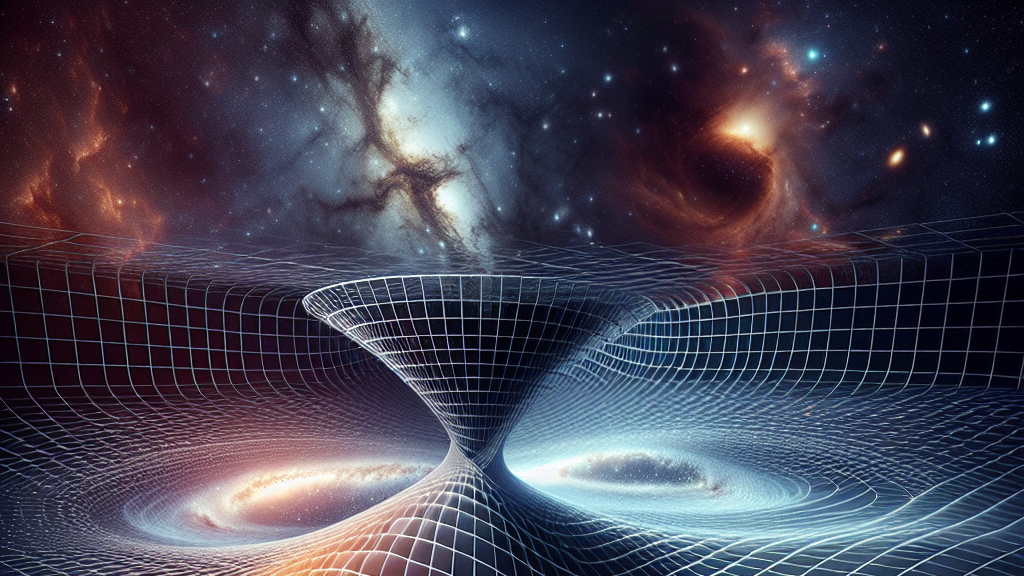
Imagine if the universe had a hidden layer, a secret code that holds the key to everything from gravity to the tiniest particles. That’s what this research explores: how the universe’s symmetry, like a dance of nature’s particles and forces, might have roots in a deeper, more complex space.

The study looks at spacetime as part of a larger, complex fabric. When viewed in this way, the usual rules of symmetry that apply to the universe’s structure don’t perfectly align. However, by introducing a unique mathematical structure called spin, a familiar picture emerges, resembling the standard model of particle physics, hinting at new ways these fundamental rules might connect to a larger, unseen whole.

In simple terms, this could one day change how we understand basic forces like gravity or electromagnetism, leading to breakthroughs in quantum technology or even new ways to think about the universe’s building blocks. Just like discovering a hidden bridge between two lands, this research might guide us to new shores in the realm of physics.

Did you know? The symmetries of spacetime might actually be hiding a deeper structure that’s key to understanding the universe!

FAQs

How does this research redefine our understanding of spacetime?

This research suggests that spacetime might be part of a larger, more complex structure, which could change how we understand fundamental forces and particles in the universe.

What are spinors and why are they important?

Spinors are mathematical objects used to describe particles like electrons. In this research, they help connect complex spaces to familiar physical concepts, potentially revealing new physics.

How could this research impact future technology?

By offering new insights into quantum mechanics and fundamental forces, this research could pave the way for breakthroughs in quantum technology and a deeper understanding of the universe’s fabric.

Background

The study of symmetries in physics often involves complex mathematical structures. In this context, spacetime symmetries, which dictate the laws governing our universe, are considered within a framework known as the Poincaré group. When seen through the lens of a complex manifold, a mathematical concept referring to higher-dimensional spaces, the usual representation of these symmetries doesn’t fit perfectly. However, by using a concept called spin structure, which is crucial in describing particles like electrons, researchers can find a more comprehensive description that aligns with known physics.

History

The search for a unified understanding of the universe’s fundamental forces has a rich history, stretching back to Einstein’s work on relativity and further refined by the development of quantum mechanics. The standard model of particle physics emerged as a framework to describe these forces and particles. This research builds on that legacy by suggesting that the underlying symmetries of the universe might be part of a larger, more complex structure, potentially offering new insights into the universe’s fundamental nature.

Based on “Complex hidden symmetries in real spacetime and their algebraic structures” by R. Vilela Mendes, available on arXiv (arxiv.org/abs/2501.12960), used under CC BY 4.0 (creativecommons.org/licenses/by/4.0/).


Trending

Latest

Can AI Save Water Discover How

Computers

AI is transforming the tech world, but it uses lots of water! A new tool, SCARF, helps us measure and reduce AI's water footprint,...

Whats a Forbush Decrease and Why Should We Care Whats a Forbush Decrease and Why Should We Care

Space

Scientists just observed the biggest solar storm event in years, revealing unexpected cosmic ray patterns. Understanding these changes could help us protect our technology...

Can Cars Spot Danger Faster Than Humans Can Cars Spot Danger Faster Than Humans

Computers

Think about how quickly you react when something unexpected happens on the road. This research brings us closer to creating self-driving cars that can...

Can Fear of the Other Stop Social Harmony Can Fear of the Other Stop Social Harmony

Physics

Fear of the unknown might make it harder for people to agree and get along. This study shows that when people have strong xenophobic...

Can AI Revolutionize Breast Cancer Diagnosis Can AI Revolutionize Breast Cancer Diagnosis

Electricity

This research introduces a groundbreaking AI model that can accurately assess HER2-positive breast cancer using widely accessible staining methods, potentially revolutionizing how we diagnose...

Can AI Transform Your Singing into a Choir Can AI Transform Your Singing into a Choir

Computers

Imagine singing solo and having AI turn you into a choir. This research unveils a groundbreaking AI tool that transforms your voice into rich...

You May Also Like

General Relativity and Quantum Cosmology

This study explores the possible fate of our universe—revealing that under certain conditions, it might one day collapse into a Big Bang-like singularity or...

Physics

Scientists are on a mission to discover if ghost-like particles called neutrinos could reveal astonishing insights about the universe. Using cutting-edge technology, they searched...

Physics

Scientists are exploring a mind-boggling idea: what if some neutrons decay into unknown particles that could reveal secrets about our universe? This research might...

General Relativity and Quantum Cosmology

Scientists are finding that black holes might not be the simple, spherical giants we once thought—they could have fractal edges, with surprising effects on...

Physics

This research digs into the mysterious boundary separating our everyday classical world from the weird quantum realm, exploring if this divide could be at...

Math

The study reveals that even the tiniest change in magnetic symmetry can drastically influence how magnetic forces are distributed, highlighting a surprising sensitivity in...

Physics

Is our universe truly curved, or could it be flat with a twist? This debate could reshape our understanding of reality, sparking curiosity about...

Physics

This study explores the groundbreaking idea that tiny particles called neutrinos, known for being neutral, might actually carry tiny electric charges. If proven true,...

Physics

Discover how understanding symmetry can revolutionize quantum physics, potentially unlocking new technological advancements that affect our daily lives.

Copyright © 2024 8ig8rain.

Disclaimer: The content on 8ig8rain.com consists of AI-generated summaries of scientific abstracts from arXiv. Please note that most arXiv abstracts are preprints and may not have undergone formal peer review. While these summaries aim to convey key ideas and potential applications, they are provided for informational purposes only and should not be interpreted as validated scientific findings or professional advice. The summaries are intended to educate, spark curiosity, and inspire further exploration of science.