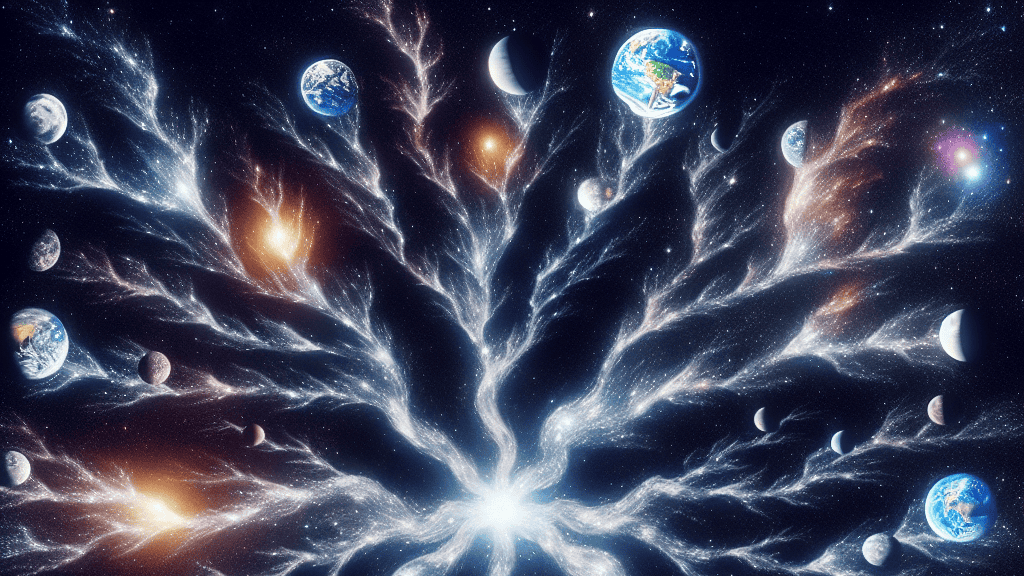
Picture this: every decision you make creates a new universe. Yes, that’s right—an entirely different world where the path not taken gets to play out. It’s a mind-boggling concept called the multiverse, and it’s not just for science fiction anymore. Scientists are delving into how quantum mechanics might actually support this idea, and the implications could change the way we understand reality itself.
The research tackles a fascinating idea present in the Everett interpretation of quantum mechanics. It proposes that multiple universes emerge through a process known as decoherence. Decoherence is like a cosmic filter: it helps explain how the classical world we live in emerges from the quantum world, where particles can be in multiple states at once. By pinning down decoherence as the mechanism for this emergence, the researchers clarify some complex metaphysical debates about the nature of reality.
Imagine the impact on our daily lives if this multiverse model is correct. For instance, it could change the way we think about fate and destiny. If every choice creates a new world, are we truly in control, or are we simply one version of ourselves in a vast array of possibilities? Such questions could inspire new ways of living, emphasizing the power and responsibility each decision holds.
Did you know? According to the multiverse theory, there’s potentially a universe out there where you are a president or a famous rock star!
FAQs
What is the multiverse in quantum mechanics?
The multiverse is a concept where every possible outcome of a quantum event happens, creating multiple and parallel universes for each possibility.
How does decoherence relate to the multiverse?
Decoherence is the process that explains the transition from the quantum world, where particles exist in multiple states, to our classical reality, effectively allowing the existence of multiple universes.
Why is the Everett interpretation significant?
The Everett interpretation offers a framework for understanding how a multiverse can logically emerge from the rules of quantum mechanics, challenging traditional views of a singular universe.
Background
To grasp this study, we need to understand some key quantum concepts. Quantum mechanics deals with particles acting in mysterious ways; they can exist in multiple states at once, a phenomenon famously exemplified by Schrödinger’s cat thought experiment. The Everett interpretation, or many-worlds interpretation, posits that these different states occur in separate, parallel universes—hence, a multiverse. Decoherence is the term used to describe how these quantum states become distinct realities, making the multiverse concept more than just a theoretical idea.
History
The notion of a multiverse has fascinated thinkers for years, from philosophical musings to sci-fi plots. However, it took quantum mechanics to bring this idea into scientific discourse. Hugh Everett’s theory posits that all possible outcomes of a quantum event occur, each in its own separate universe. This has sparked debates and further scrutiny, such as the critiques addressed in this study, which aim to solidify the multiverse as a viable interpretation of quantum phenomena.
Based on “Incoherent? No, Just Decoherent: How Quantum Many Worlds Emerge” by Alexander Franklin, available on arXiv (arxiv.org/abs/2501.16020), used under CC BY 4.0 (creativecommons.org/licenses/by/4.0/).