Imagine a force that’s quietly shaping the entire universe, but we can’t see it. That’s the enigma of dark matter, a mysterious component thought to hold galaxies together, affect their rotation speeds, and even bend light around them. But what if the way we understand gravity could explain all of this? Enter a new theory that tweaks our traditional ideas about gravity by adding something called the energy-momentum squared term.
This scientific exploration played with the basic idea of gravity by adding an extra bit—the energy-momentum squared term—to see if it could account for the effects of dark matter. Researchers focused on galaxies, observing their rotation speeds and how light behaves when it passes by them. What they found was exciting: this modified gravity theory might explain why galaxies spin the way they do, with a consistent speed at their edges, known as a flat rotation curve. Moreover, it even predicts how light bends around these massive cosmic structures.
Think about it this way: If we could replace our mysterious dark matter wildcard with a new understanding of gravity, we could potentially revolutionize our view of the universe. Imagine technology that might harness this understanding to predict cosmic events or develop new ways to explore space. These future possibilities could redefine our place among the stars, making intergalactic travel more feasible and unlocking secrets of the cosmos that were once the stuff of science fiction.
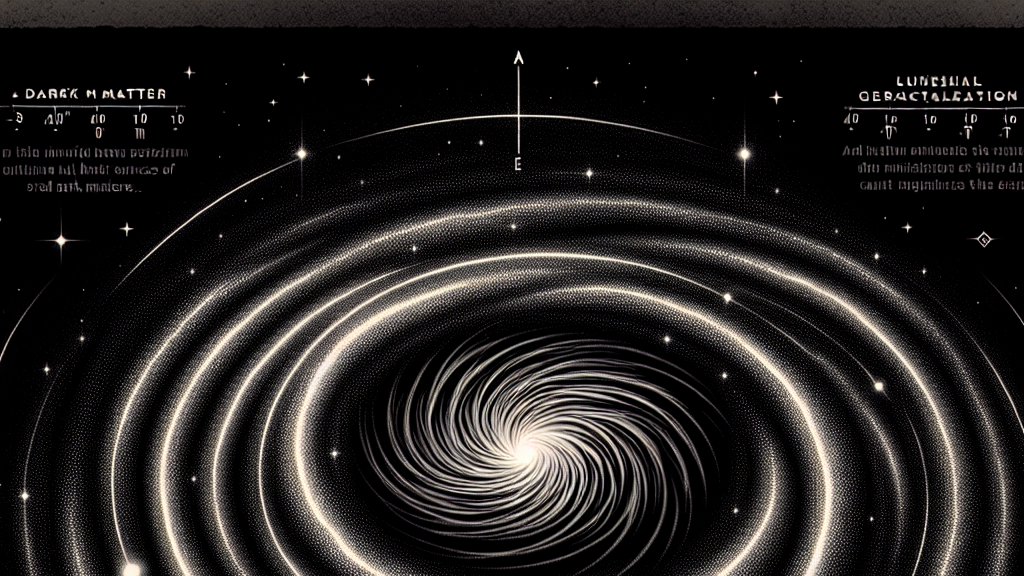
Flat rotation curves in galaxies hint at more mass than we can see, revealing the dark matter mystery!
FAQs
What is the energy-momentum squared modified theory of gravity?
This theory adds a special term to our usual ideas about gravity, aiming to better explain cosmic phenomena like dark matter’s effects on galaxy rotation and light deflection.
How does this theory explain a galaxy’s flat rotation curve?
By incorporating the energy-momentum squared term, the theory predicts galaxies maintain a nearly constant spin speed at their edges, matching observations of flat rotation curves attributed to dark matter.
Can this modified gravity theory explain light deflection and radar echo delay?
Yes, the theory suggests that by altering the gravitational field, it can impact both how light bends around massive objects and the time it takes for radar signals to bounce back, aligning with observed data.
Does this mean we no longer need dark matter to explain cosmic phenomena?
While intriguing, more testing and observation are needed. This theory offers a potential explanation but doesn’t yet replace the need for dark matter in our current models.
Could this theory lead to new technology or discoveries?
Understanding and applying this theory could lead to breakthroughs in space exploration, offering new methods to observe and interact with the universe.
Background
The study focuses on modifying our understanding of gravity with an added term called energy-momentum squared. Gravity traditionally is explained by equations that describe how massive things, like planets and stars, pull on each other. Dark matter has been a mystery because we see its effects but not the stuff itself. This new theory seeks to explain those effects, particularly in how galaxies spin and light bends, using a refined version of gravity.
History
For years, scientists have been puzzled by the fact that stars on the outer edges of galaxies move faster than expected, leading to the dark matter theory. This theory was born out of necessity, trying to account for the unseen mass that seemed to be driving these motions. While general relativity has been our best guide for understanding gravity, deviations at cosmic scales have called for new ideas like the energy-momentum squared modification to be tested.
Based on “Dark Matter and Energy-Momentum Squared Gravity” by H. R. Fazlollahi, H. Velten, H. Shojaie, available on arXiv (arxiv.org/abs/2501.19141), used under CC BY 4.0 (creativecommons.org/licenses/by/4.0/).