Connect with us

Search by keyword

Space

Can Space Dust Spread Life Across Galaxies?

This study explores how tiny space dust grains might escape a planet’s grip and travel through the cosmos, potentially carrying life to other star systems. If true, this could mean life isn’t just on Earth but could spread across galaxies!

Can Space Dust Spread Life Across Galaxies
✨Researched by humans. Explained by robots. Learn more.

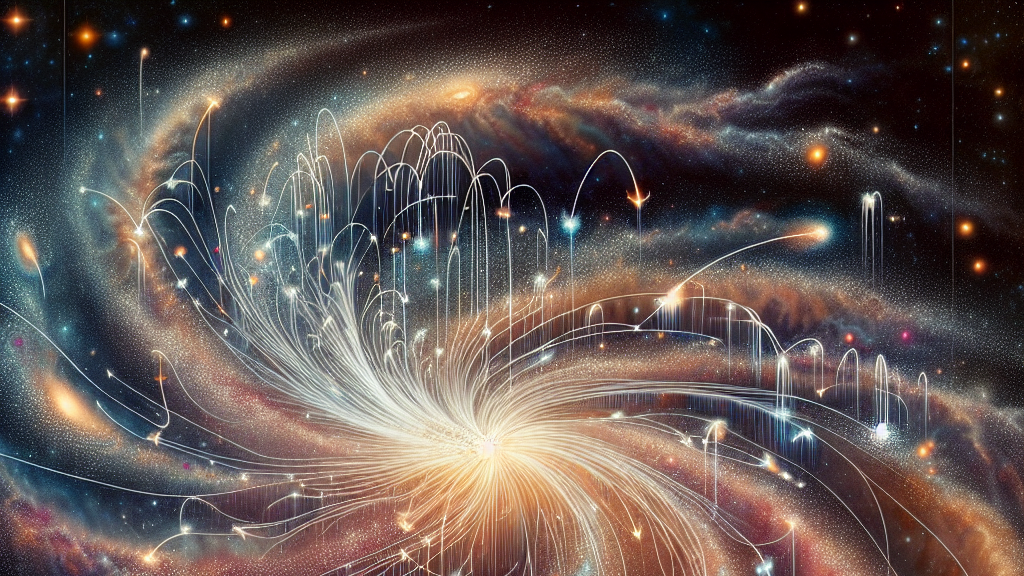
Imagine if tiny particles of dust from a planet could escape its gravitational pull and fly across the universe, potentially carrying the seeds of life with them. That’s precisely what this new research suggests is possible. These dust grains, pushed by the radiation from stars, might spread across the galaxy, participating in a process known as panspermia, where life could potentially spread from one planet to another.

The researchers looked at how dust grains, often no larger than a speck of sand, can be propelled by the light emitted by stars. These grains could travel through space over billions of years, possibly reaching tens of thousands of new star systems. If some grains happen to carry tiny organisms or the building blocks of life, they could essentially distribute life throughout the galaxy.

One incredible possibility of this research is the thought that life on Earth may not have originated here but could have come from a distant planet via these traveling space dust particles. Imagine future missions collecting samples of this cosmic dust that could potentially hold life’s building blocks. It’s a mind-boggling concept that makes us rethink the origins of life and the vast, interconnected nature of the universe.

Did you know that space dust grains can travel light years, potentially spreading life across galaxies?

FAQs

How can planetary dust particles escape a planet’s gravity?

Planetary dust particles can escape a planet’s gravity when they are small enough to be propelled by the radiation pressure from a star, similar to when sunlight pushes particles away.

What is panspermia and how does it relate to space dust?

Panspermia is a hypothesis that suggests life can spread across the universe via space dust, meteorites, or other celestial bodies. The study proposes that radiation pressure could propel dust grains carrying life forms from one star system to another.

Why is spreading life through galaxies important to study?

Studying the spread of life through galaxies can help us understand the potential origins of life on Earth, the possibility of life elsewhere in the universe, and the interconnected nature of cosmic ecosystems.

What role does radiation pressure play in this research?

Radiation pressure is the force exerted by light from a star. It can push small particles, like dust, away from the star, potentially allowing them to travel vast distances across space and spread life.

Could this research change our understanding of life in the universe?

Yes! It suggests that life might not be unique to Earth and could be more widespread, potentially altering our perspective on life’s existence and distribution in the universe.

Background

The study is based on the idea of panspermia, a hypothesis in which life exists throughout the universe and is distributed by space dust, meteoroids, and other celestial bodies. Here, the focus is on how small dust particles, which are influenced by forces such as gravity and radiation pressure (the force exerted by light), might be able to escape a planet’s gravity and travel across space.

History

The concept of panspermia has been around for centuries, with notable scientists like Svante Arrhenius in the early 20th century contributing to its development. Interest in how cosmic events and processes might spread life gained further traction with advancements in space exploration and the discovery of extremophiles—organisms that can survive harsh environments. This study builds upon the idea that dust particles, driven by radiation pressure, could be a vehicle for this distribution.

Based on “The possibility for panspermia in the galaxy by means of planetary dust grains” by Z. N. Osmanov, available on arXiv (arxiv.org/abs/2402.04990), used under CC BY 4.0 (creativecommons.org/licenses/by/4.0/).

Trending

Latest

Can AI Save Water Discover How

Computers

AI is transforming the tech world, but it uses lots of water! A new tool, SCARF, helps us measure and reduce AI's water footprint,...

Whats a Forbush Decrease and Why Should We Care Whats a Forbush Decrease and Why Should We Care

Space

Scientists just observed the biggest solar storm event in years, revealing unexpected cosmic ray patterns. Understanding these changes could help us protect our technology...

Can Cars Spot Danger Faster Than Humans Can Cars Spot Danger Faster Than Humans

Computers

Think about how quickly you react when something unexpected happens on the road. This research brings us closer to creating self-driving cars that can...

Can Fear of the Other Stop Social Harmony Can Fear of the Other Stop Social Harmony

Physics

Fear of the unknown might make it harder for people to agree and get along. This study shows that when people have strong xenophobic...

Can AI Revolutionize Breast Cancer Diagnosis Can AI Revolutionize Breast Cancer Diagnosis

Electricity

This research introduces a groundbreaking AI model that can accurately assess HER2-positive breast cancer using widely accessible staining methods, potentially revolutionizing how we diagnose...

Can AI Transform Your Singing into a Choir Can AI Transform Your Singing into a Choir

Computers

Imagine singing solo and having AI turn you into a choir. This research unveils a groundbreaking AI tool that transforms your voice into rich...

You May Also Like

Space

This research uncovers how setting a visibility limit on starlight reveals more realistic details about galaxies, helping us understand their size and mass better—crucial...

Space

This research explores how tiny dust particles could escape a planet and potentially spread life across the galaxy by traveling to numerous star systems...

Space

Scientists have found a novel way to measure dark matter around black holes using light echoes from space. This could change how we understand...

Space

Scientists have uncovered why some small galaxies are born without stars. It turns out, they lack the dense gas needed for star formation, thanks...

Space

Scientists are exploring whether dark matter could be a cloud of super tiny particles, which may reshape our understanding of galaxies and the universe.

Space

In a fascinating twist, tiny dust particles from planets might travel vast cosmic distances, potentially spreading life across different star systems. This research looks...

Space

Scientists are discovering that tiny dust particles might carry life across the galaxy. This cosmic dust, pushed by radiation pressure, serves as a potential...

Space

Scientists discovered that space dust can escape planets and travel vast distances, possibly spreading life throughout the galaxy. This means that tiny particles might...

Space

Tiny blue galaxies, like the one studied, may hold clues to the early universe, but there's a puzzling twist: their high-energy emissions hint at...

Copyright © 2024 8ig8rain.

Disclaimer: The content on 8ig8rain.com consists of AI-generated summaries of scientific abstracts from arXiv. Please note that most arXiv abstracts are preprints and may not have undergone formal peer review. While these summaries aim to convey key ideas and potential applications, they are provided for informational purposes only and should not be interpreted as validated scientific findings or professional advice. The summaries are intended to educate, spark curiosity, and inspire further exploration of science.