Connect with us

Search by keyword

Space

Are Cosmic Rays Lighting Up Our Galaxy?

This research unveils that the soft X-ray glow surrounding our Milky Way and Andromeda galaxies might be caused by cosmic rays interacting with photons from the cosmic microwave background. Understanding this could reshape how we view galaxy physics and pressures.

Are Cosmic Rays Lighting Up Our Galaxy
✨Researched by humans. Explained by robots. Learn more.

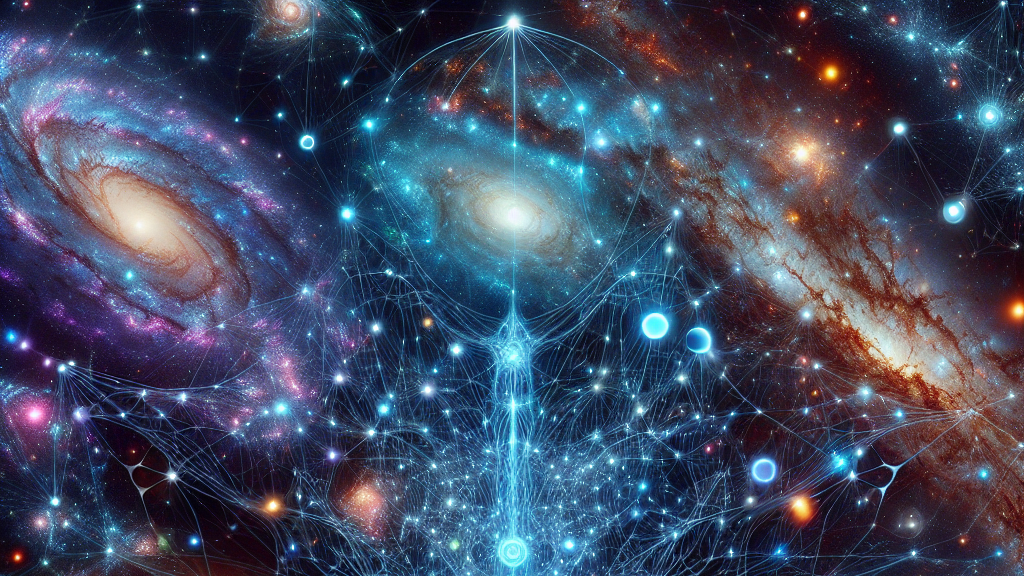
Imagine the endless stretch of space surrounding our galaxy, the Milky Way, crowned with a halo of soft X-ray light. But what’s lighting it up? Traditional theories struggle to explain this mysterious glow—until now. Scientists might have uncovered a cosmic beacon, shining a light on the invisible forces at play in the universe.

Rather than hot gas as previously thought, this halo may actually be the work of cosmic rays—high-energy particles zipping through space. These cosmic rays collide with photons from the cosmic microwave background, the universal afterglow of the Big Bang, and scatter them to produce the glow. This fascinating process occurs far beyond our galaxy, extending outwards over 100,000 light-years.

So why should we care about the glow over 100,000 light-years away? This discovery helps astronomers understand how galaxies like ours are built and what happens beyond the visible stars. Imagine knowing the pressure that keeps our galaxy ‘puffed up’ or stable. This kind of research could even show us how cosmic rays influence Earth over time, guiding future explorations of our vast, mysterious universe.

If cosmic rays could be seen with the naked eye, they’d light up the sky, turning the night into a glowing mist of X-rays.

FAQs

What causes the mysterious halos around galaxies?

The soft X-ray halos around galaxies like the Milky Way are likely caused by cosmic rays—high-energy particles that scatter photons from the cosmic microwave background, rather than by hot gas as once thought.

Why are cosmic ray interactions important?

These interactions give us insight into the structure and behavior of the circumgalactic medium, helping us understand galaxy formation and pressure dynamics.

What practical implications does understanding cosmic ray interactions have?

This research might help uncover the role of cosmic rays in shaping galaxies and could influence our understanding of cosmic phenomena affecting Earth over time.

How far do cosmic rays travel beyond galaxies?

Cosmic rays can travel beyond 100,000 light-years, forming extensive halos around galaxies such as the Milky Way and Andromeda.

What role does the cosmic microwave background play in this research?

The cosmic microwave background, the universal glow from the Big Bang, provides photons that cosmic rays scatter, creating the X-ray halos we observe around galaxies.

Background

The research focuses on a type of radiation known as cosmic rays, which are high-energy particles that travel through space. When these rays interact with the cosmic microwave background—a faint afterglow of the Big Bang—they scatter the light, creating X-rays. Understanding this interaction reveals information about the circumgalactic medium, the region around galaxies, and gives insight into the pressure dynamics within these cosmic structures.

History

Historically, scientists believed that the diffuse X-ray halos around galaxies were due to hot gas. However, discrepancies in brightness profiles led researchers to consider alternative explanations. Building on previous studies of cosmic rays and their long lifespans, this new research suggests that these high-energy particles could be responsible for the observed X-ray emissions, creating a connection between cosmic ray studies and galactic dynamics.

Based on “Cosmic Rays Masquerading as Hot CGM Gas: An Inverse-Compton Origin for Diffuse X-ray Emission in the Circumgalactic Medium” by Philip F. Hopkins, Eliot Quataert, Sam B. Ponnada, Emily Silich, available on arXiv (arxiv.org/abs/2501.18696), used under CC BY 4.0 (creativecommons.org/licenses/by/4.0/).

Trending

Latest

Can AI Save Water Discover How

Computers

AI is transforming the tech world, but it uses lots of water! A new tool, SCARF, helps us measure and reduce AI's water footprint,...

Whats a Forbush Decrease and Why Should We Care Whats a Forbush Decrease and Why Should We Care

Space

Scientists just observed the biggest solar storm event in years, revealing unexpected cosmic ray patterns. Understanding these changes could help us protect our technology...

Can Cars Spot Danger Faster Than Humans Can Cars Spot Danger Faster Than Humans

Computers

Think about how quickly you react when something unexpected happens on the road. This research brings us closer to creating self-driving cars that can...

Can Fear of the Other Stop Social Harmony Can Fear of the Other Stop Social Harmony

Physics

Fear of the unknown might make it harder for people to agree and get along. This study shows that when people have strong xenophobic...

Can AI Revolutionize Breast Cancer Diagnosis Can AI Revolutionize Breast Cancer Diagnosis

Electricity

This research introduces a groundbreaking AI model that can accurately assess HER2-positive breast cancer using widely accessible staining methods, potentially revolutionizing how we diagnose...

Can AI Transform Your Singing into a Choir Can AI Transform Your Singing into a Choir

Computers

Imagine singing solo and having AI turn you into a choir. This research unveils a groundbreaking AI tool that transforms your voice into rich...

You May Also Like

Space

Scientists just observed the biggest solar storm event in years, revealing unexpected cosmic ray patterns. Understanding these changes could help us protect our technology...

Physics

Recent research suggests that supernova explosions in our galaxy might be key to discovering new, elusive forms of dark matter. These cosmic events could...

Physics

Supernovae might be key to unlocking the secrets of dark matter, especially through its activity in our own galaxy, the Milky Way. This research...

Physics

Imagine catching illegal drugs hidden in cargo using cosmic rays! This new tech leverages particles from space to safely and quickly scan shipments, potentially...

Space

In a fascinating twist, tiny dust particles from planets might travel vast cosmic distances, potentially spreading life across different star systems. This research looks...

Space

Scientists are discovering that tiny dust particles might carry life across the galaxy. This cosmic dust, pushed by radiation pressure, serves as a potential...

Space

Imagine if stars could live forever, thanks to dark matter! Upcoming telescopes may reveal a new 'dark main sequence' where stars burn longer with...

Space

AI is now being used to unearth the secrets of outer space, tapping into the ultra-high energies of cosmic rays and galaxy formations to...

Space

AI is helping scientists unlock the mysteries of cosmic rays from outer space. By using advanced networks called Transformers, researchers are learning more about...

Copyright © 2024 8ig8rain.

Disclaimer: The content on 8ig8rain.com consists of AI-generated summaries of scientific abstracts from arXiv. Please note that most arXiv abstracts are preprints and may not have undergone formal peer review. While these summaries aim to convey key ideas and potential applications, they are provided for informational purposes only and should not be interpreted as validated scientific findings or professional advice. The summaries are intended to educate, spark curiosity, and inspire further exploration of science.