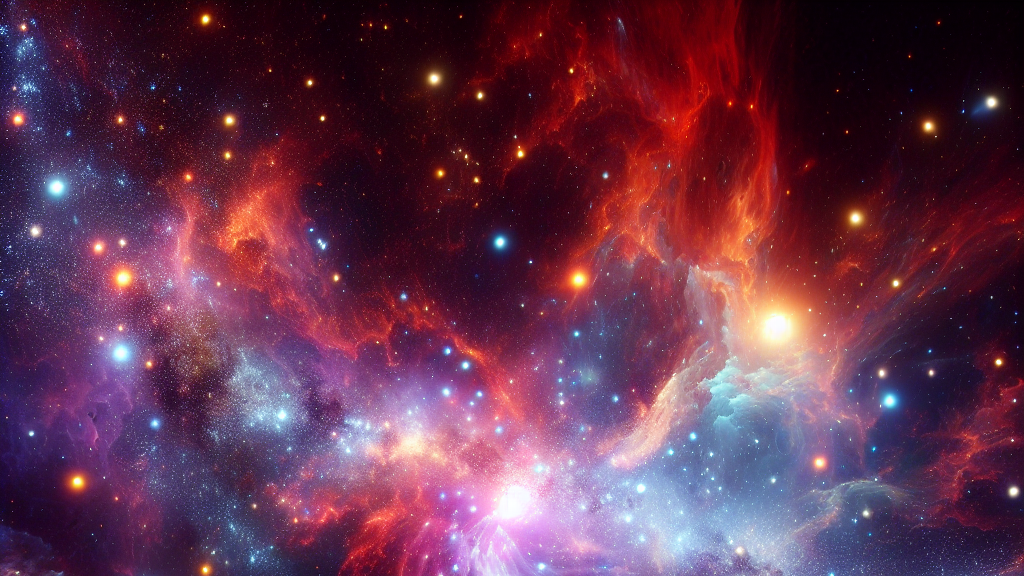
Connect with us

Search by keyword

Space

Can Star Dust Spread Life Across The Galaxy?

In a fascinating twist, tiny dust particles from planets might travel vast cosmic distances, potentially spreading life across different star systems. This research looks at how these particles could escape a planet’s gravity and travel the galaxy, thanks to the power of the star’s radiation, reaching hundreds of thousands of star systems within billions of years.

Can Star Dust Spread Life Across The Galaxy
✨Researched by humans. Explained by robots. Learn more.

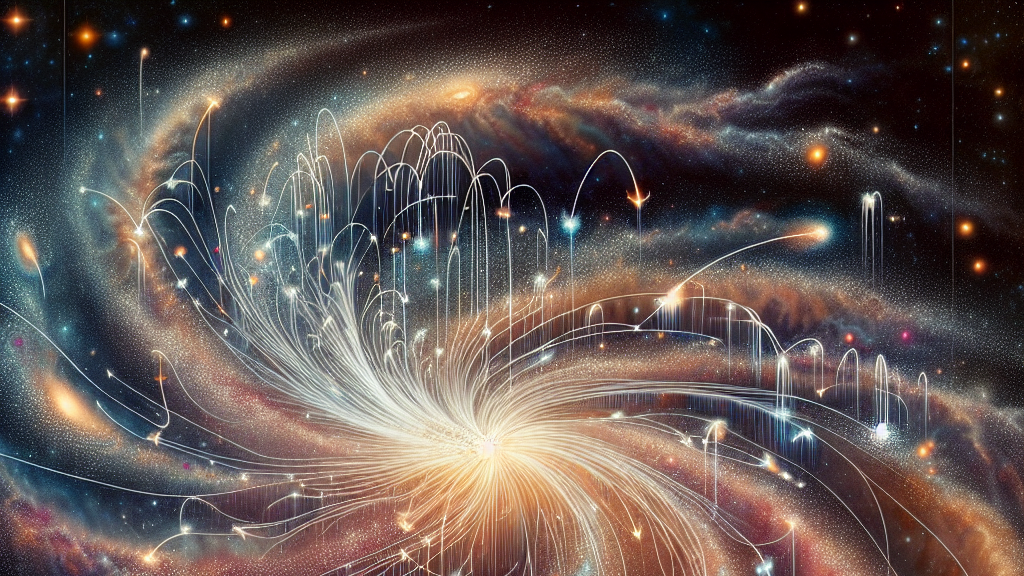
Imagine if tiny particles from planets could travel across the galaxy, like cosmic seeds in a vast celestial garden. This isn’t just science fiction; groundbreaking research suggests that planetary dust particles, which are much smaller than we can see, might be propelled by the energy from stars. These particles have the potential to journey across the cosmos, reaching new star systems and possibly spreading the building blocks of life as they go.

The research investigates how these dust particles can escape a planet’s gravitational pull and be pushed away by the pressure of a star’s radiation. It turns out that over billions of years, these particles could travel to a staggering 100,000 different star systems. This idea links to the concept of panspermia, which proposes that life, or at least the ingredients for it, could spread across the galaxy through natural processes.

Now, think about how this might affect the search for extraterrestrial life. If these tiny travelers are carrying the seeds of life, other planets in the galaxy could potentially develop life forms similar to those on Earth. This could mean our galaxy is a much more lively place than we currently imagine, with the potential for planets everywhere to be teeming with life sparked by cosmic dust.

Did you know that dust particles from planets could travel up to 100,000 star systems within 5 billion years?

FAQs

How can dusty particles escape a planet’s gravity?

Dust particles can escape a planet’s gravity by being propelled by radiation pressure from stars, which can push them away from the planet.

What is panspermia and how does it relate to this research?

Panspermia is the theory that life can travel throughout the universe via natural mechanisms. This research suggests that planetary dust particles could spread the building blocks of life across the galaxy, supporting the panspermia theory.

Why is the possibility of dust reaching 100,000 star systems significant?

If dust particles can reach 100,000 star systems, they could potentially bring the ingredients of life to countless planets, increasing the chances of finding extraterrestrial life.

What role does radiation pressure play in this research?

Radiation pressure from stars acts like a wind, pushing dust particles away from a planet and potentially out of its solar system, allowing them to travel to other stars.

How does this research affect the search for life in our galaxy?

This research provides a new perspective on how life might spread across the galaxy, suggesting that life’s building blocks could reach many more planets than we previously imagined.

Background

Planetary dust particles are tiny fragments that can escape a planet’s gravity if influenced by a star’s radiation pressure, akin to solar wind. Radiation pressure acts on these particles by exerting force that pushes them away from the star, like a constant breeze. This mechanism is central to understanding how particles could spread through space and contribute to the panspermia theory.

History

The panspermia theory has been around for over a century, suggesting that life can travel through space via natural processes. Early versions focused on meteorites and asteroids as transport vehicles. Recent studies have shifted focus to microscopic particles, like planetary dust, propelled by radiation pressure. This research builds on these past ideas by providing a plausible mechanism for dust particles to travel vast distances, further lending credibility to panspermia.

Based on “The possibility for panspermia in the galaxy by means of planetary dust grains” by Z. N. Osmanov, available on arXiv (arxiv.org/abs/2402.04990), used under CC BY 4.0 (creativecommons.org/licenses/by/4.0/).

Trending

Latest

Can AI Save Water Discover How

Computers

AI is transforming the tech world, but it uses lots of water! A new tool, SCARF, helps us measure and reduce AI's water footprint,...

Whats a Forbush Decrease and Why Should We Care Whats a Forbush Decrease and Why Should We Care

Space

Scientists just observed the biggest solar storm event in years, revealing unexpected cosmic ray patterns. Understanding these changes could help us protect our technology...

Can Cars Spot Danger Faster Than Humans Can Cars Spot Danger Faster Than Humans

Computers

Think about how quickly you react when something unexpected happens on the road. This research brings us closer to creating self-driving cars that can...

Can Fear of the Other Stop Social Harmony Can Fear of the Other Stop Social Harmony

Physics

Fear of the unknown might make it harder for people to agree and get along. This study shows that when people have strong xenophobic...

Can AI Revolutionize Breast Cancer Diagnosis Can AI Revolutionize Breast Cancer Diagnosis

Electricity

This research introduces a groundbreaking AI model that can accurately assess HER2-positive breast cancer using widely accessible staining methods, potentially revolutionizing how we diagnose...

Can AI Transform Your Singing into a Choir Can AI Transform Your Singing into a Choir

Computers

Imagine singing solo and having AI turn you into a choir. This research unveils a groundbreaking AI tool that transforms your voice into rich...

You May Also Like

Space

This study explores how tiny space dust grains might escape a planet's grip and travel through the cosmos, potentially carrying life to other star...

Space

This research explores how tiny dust particles could escape a planet and potentially spread life across the galaxy by traveling to numerous star systems...

Space

Scientists are discovering that tiny dust particles might carry life across the galaxy. This cosmic dust, pushed by radiation pressure, serves as a potential...

Space

Scientists discovered that space dust can escape planets and travel vast distances, possibly spreading life throughout the galaxy. This means that tiny particles might...

Space

AI is helping scientists unlock the mysteries of cosmic rays from outer space. By using advanced networks called Transformers, researchers are learning more about...

Space

Transformers, the same tech behind smarter chatbots, are now being used to uncover hidden patterns in cosmic rays from galaxies. This means our understanding...

Space

New research using ground-based telescopes could help uncover the secrets of dark matter by studying the way gamma rays and galaxies interact across the...

Space

Researchers explored how small galaxies orbit larger ones, revealing they often form organized structures influenced by cosmic filaments—thin threads of matter in the universe....

Space

Stars dancing in pairs across our galaxy could be formed through gravitational tugs when three stars meet up and create a new duo. This...

Copyright © 2024 8ig8rain.

Disclaimer: The content on 8ig8rain.com consists of AI-generated summaries of scientific abstracts from arXiv. Please note that most arXiv abstracts are preprints and may not have undergone formal peer review. While these summaries aim to convey key ideas and potential applications, they are provided for informational purposes only and should not be interpreted as validated scientific findings or professional advice. The summaries are intended to educate, spark curiosity, and inspire further exploration of science.