Connect with us

Search by keyword

Computers

Why Fake Reviews and Plagiarism Still Fool Us

Ever been fooled by fake news? Now imagine the same issue in science! This study dives into the murky waters of retracted scientific papers, exposing how fake peer reviews and plagiarism can mislead researchers and erode academic trust. It’s a wake-up call to sharpen our critical thinking skills!

Why Fake Reviews and Plagiarism Still Fool Us
✨Researched by humans. Explained by robots. Learn more.

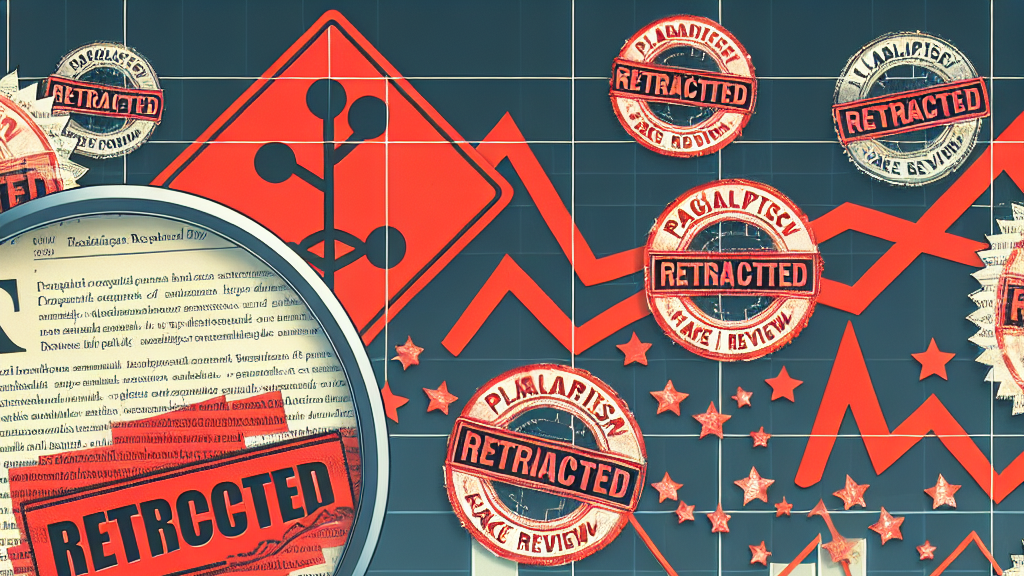
**Imagine opening a book only to find the words inside are not what they seem. That’s the tricky situation researchers face with retracted papers in science. Despite being discredited, these papers often continue to get cited, spreading false information further and eroding trust in scientific research. This fascinating study sheds light on two surprising culprits: plagiarism and fake peer reviews.**

**At first glance, plagiarism seems straightforward—it’s copying someone else’s work. However, what might shock you is that these plagiarized papers, even after being retracted, are still frequently cited. This research found that cases of fake peer reviews, where unauthorized evaluations falsely boost research credibility, have grown at an alarming rate. While fewer plagiarized papers get retracted than fake peer review cases, the former actually gathers more citations, illustrating how deeply embedded misinformation can become!**

**Why does this matter to you? Well, imagine relying on a science fact that’s wrong because of bad citations in research papers. It might lead to misguided discoveries or wrong conclusions. By addressing these retractions more promptly and effectively, the research community can maintain the credibility of academic literature, ensuring that what you read and learn is both accurate and trustworthy—making us all a little wiser in our quest for knowledge!**

Did you know? Fake peer-reviewed papers can grow in numbers 5.5 times faster than those retracted for plagiarism!

FAQs

Why do retracted citations in academic research still cause problems?

Retracted citations can spread misinformation by continuing to be cited even after discreditation, leading to false conclusions and eroding trust in scientific literature.

How does plagiarism compare to fake peer reviews in terms of retraction impact?

While fewer papers are retracted due to plagiarism, they receive more citations than fake peer-reviewed papers, indicating deep-rooted misinformation.

Why is the issue of fake peer reviews growing so quickly?

Fake peer reviews show a fluctuating pattern with rapid average growth, potentially due to sophisticated means of bypassing traditional review systems.

How quickly are fake peer reviews retracted compared to plagiarism cases?

Fake peer review cases tend to be identified and retracted more rapidly than plagiarism cases, suggesting more efficient detection mechanisms.

What role do self-citations play in retracted papers?

Self-citations, though a small percentage, are notably higher in retracted papers, suggesting a bias in citing one’s own, possibly flawed work.

Background

In academia, retracted citations refer to references to papers that have been discredited or withdrawn post-publication. Such retractions typically occur due to issues like plagiarism—where someone copies another’s work—and fake peer reviews, which involve fraudulent evaluation processes to falsely elevate research credibility. These retractions are critical to maintaining scientific integrity as they prevent the spread of misinformation.

History

The issue of retracted citations isn’t new but has gained more attention with the accessibility of digital databases like Scopus. Previous studies have shown that retractions do not immediately stop misinformation spread. Technological advancements have improved detection of plagiarism and fake peer reviews, though the challenge remains to rapidly retract faulty research and minimize its impact.

Based on “Retracted Citations and Self-citations in Retracted Publications: A Comparative Study of Plagiarism and Fake Peer Review” by Kiran Sharmaa, Parul Khurana, available on arXiv (arxiv.org/abs/2502.00673), used under CC BY 4.0 (creativecommons.org/licenses/by/4.0/).

Trending

Latest

Can AI Save Water Discover How

Computers

AI is transforming the tech world, but it uses lots of water! A new tool, SCARF, helps us measure and reduce AI's water footprint,...

Whats a Forbush Decrease and Why Should We Care Whats a Forbush Decrease and Why Should We Care

Space

Scientists just observed the biggest solar storm event in years, revealing unexpected cosmic ray patterns. Understanding these changes could help us protect our technology...

Can Cars Spot Danger Faster Than Humans Can Cars Spot Danger Faster Than Humans

Computers

Think about how quickly you react when something unexpected happens on the road. This research brings us closer to creating self-driving cars that can...

Can Fear of the Other Stop Social Harmony Can Fear of the Other Stop Social Harmony

Physics

Fear of the unknown might make it harder for people to agree and get along. This study shows that when people have strong xenophobic...

Can AI Revolutionize Breast Cancer Diagnosis Can AI Revolutionize Breast Cancer Diagnosis

Electricity

This research introduces a groundbreaking AI model that can accurately assess HER2-positive breast cancer using widely accessible staining methods, potentially revolutionizing how we diagnose...

Can AI Transform Your Singing into a Choir Can AI Transform Your Singing into a Choir

Computers

Imagine singing solo and having AI turn you into a choir. This research unveils a groundbreaking AI tool that transforms your voice into rich...

You May Also Like

Economics

Social media might not always be the villain when it comes to spreading fake news. In regions with strong public engagement, social media can...

Computers

This research uncovers how everyday people, not just experts, can help catch fake news online. By understanding what influences our judgments, we can create...

Computers

This research explores how non-experts can help detect online misinformation, showing that their judgments often align with experts. By understanding human biases, we aim...

Computers

Misinformation in digital media is everywhere, but a new multi-agent AI framework aims to tackle it from all angles. By breaking down tasks like...

Computers

This research helps us glimpse into the minds of those spreading fake news, enabling better tools to spot misleading stories with hidden motives.

Computers

Countries worldwide are making new laws to tackle fake news and misinformation online. With diverse strategies and global reach, these laws aim to protect...

Computers

TrueFake is a groundbreaking dataset created to help improve the detection of fake images on social media. With 600,000 images tested under realistic sharing...

Computers

AI might just be our secret weapon against the rising flood of misinformation on social media. By enhancing our ability to detect and counter...

Computers

Engaging in conversations with artificial intelligence might help people become better at telling real news from fake news, but the skill doesn't stick around...

Copyright © 2024 8ig8rain.

Disclaimer: The content on 8ig8rain.com consists of AI-generated summaries of scientific abstracts from arXiv. Please note that most arXiv abstracts are preprints and may not have undergone formal peer review. While these summaries aim to convey key ideas and potential applications, they are provided for informational purposes only and should not be interpreted as validated scientific findings or professional advice. The summaries are intended to educate, spark curiosity, and inspire further exploration of science.