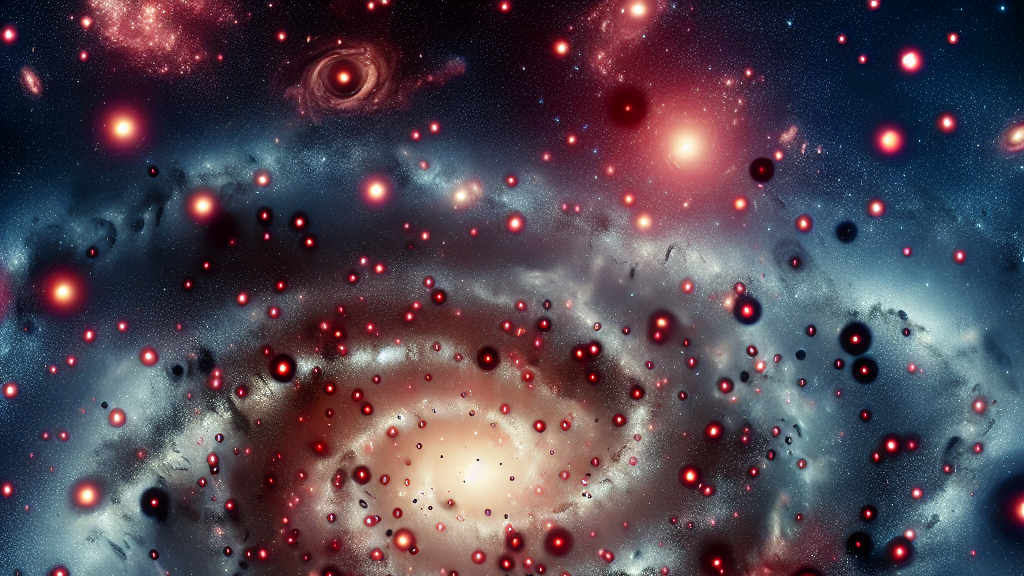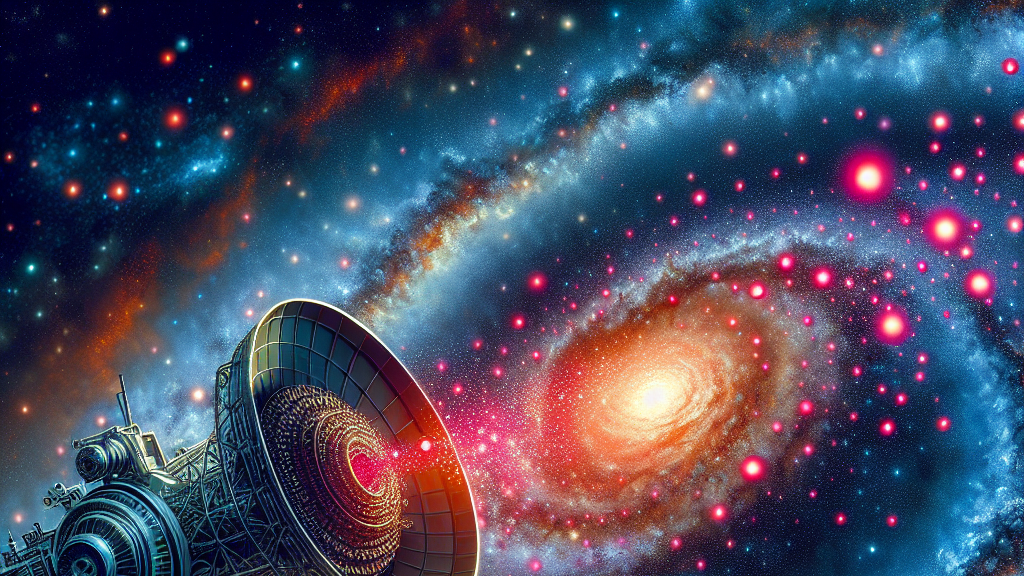
Imagine this: A new space telescope, the James Webb, is helping scientists spot mysterious little red dots in the universe. These aren’t just any dots; they’re potentially the key to understanding galaxies that are billions of years old. What’s intriguing is that their unique colors are unlike anything we’ve seen before, sparking curiosity and excitement in the astronomy world.
Through the powerful lenses of the James Webb Space Telescope, scientists are proposing that these little red dots might actually be active galactic nuclei or AGNs. AGNs are incredibly energetic regions at the center of galaxies, but what’s even more fascinating is that these red dots have a peculiar v-shape in their light spectrum. By studying their spectral energy, scientists can now understand how much of these dots’ light comes from the galaxy itself and how much comes from the AGN within it.
In the future, understanding these little red dots could give us fresh insights into how galaxies form and evolve, especially in the very early universe. Picture this: a new way to study galaxy formation much earlier in cosmic history than we ever thought possible. This could redefine our timeline of the universe and tell us more about why these red dots appear in galaxies younger than a billion years old.
The little red dots might represent galaxies forming when the universe was less than a billion years old!
FAQs
What are the little red dots discovered by the James Webb Space Telescope?
The little red dots are potentially dust-reddened active galactic nuclei, which are energetic regions at the centers of galaxies, discovered through the unique v-shape spectral features observed by the James Webb Space Telescope.
Why are the little red dots significant in our understanding of galaxies?
The little red dots could provide insights into the formation and evolution of galaxies in the early universe, especially those that are younger than a billion years old, by showing how much light originates from the galaxy versus the active galactic nucleus.
How do scientists study the spectral energy distribution (SED) of little red dots?
Scientists analyze the spectral energy distribution across UV to infrared bands to understand how much light is absorbed and emitted by dust around the active galactic nucleus, revealing unique characteristics that help identify the nature of these dots.
How is the James Webb Space Telescope different from other telescopes in observing these dots?
The James Webb Space Telescope has advanced infrared capabilities, allowing it to capture detailed spectral data from very distant and faint objects, such as these little red dots, with higher precision than previous telescopes.
What might the discovery of little red dots suggest about the universe’s history?
The discovery of little red dots suggests that galaxies in the early universe may have been forming differently, possibly experiencing more dynamic processes like inflows and outflows around their centers than previously thought.
Background
The James Webb Space Telescope, known for its advanced infrared capabilities, has brought a new dimension to extragalactic research. By observing far-off galaxies and their spectra, scientists can determine the components contributing to their light. The telescope’s sensitivity to infrared light allows it to detect complex features in galactic nuclei, known as active galactic nuclei, which are characterized by their intense radiation and are often obscured by dust in the galaxy.
History
The study of galactic nuclei and their active cores has a rich history, with significant progress made as technology evolved. Earlier telescopes could only pick up limited spectra, but the advent of infrared technology widened the scope of observable features. Little red dots add to previous research but challenge old models by presenting new spectral characteristics seen with the James Webb, suggesting different processes in galaxy evolution than previously hypothesized.
Based on “Little Red Dots: Rapidly Growing Black Holes Reddened by Extended Dusty Flows” by Zhengrong Li, Kohei Inayoshi, Kejian Chen, Kohei Ichikawa, Luis C. Ho, available on arXiv (arxiv.org/abs/2407.10760), used under CC BY 4.0 (creativecommons.org/licenses/by/4.0/).