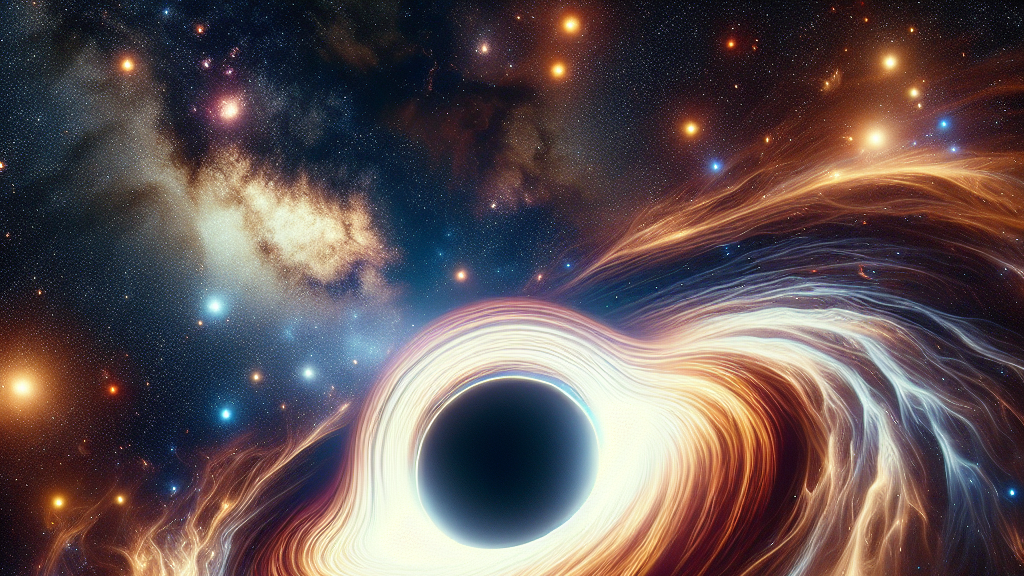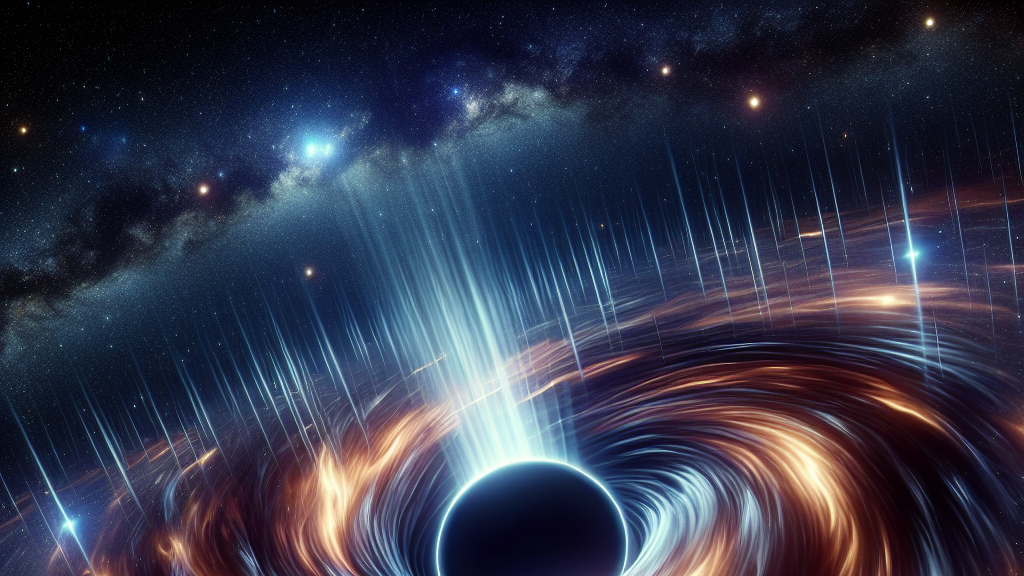
Imagine if black holes weren’t just the mysterious cosmic vacuum cleaners we’ve always thought they were. What if these massive space objects could become cosmic slingshots, launching particles at incredible speeds? That’s what a recent study suggests, potentially unraveling new secrets about our universe. By looking at ultralight particles that collect around rotating black holes, researchers think these tiny particles can reach massive energy levels, creating intense fields that could slingshot other particles, including neutrinos and dark matter, into the vastness of space.
The study dives deep into the dance between ultralight bosons and black holes. When these bosons get close to a spinning black hole, they can siphon off energy—a bit like grabbing a ride on a merry-go-round. This energy boost can shoot particles like neutrinos to speeds we can hardly imagine, way beyond what’s produced elsewhere in the universe. We’re not just talking about a few particles either; this process could generate observable streams of them. This means black holes could be acting like giant particle accelerators, a concept that has astronomers more excited than ever.
So, why should you care? Well, these fast-moving particles could be detected by instruments like the IceCube Observatory or experiments searching for dark matter. Imagine tracking the journey of particles that were once swirling around black holes billions of light-years away. By studying them, we might solve some of the deepest cosmic mysteries, like the nature of dark matter, or even uncover forces and particles that challenge everything we know about the universe. It’s like having a front-row seat to the next big thing in space exploration.
Did you know? While black holes are known for pulling everything in, this research suggests they could also be responsible for launching particles at near-light speeds!
FAQs
How do ultralight bosons interact with black holes?
Ultralight bosons can gather around spinning black holes and extract energy from them. This energy can transform the bosons into extremely powerful fields capable of influencing other particles.
What is superradiance in the context of black holes?
Superradiance is a process where particles, like bosons, gain energy while interacting with a rotating black hole. This can amplify their fields and result in significant particle acceleration.
Why could this research help detect dark matter?
The interaction between boson fields and fermions around black holes could produce fast-moving dark matter particles. Observing these particles with detectors might reveal clues about dark matter’s mysterious nature.
How do high-energy neutrinos relate to this research?
High-energy neutrinos, accelerated by fields around black holes, could be detected by observatories like the IceCube, providing new insights into cosmic processes and particle physics.
Can this research change our understanding of the universe?
Absolutely! By studying particle acceleration around black holes, we could uncover new physics that challenges existing theories and provide answers to unsolved astronomical questions.
Background
Black holes are massive celestial objects with gravitational pulls so strong that nothing, not even light, can escape them. Ultralight bosons, hypothetical particles much lighter than anything in the Standard Model of particle physics, are thought to form clouds around rotating black holes. In this environment, these bosons can extract energy from the black holes through a process known as superradiance, leading to potential acceleration of other particles like neutrinos.
History
The concept of black holes influencing surrounding particles has intrigued scientists for decades. The idea of superradiance has roots in quantum mechanics and general relativity, proposing that energy can be extracted from rotating black holes. Previous research has focused on how this might work with theoretical particles like bosons, but this study takes it a step further by looking at the implications for neutrinos and dark matter—a topic of intense study since these mysterious substances make up a large portion of the universe.
Based on “Black Holes as Fermion Factories” by Yifan Chen, Xiao Xue, Vitor Cardoso, available on arXiv (arxiv.org/abs/2308.00741), used under CC BY 4.0 (creativecommons.org/licenses/by/4.0/).