Connect with us

Search by keyword

Physics

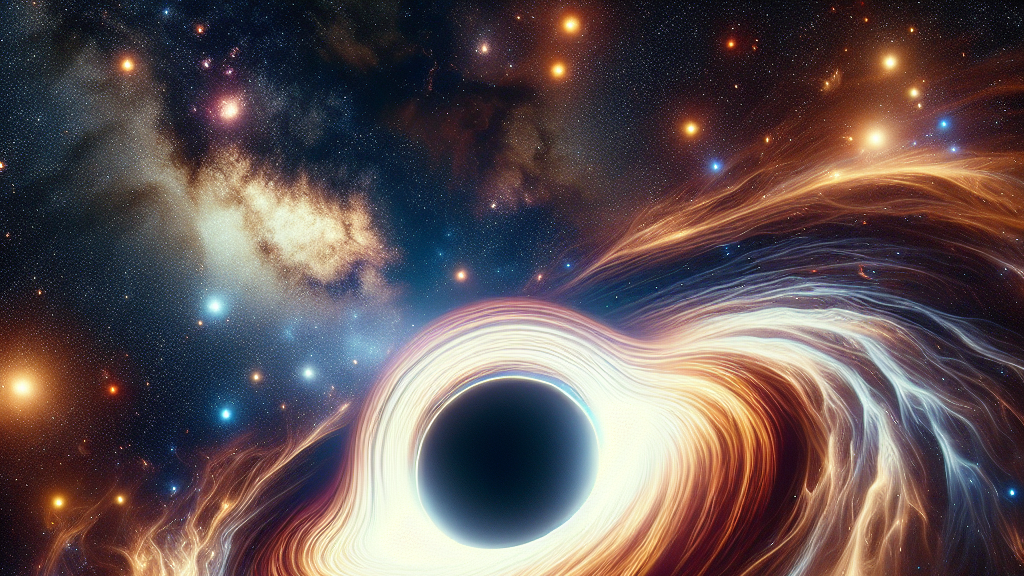
Do Black Holes Fuel Dark Matter Boosts?

Imagine black holes powering up particles like a cosmic battery, potentially unveiling mysteries of dark matter! By understanding how they interact with invisible particles, this new research could change how we detect dark matter in the universe—and maybe redefine our cosmic map.

Do Black Holes Fuel Dark Matter Boosts
✨Researched by humans. Explained by robots. Learn more.

Black holes, those enigmatic giants of the universe, might be doing something astonishing: energizing particles to unimaginable levels, much like cosmic superchargers! This research uncovers how ultralight bosons near black holes extract energy, potentially reaching unimaginable field strengths and altering the black holes’ behavior.

Now, picture a rotating black hole surrounded by fields of these ultralight bosons. When these fields interact with specific particles, like neutrinos (the ghost particles of the Standard Model), they can accelerate them to tremendous energies, far beyond anything we’ve seen. This process could also reveal insights into the dark matter that makes up most of the universe but remains invisible to us.

The exciting prospect here is that these superpowered particles might be observable with our current technology, like high-energy neutrino detectors such as IceCube. Imagine finding clues about dark matter in a black hole’s neighborhood! This could revolutionize our understanding of the universe and even lead to new technologies right here on Earth.

Did you know? Black holes can act like giant cosmic batteries, supercharging particles!

FAQs

How do black holes power up particles?

Black holes can extract energy from surrounding ultralight boson fields through a process called superradiance. These fields can then transfer energy to particles, like neutrinos, effectively boosting their energy levels to extremely high values.

Why is understanding black holes and ultralight bosons important?

Studying these interactions can help us learn about dark matter, which is a mysterious form of matter that doesn’t emit or absorb light but makes up most of the universe’s mass. Discovering more about dark matter can potentially solve many cosmic mysteries.

Could this research change how we detect dark matter?

Yes, it opens up new possibilities to observe high-energy particles near black holes using detectors like IceCube, which could provide vital clues about dark matter’s nature and behavior.

What role do neutrinos play in this research?

Neutrinos, often called ghost particles because they rarely interact with matter, can be accelerated to high energies through interactions with boson fields near black holes. This could make them more detectable and help us learn more about their interactions and dark matter.

How might this research impact our everyday lives?

While the research is primarily focused on fundamental science, understanding dark matter and energy extraction processes could lead to technological breakthroughs that impact energy generation or improve our understanding of physics and the universe.

Background

In physics, black holes are regions of spacetime where gravity is so strong that nothing, not even light, can escape. When certain particles called ultralight bosons gather around a rotating black hole, they can extract energy from it through a process known as superradiance. This extracted energy can then be transferred to other particles, like neutrinos. Neutrinos are subatomic particles that interact very weakly with other matter, making them challenging to detect in everyday scenarios.

History

The study of black holes has been a pivotal part of astrophysics for decades. In recent years, research has focused on understanding how these massive entities interact with different types of particles and fields. Discoveries concerning ultralight bosons and their interactions with black holes have sparked new interest in potential connections to dark matter. Prior research had established constraints on boson-neutrino interactions, but this study offers new insights into the energy dynamics and potential observability of these processes.

Based on “Black Holes as Fermion Factories” by Yifan Chen, Xiao Xue, Vitor Cardoso, available on arXiv (arxiv.org/abs/2308.00741), used under CC BY 4.0 (creativecommons.org/licenses/by/4.0/).

Trending

Latest

Can AI Save Water Discover How

Computers

AI is transforming the tech world, but it uses lots of water! A new tool, SCARF, helps us measure and reduce AI's water footprint,...

Whats a Forbush Decrease and Why Should We Care Whats a Forbush Decrease and Why Should We Care

Space

Scientists just observed the biggest solar storm event in years, revealing unexpected cosmic ray patterns. Understanding these changes could help us protect our technology...

Can Cars Spot Danger Faster Than Humans Can Cars Spot Danger Faster Than Humans

Computers

Think about how quickly you react when something unexpected happens on the road. This research brings us closer to creating self-driving cars that can...

Can Fear of the Other Stop Social Harmony Can Fear of the Other Stop Social Harmony

Physics

Fear of the unknown might make it harder for people to agree and get along. This study shows that when people have strong xenophobic...

Can AI Revolutionize Breast Cancer Diagnosis Can AI Revolutionize Breast Cancer Diagnosis

Electricity

This research introduces a groundbreaking AI model that can accurately assess HER2-positive breast cancer using widely accessible staining methods, potentially revolutionizing how we diagnose...

Can AI Transform Your Singing into a Choir Can AI Transform Your Singing into a Choir

Computers

Imagine singing solo and having AI turn you into a choir. This research unveils a groundbreaking AI tool that transforms your voice into rich...

You May Also Like

Space

Scientists have discovered a new way that tiny early-universe structures might grow into massive black holes, potentially changing our understanding of cosmic evolution! This...

Space

This research uncovers how setting a visibility limit on starlight reveals more realistic details about galaxies, helping us understand their size and mass better—crucial...

Physics

Recent research suggests that supernova explosions in our galaxy might be key to discovering new, elusive forms of dark matter. These cosmic events could...

Space

Imagine invisible particles shaping galaxies from within! This study suggests that certain types of dark matter could help solve long-standing puzzles about galaxy formations...

Physics

Supernovae might be key to unlocking the secrets of dark matter, especially through its activity in our own galaxy, the Milky Way. This research...

Space

Scientists have discovered a possible explanation for how supermassive black holes could form in the early universe. This breakthrough could change our understanding of...

Physics

Scientists are on a mission to discover if ghost-like particles called neutrinos could reveal astonishing insights about the universe. Using cutting-edge technology, they searched...

Space

Scientists have found a novel way to measure dark matter around black holes using light echoes from space. This could change how we understand...

Space

Scientists have uncovered why some small galaxies are born without stars. It turns out, they lack the dense gas needed for star formation, thanks...

Copyright © 2024 8ig8rain.

Disclaimer: The content on 8ig8rain.com consists of AI-generated summaries of scientific abstracts from arXiv. Please note that most arXiv abstracts are preprints and may not have undergone formal peer review. While these summaries aim to convey key ideas and potential applications, they are provided for informational purposes only and should not be interpreted as validated scientific findings or professional advice. The summaries are intended to educate, spark curiosity, and inspire further exploration of science.