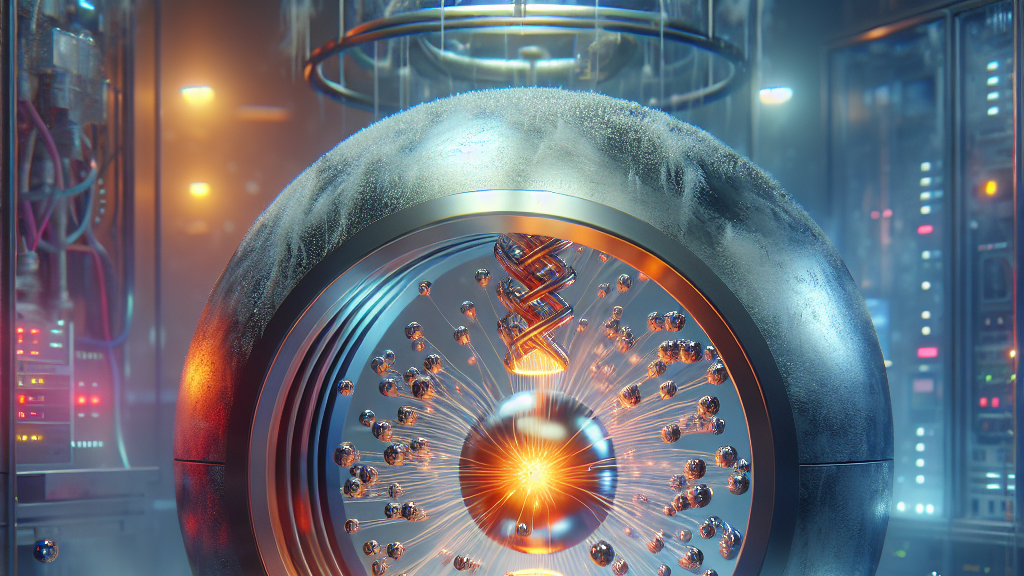
Imagine harnessing the power of antiprotons to revolutionize the world of technology. That’s exactly what’s happening as scientists explore how to use antiprotons to form synthetic qubits, which are the building blocks of quantum computers. With these qubits, future tech could be faster, more precise, and even more reliable.
The research focuses on using antiprotons to annihilate specific particles, creating hydrogen-like atoms with special properties. These atoms are made from isotopes and electrons, allowing scientists to select ones that yield highly charged qubits. Certain elements, like Yttrium and Indium, have been identified as ideal candidates because their energy transitions happen in the infrared spectrum, making them stable for practical applications.
Envision a world where your smartwatch could use quantum tech to gain ultra-precise timekeeping abilities or future computers that solve complex problems in seconds. This research lays the groundwork for such innovations by uncovering new ways to manipulate atomic particles to their full potential. Who knew the key to the future might just be hidden in the annihilation of antiprotons?
A single transition of these synthetic qubits occurs in the infrared spectrum, giving them long-lasting stability ideal for precision tasks.
FAQs
How does the annihilation of antiprotons create synthetic qubits?
Antiprotons are used to annihilate certain particles, resulting in highly charged qubits made from hydrogen-like atoms composed of an isomer and an electron. These qubits have unique energy transitions ideal for quantum tech.
Why are Yttrium and Indium ideal for creating qubits?
Yttrium and Indium isotopes allow their qubit transitions to occur in the infrared spectrum, providing long-lived stability suitable for practical applications in technology such as metrology.
What practical benefits could synthetic qubits offer?
Synthetic qubits could improve quantum technologies like superfast computing, more precise timekeeping, and enhance the accuracy of various measurements in scientific research and everyday devices.
Background
Synthetic qubits are crucial for the development of quantum computing, which uses the principles of quantum mechanics to perform calculations far beyond the capabilities of traditional computers. In this research, scientists looked at how annihilating antiprotons – the antimatter counterparts of protons – could create a new type of qubit. By focusing on certain isotopes that react with single electrons, they can form stable atoms with transitions suitable for precise measurement and computing.
History
The study of qubits and quantum computing has been ongoing for decades. Traditional qubits rely on superconducting circuits or trapped ions, but these often struggle with stability and error rates. This research builds on past findings by suggesting that using antimatter, specifically antiprotons, could form qubits with enhanced stability and precision. Such advances might eventually overcome some of the challenges facing quantum technology today.
Based on “Highly charged isomeric qubits from antiproton annihilation” by Sara Alfaro, Lorenz Panzl, Jakub Zieliński, Sankarshan Choudapurkar, Fredrik Parnefjord Gustafsson, Matthias Germann, Tommaso Faorlin, Yannick Weiser, Thomas Lafenthaler, Thomas Monz, Michael Doser, Georgy Kornakov, Giovanni Cerchiari, available on arXiv (arxiv.org/abs/2502.12832), used under CC BY 4.0 (creativecommons.org/licenses/by/4.0/).