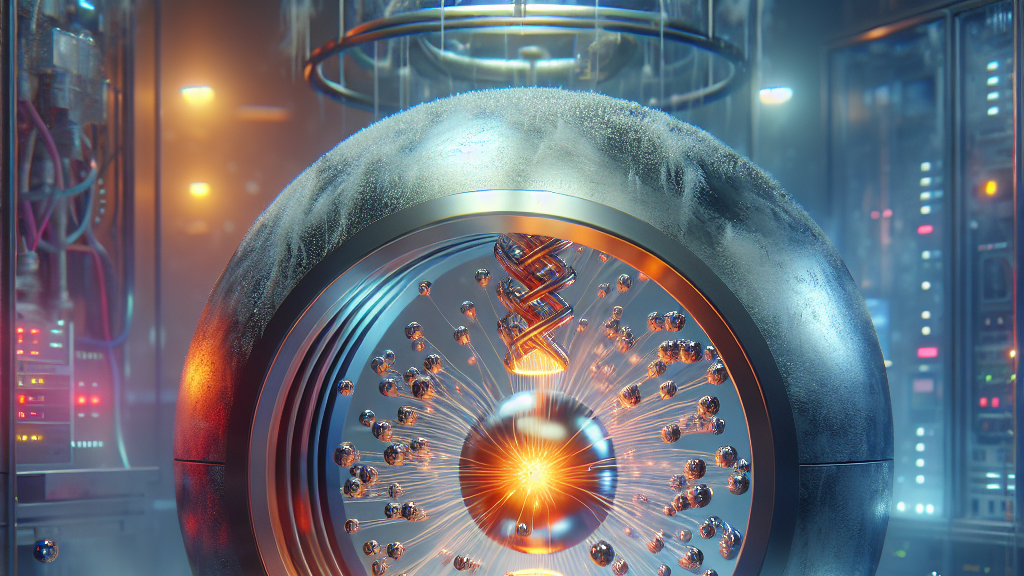
What if I told you that something incredible happens when you throw together magnets, microwaves, and an extreme chill? We’re not talking about your kitchen fridge kind of cold, but temperatures close to the ones you’d find in outer space. This experiment has managed to observe something that’s never been seen before: magnomechanics coming to life at such low temperatures.
This new frontier in science involves the study of magnons, which are tiny magnetic excitations, in a material known as YIG, short for Yttrium Iron Garnet. Researchers have placed a YIG sphere inside a microwave cavity and cooled everything down to a bone-chilling 9 Kelvin, just a smidgen above absolute zero. At these temperatures, they could observe how magnons interact with the microwaves and the mechanical vibrations, creating a unique triple-resonance condition.
Imagine future computers or communication devices powered by this technology, operating faster and more efficiently because of these discoveries. We might even see advances in quantum computing that were once thought impossible. By understanding how these systems work at cryogenic temperatures, scientists are paving the way for revolutionary tech that could change how we live and interact with the world.
Did you know that 9 Kelvin is colder than the surface temperature of Pluto?
FAQs
What are magnons and why are they important in quantum technology?
Magnons are tiny magnetic excitations in materials. They are important in quantum technology because they can interact with both light and mechanical vibrations, potentially leading to new advances in quantum computing and communications.
How does lowering the temperature to 9 Kelvin affect the research on magnomechanics?
Lowering the temperature to 9 Kelvin allows scientists to observe quantum properties that are hidden at higher temperatures. This cold environment is crucial for discovering how magnomechanics function at a quantum level.
What could these findings mean for future technologies?
This research could lead to significant advances in quantum computing and communication technologies, making them faster and more energy-efficient. It could change the way we process information and interact with technology in everyday life.
Why does the research use a YIG sphere in a microwave cavity?
YIG, or Yttrium Iron Garnet, has excellent magnetic properties that make it ideal for studying magnons. By placing it in a microwave cavity, researchers can observe interactions between magnons, microwaves, and mechanical vibrations.
What practical applications could arise from cavity magnomechanics?
Potential applications include ultra-fast computing systems, improved communication technologies, and advancements in quantum computing, all of which could have a transformative impact on technology and society.
Background
Magnomechanics is a field that studies the interaction of magnons, which are quantum magnetic waves, with mechanical vibrations and microwaves. This interaction can lead to new ways to control quantum information, which is essential for developing advanced quantum computing systems. The research uses cryogenic temperatures to enhance these interactions, allowing scientists to observe phenomena that are impossible to see at room temperature.
History
The study of quantum magnomechanics has evolved from the investigation of individual quantum particles and their interactions. Early research focused on understanding the properties of magnons, and how they could be used in technology. This study builds on previous work by examining these interactions at cryogenic temperatures, a temperature realm that reveals new quantum behaviors.
Based on “Observation of Magnomechanics at Low Temperatures” by Y. Huang, P. M. C Rourke, A. Peruzzi, J. Jin, M. Ebrahimi, A. Rashedi, J. P. Davis, available on arXiv (arxiv.org/abs/2503.21945), used under CC BY 4.0 (creativecommons.org/licenses/by/4.0/).