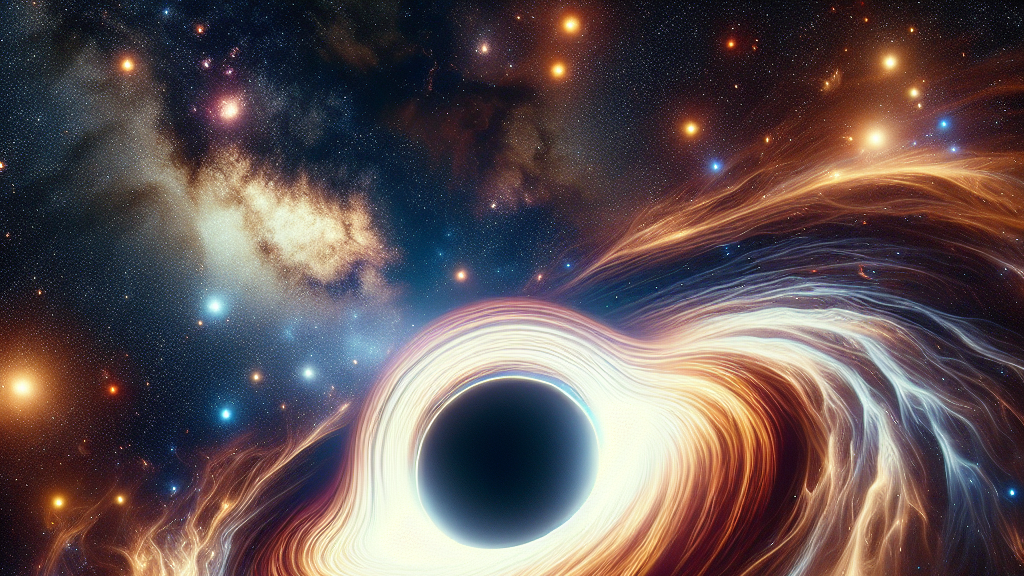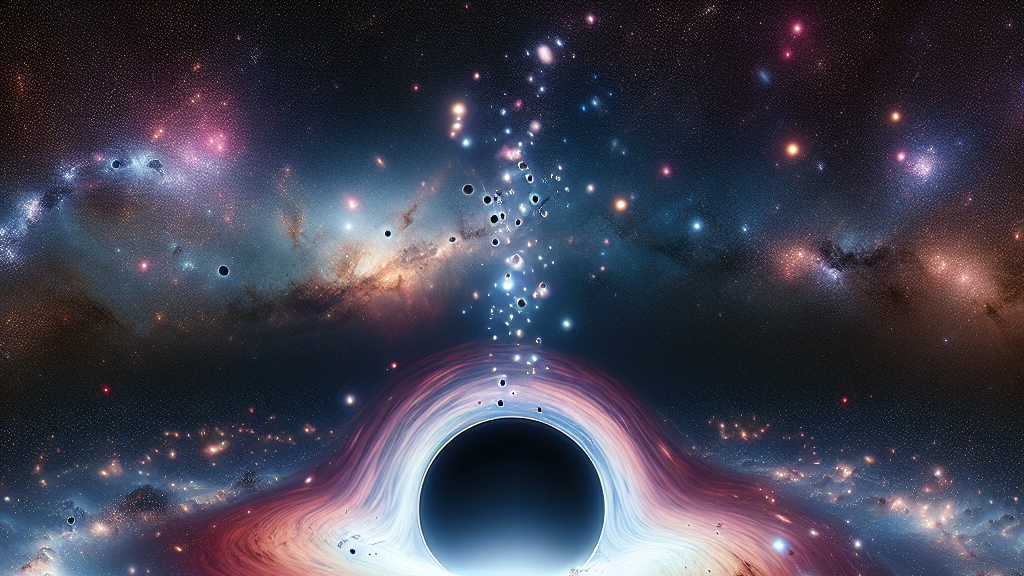
Ever wonder if the mysterious corners of the universe might hold incredible secrets? Picture this: a tiny black hole, smaller than anything we can imagine, shooting out the most energetic particles known to existence, neutrinos! These little cosmic powerhouses could be rewriting the rulebook on what we know about the universe, thanks to a fascinating new study.
Scientists have long pondered where these ultra-high energy neutrinos might come from. Recently, these questions have taken them to the realm of black holes. Not just any black holes, but primordial black holes, which might have formed right after the Big Bang. These tiny beasts, potentially slowed down by bizarre quantum effects, could still be lurking around, spewing neutrinos as they slowly evaporate. With masses less than 10 million grams, they’re thought to be long gone, but just maybe, they’re still around, influencing our cosmic backyard.
So, what’s the big deal for us? Well, if these tiny black holes are indeed out there, they could help us understand both the building blocks and history of our universe on a whole new level. Imagine being able to ‘see’ back in time to the early universe or even uncover new physics that could revolutionize our understanding of dark matter. The next time you hear about neutrinos, think of the possibility that tiny ancient black holes might be driving our universe’s grand mysteries!
Primordial black holes might be ‘paused’ in their evaporation due to quantum effects, potentially lasting as long as the universe itself!
FAQs
What are primordial black holes?
Primordial black holes are hypothetical black holes that could have formed shortly after the Big Bang. Unlike regular black holes, they could be very small, and their existence could help us understand the early universe better.
How can black holes create neutrinos?
As black holes evaporate, they release energy and particles. These can include neutrinos, especially in the case of tiny black holes which might emit highly energetic particles.
What is the ‘memory burden’ effect?
The ‘memory burden’ refers to theoretical quantum effects that might slow down a black hole’s evaporation, potentially allowing tiny black holes to survive much longer than expected.
Why is this research about neutrinos and black holes important?
This research could offer insights into cosmic phenomena, the nature of dark matter, and the universe’s early conditions, potentially leading to groundbreaking discoveries in physics.
How can we detect these tiny black holes?
Scientists use neutrino detectors like KM3NeT to spot high-energy particles that might have been emitted by tiny black holes, helping to confirm their existence.
Background
Understanding this research requires a basic grasp of black holes and neutrinos. Black holes are regions of space where gravity is so strong that nothing, not even light, can escape. They’re typically formed from dying stars, but primordial black holes are thought to originate from high-energy conditions shortly after the Big Bang. Neutrinos are incredibly light, nearly massless particles that zip through the universe almost undetectably, making them essential messengers of cosmic events. The concept of ‘memory burden’ touches on specific quantum mechanics where black holes may retain ‘memories’ of particles, altering their evaporation speed.
History
The study of neutrinos began in the early 20th century when scientists detected these mysterious particles streaming from the sun. Over the decades, scientists built neutrino detectors deep underground to shield from cosmic rays, like the Sudbury Neutrino Observatory. The idea of primordial black holes dates back to the 1970s when they were proposed as remnants from the Big Bang. Recent observations by KM3NeT have provided data that might connect these two intriguing ideas, potentially pointing to primordial black holes as neutrino sources.
Based on “A strike of luck: could the KM3-230213A event be caused by an evaporating primordial black hole?” by Andrea Boccia, Fabio Iocco, available on arXiv (arxiv.org/abs/2502.19245), used under CC BY 4.0 (creativecommons.org/licenses/by/4.0/).